FORTUNE+ VIDEO SPONSORED CONTENTS ADVERTORIALS FORTUNE AUDIO Fortune Careers TRADE AFRICA Election 2026 New TIME REMAINING UNTIL ETHIOPIA’S NATIONAL ELECTION 0Days 0Hours 0Minutes 0Seconds

Civil Servants Rush to Secure Digital Certificates, Skills Take a Back Seat

More than 120,000 government employees in Addis Abeba are racing to collect coding certificates under a citywide digital training initiative, part of a sweeping national goal to produce “five million coders.” Promoted by officials as a stepping stone to a digitally capable workforce, the program is beginning to resemble a paperwork exercise rather than a revolution in skills.

Officials at the Addis Abeba Innovation & Technology Development Bureau say the effort is meant to prepare civil servants for an economy in transition.

“This initiative was created to build Ethiopia’s coding capacity,” said Amha Gorzes, the Bureau’s director of Capacity Building. “It isn’t advanced training; anyone can enrol. The goal is to give workers better skills and better opportunities.”

The training, delivered through the global online platform, Udacity, covers data science, programming, Android development, and artificial intelligence (AI). While the public launch grabbed headlines this summer, Amha disclosed that government employees had begun enrolling a year earlier.

Udacity’s approach is simple. Participants sign up with basic personal details, choose a course, and are free to begin watching introductory videos. Each program is designed to last between five and eight weeks, with assessments scattered throughout.

However, the flexible design quickly revealed gaps. Employees under pressure to comply found that the platform allows them to skip instructional content entirely, jumping straight to the tests. Once the evaluations are complete, certificates arrive in their inbox, sometimes within hours, regardless of whether they absorbed the material.

The pressure to collect certificates, combined with the system’s loopholes, has led to the development of creative workarounds.

A hygiene awareness worker in one of the districts enrolled in four courses. She finished them in three days by ignoring most of the material and heading directly to the assessments. She received certificates meant to represent eight months of study almost instantly.

“The course is easy,” she told Fortune.

The pace and methods of certificate collection have not gone unnoticed in public offices. At Haddis Alemayhu Secondary School, an employee described how her supervisors insisted all staff secure at least one certificate, with principals expected to collect all four. Lacking an IT background, the employee, who requested anonymity, struggled with the English-language material.

“The courses are in English and require some technical knowledge,” she said. “I had no idea where to start.”

Unable to complete the courses on her own, she paid someone else to do it for her, a practice several employees confirmed is not uncommon.

The unintended result is a small but growing market for outsourcing certificate work.

Yididiya Girma, a 19-year-old student, saw the opportunity after his mother had difficulty with the training. With his IT knowledge, he found the content familiar.

“I don’t need to watch the videos,” he said. “I’ve already seen this material. I sign up with their email, complete the assessments, and hand them the certificates.”

He charges 200 Br for a certificate, estimating he has completed the process for at least 10 government employees. For Yididiya and others with digital skills, the job is less about coding and more about copying and pasting the right answers. Since the assessments remain constant, repetition makes each subsequent course easier.

The speed at which the city’s workers are stacking up certificates is raising eyebrows among local technologists.

Muse Teshome, a freelance web designer and software engineer sees potential in the program but stated that genuine online learning demands time and effort. He is critical of the one-size-fits-all approach. Udacity’s platform does not screen for prior experience.

“Some platforms tailor courses to the level of the participant,” he said. “Here, everyone is given the same content.”

He believes guided tutorials, led by professionals, would help public employees build a real foundation.

The program’s fast-track approach is hardly unique to Ethiopia. It is modelled after the “One Million Arab Coders” program, launched in the United Arab Emirates (UAE) in 2017. Locally, the initiative was announced on July 27, 2024, as a partnership between the governments of Ethiopia and the United Arab Emirates. According to official statements, the goal is to equip five million Ethiopians with the digital skills needed for the future workplace.

According to Assegid Getachew (PhD), a former state minister for Labour & Skills, while such programs are used by other countries to open up new job opportunities, especially in remote work, Ethiopia’s results so far appear more symbolic than practical.

“Here, the number of people working remotely remains small,” he told Fortune.

However, he believes the initiative could connect Ethiopian workers to global labour markets, especially in the Gulf states and Europe, if managed properly.
New Entrants Rattle Insurance Industry, But Old Constraints Persist

Two new insurance companies, Standard Insurance and Was Insurance, are poised to join the fragmented and slow-growing domestic insurance industry, eyeing to carve out niche offerings in a market long dominated by conventional players.

Backed, respectively, by Awach Savings & Credit Cooperative and Droga Pharma-affiliated stakeholders, their emergence marks both continuity and potential disruption in an industry still struggling with low penetration, structural inefficiencies, and pending regulatory shifts.

Emerging from dissatisfaction with existing market players, Standard Insurance is the product of years of behind-the-scenes organising by Awach, whose directors and managers grew disillusioned with the service quality and financial protection offered by incumbent insurers.

“The main reason for our establishment is that Awach wasn’t receiving the financial protection and quality service it needed from the market,” said Endeshaw Yibeltal, a coordinator of the founding committee.

He disclosed that aside from regulatory restrictions, the new firm plans to offer customers lower premiums. The company is still awaiting final approval from the National Bank of Ethiopia (NBE), the industry’s primary regulator.

With a paid-up capital of 135 million Br and 1,749 shareholders, the company’s ambitions are grounded in conventional offerings (general and life insurance) with its headquarters established on Queen Elizabeth II Road, in the Kebena area.

The founding process began four years ago and led to the first shareholders’ meeting a year later, where the board of directors, chaired by Mesfin Gebresellasie, and Solomon Assefa was hired as the founding Chief Executive Officer.

Organisers bank on what distinguishes Standard, not its product suite, but its foundational motive. It has a cooperative model that seeks autonomy in risk protection. The rebranding from Awach Insurance to Standard earlier this year signalled its founders’ desire for broader market appeal beyond its parent SACCO. However, with only 135 million Br in paid-up capital, it remains below the National Bank of Ethiopia’s (NBE) minimum threshold of 400 million Br for general insurance and 100 million Br for life insurance, casting uncertainty over its launch slated for October 1, 2025.

While pledging lower premiums, Standard Insurance may find itself in a regulatory bind. NBE’s stringent capital requirements and final approval process remain critical limitations. The NBE has set the minimum paid-up capital at 400 million Br for general insurers and 100 million Br for life and health insurers.

“Last-minute efforts to meet minimum capital rules may not be enough to plug the gaps,” an official of the NBE, who requested anonymity because he was not authorised to speak on the issue, told Fortune.

Lower premiums could also pose solvency risks if not aligned with actuarial standards, a tension industry veterans have repeatedly highlighted.

Was Insurance is also positioning itself as the first health-focused insurer, with a narrower investor base (159 shareholders) and a capital base of 76.9 million Br in paid-up capital, against 293.1 million Br subscribed. Spearheaded by promoters from Droga Pharma and Droga Health Saving & Credit Cooperative, Was Insurance sees an opening in the underdeveloped health insurance segment, where coverage stood at just 28.1pc in 2022.

According to Henok Teka, coordinator of the firm’s incorporation, the intent is to offer short-term healthcare packages with diagnostics and regular check-ups, complemented by motor insurance to stabilise cash flow.

“We’re the first to specialise in health insurance,” said Henok.

The company has already appointed its CEO and board of directors and now awaits approval from the NBE, although they have yet to disclose their identities.

Nonetheless, for experts, this dual strategy of socially targeted products and traditional underwriting mirrors the necessity of balancing idealism with financial pragmatism in a hypercompetitive market.

The new entrants are temporarily shielded from the new capital minimums, having been established under the older 60 million Br threshold for general insurance. But they should fully comply by 2027, a ticking clock that might pressure them toward consolidation or capital injection in the near term.

“Meeting the requirements within two years may prove too ambitious,” said Mekonnen Gebreweld, former employee of the state-owned Ethiopian Insurance Corporation (EIC). “The rules mandating the conversion of subscribed to paid-up capital could also pose problems.”

Both firms enter a sector that is, at once, expanding and stagnant. The number of players has ballooned to 18, potentially 20 if Standard and Was gain approval, and yet the insurance-to-GDP ratio remains below 0.5pc, among the lowest in sub-Saharan Africa.

The NBE official acknowledged the entrance of new players but cautioned that the sector’s overall growth remains limited in relation to the GDP.

Industry observers attribute much of this to the urban bias and weak rural penetration, redundant product portfolios (especially in motor insurance), low public awareness and financial literacy, the absence of foreign capital and modern underwriting tools, and inadequate technological integration, leaving the customer experience decades behind that of banking or telecom.

However, the insurance industry is well-capitalised, boasting 16.4 billion Br in aggregate capital, with post-reform profitability improving. Regulatory pressure has increased, with the NBE demanding that insurers meet capital adequacy benchmarks and convert subscribed capital to paid-up capital. However, no formal framework for consolidation exists, a glaring omission that leaves smaller firms scrambling to survive.

Insiders see market liberalisation as both a threat and an opportunity. If foreign insurance firms are permitted entry, a scenario increasingly likely given the broader liberalisation of the financial sector, domestic players could face existential pressures. More advanced products, higher service standards, and stronger balance sheets could emerge. Domestically, banks are beginning to eye insurance as a vertical expansion. Abay and Tsedey banks are reportedly preparing their subsidiaries, potentially emulating the bancassurance models prevalent in other emerging markets.

According to Asseged Gebremedhin, former EIC executive and now with AT Insurance Broker & Consultant, there is a reason to be alarmed.

“The flame of the banks will burn the insurance firms at some point,” he told Fortune.

Asseged estimated that only 40pc of existing insurers, those who have been in the industry for the past two decades, have met the NBE’s requirements. He also warned of fresh challenges as foreign banks prepare to enter the domestic market, likely demanding more sophisticated insurance products, or even foreign insurance subsidiaries.

NBE officials stated that, while the broader financial sector is being liberalised for foreign capital, the insurance industry remains closed. Unlike banks, insurers have so far been shielded from the pressure of forced mergers or acquisitions, despite the looming capital requirements. Instead, they may voluntarily merge before the impending 2027 deadline.

For others, the flame may not only come from financial muscle, but also from integration capacity, with banks already possessing trust, infrastructure, and digital systems that insurers have largely failed to develop. Veteran observers caution against quick wins.

Mekonnen believes that pricing should reflect actuarial realities, not ambitions. He observed that underpricing premiums, particularly in health insurance, may offer short-term gains but endanger long-term solvency.

“Actuarial science, not ambition, determines rates,” he said.

He also noted the tax burden on premiums as a policy flaw, a structural disincentive to growth. Mekonnen emphasized that meaningful tax incentives are crucial to expanding life insurance in Ethiopia. He argued that policymakers should consider premium deductions for policyholders and income tax incentives for insurers, either in the form of full exemption or reduced minimum tax, to encourage uptake and product development. While life insurance is already exempt from VAT, he believes further alignment and corrective measures are needed to create a more supportive and coherent policy framework.

Siinqee Bank Makes Foray into Investment Banking

Siinqee Bank is set launch an investment banking subsidiary with a registered capital of 497 million Br. The new company, which finalized application for registration with the Ethiopian Capital Market Authority (ECMA) on August 15, 2025, marks a milestone for Siinqee, representing a major expansion from its roots as a microfinance institution.

The Bank had already received commercial registration from the Ministry of Trade & Regional Integration a week earlier. With only final ECMA approval pending, operations are expected to commence soon.

The new subsidiary will become the third officially registered investment banking firm in the emerging securities market if approved by ECMA.

Ownership of the subsidiary is dominated by Siinqee Bank, which holds a 90pc stake, with the remaining shares distributed among several institutional investors, including the Oromia Sovereign Fund, Oromia Capital Goods Finance S.C., Shaggar Investment Group, Oromia Industrial Parks Development Corporation, and Oro-Construction Group.

Siinqee Bank formed a seven-member board chaired by its president, Neway Megersa, who previously oversaw the Bank’s transformation from a microfinance institution into a full commercial bank. The Bank has tapped Girma Muleta, 41, as both Chief Executive Officer of the subsidiary.

Girma, born in Lega Robi, West Shewa Zone, Oromia Regional State, brings over eight years of experience in banking, including more than five years with the Commercial Bank of Ethiopia (CBE) in various roles, ranging from marketing to credit monitoring. He joined Siinqee in 2022 as a strategic change management manager and was later promoted to director.

Alongside his banking career, Girma has spent more than a decade teaching at St. Mary’s University and local high schools. He holds an undergraduate degree in applied mathematics from Addis Abeba University and a postgraduate degree in development economics from St. Mary’s.

“The objective in setting up this subsidiary is to strengthen our position in the capital market and explore new types of investment,” Girma told Fortune.

He disclosed that the initial offerings will focus on advisory and brokerage services, laying the groundwork for Siinqee’s expansion into investment banking.

“We’ve finalised what is expected from us,” he said.

Siinqee Bank has moved quickly since it was granted a full commercial banking license in April 2022, following its transformation from Oromia Microfinance Institution, which was initially founded in 1996. Headquartered in Addis Abeba, the Bank operates primarily in the Oromia Regional State.

As of the end of the last financial year, Siinqee reported a paid-up capital of eight billion Birr, well above the five billion Birr minimum set by the National Bank of Ethiopia (NBE) for 2026. The Bank’s deposits exceed 105 billion Br, with loans outstanding of more than 58 billion Br and total assets reaching 121 billion Br.

The ECMA has acknowledged receipt of Siinqee’s application, confirming that the required documents are under review.

For market newcomers, ECMA’s rules require strict compliance. Applying firms should meet capital and governance standards, submit audited accounts, and secure approval from the NBE. Additional requirements include inspections to verify risk management, governance, and operational capacity, along with fidelity guarantees equivalent to 20pc of shareholder equity.

Wegagen Capital Investment Bank was the first licensed under this regime, starting with a capital of 358 million Br. It was followed by CBE Capital Investment Bank, a joint venture between the CBE and Dalol Capital, managed by Zemedeneh Negatu. More recently, Awash Bank announced plans for an investment banking subsidiary capitalised at 200 million Br, though this process is still ongoing.

Experts view Siinqee Bank’s latest move as broadening the financial sector, signalling growing confidence among domestic banks in the capital market’s prospects. However, industry analysts warn that the opportunities also come with substantial risks.

“Launching investment banks in an environment where the secondary market is still in its infancy, with limited trading activity, is risky,” said Tilahun Girma, a financial policy analyst who manages the Ethiopian subsidiary of PKF Global.

According to Tilahun, Ethiopia’s weak shareholder trading culture and underdeveloped market infrastructure are key challenges facing new investment banks.

Tilahun urged newer commercial banks such as Siinqee to closely observe the performance of existing players before entering the market.

“Profitability trends should inform whether a bank proceeds alone or collaborates with peers,” he said. “Otherwise, banks may end up investing millions, only to operate at a loss.”

Tilahun warned that competition with larger and more established banks could strain smaller entrants in a market that is still maturing. He contrasted banks with non-bank institutions that provide advisory services and operate at lower costs with fewer risks.

While Tilahun does not expect bankruptcies in the short term, he stated that broader structural problems, such as a lack of skilled professionals, weak capital market infrastructure, and the absence of a strong stock-selling culture, persist.

“It’s difficult to succeed in investment banking without addressing these foundational issues,” he said.

Tilahun also echoed broader industry concerns that the investment banking market could end up replicating the overcrowded model seen in the commercial banking industry, which has produced a proliferation of fragmented institutions and the risk of eventual consolidation. He advocated for a collaborative approach.

“It would be more sustainable if four or five banks jointly established a single investment bank, rather than each setting up one independently,” he said.

Tilahun urged the NBE to prohibit banks with insufficient paid-up capital from entering the sector, and that ECMA should raise entry thresholds to ensure that only financially robust institutions are allowed to participate.

“These measures,” he said, “would protect the market from early failures and reduce the risk of public fund losses, and create a healthier foundation for the investment banking industry.”

Mesob Pushes Digital Platform to Meet Entrenched Resistance

The federal government is formalising the legal scaffolding for the Mesob One-Stop Centre, a digital hub launched in Addis Abeba six months ago, in a fresh salvo against a deeply entrenched bureaucracy and widespread public discontent as a result.

The initiative promises to revolutionise how citizens interact with government, consolidating fragmented services, digitising processes, and confronting corruption head-on. Unveiled by Prime Minister Abiy Ahmed (PhD) in April 2025, the Centre was lauded as a flagship for a digital governance renaissance.

“We know the public is tired of slow and frustrating services,” said Abiy during the launch. “Land issues and corruption have been sources of deep dissatisfaction. This Centre is part of our promise to make those grievances a thing of the past.”

A draft regulation, “Establishment of a One-Stop Digital Government Service”, has been tabled before the Council of Ministers, whose passage officials hope will challenge an emerging institutional inertia. While designed as a coordination platform rather than a power usurper, Mesob’s reception by federal agencies has been mixed, an early test of the Administration’s reformist credibility.

“It’s an aggregator, not a mandate taker,” said Anteneh Mamo, Mesob’s CEO, addressing agencies hesitant to relinquish turf.

The draft regulation defines Mesob as an autonomous federal office, legally nested under the Civil Service Commission, and governed by a board chaired by a Prime Minister-appointed official. The Board features high-profile figures, including ministers of Finance, Labour & Skills, Planning & Development, and Innovation & Technology. The heads of INSA and the AI Institute, as well as CEOs from Ethio telecom and the Ethiopian Telecommunications Authority, are also included.

The Mesob CEO will act as a non-voting secretary, and the Mesob Services Office will serve as the Board’s secretariat.

Its legal mandate extends beyond public offices to include third-party contractors and public enterprises. Its objectives are ambitious, from digitising public services to enhancing transparency, eliminating redundancies, and strengthening accountability. Mesob is responsible for coordinating fee collection, operating service centres, ensuring accessibility, and protecting personal data.

Initially offering 22 services from Ethio telecom, the Commercial Bank of Ethiopia (CBE), and Ethio Post, Mesob now hosts 124 services from 11 institutions. Agencies like the Immigration Service and the Document Registration & Authentication Service (DARS) have paused their own expansion plans to instead integrate with Mesob’s platform. Services should meet strict onboarding criteria, interoperability, digital readiness, commercial viability, and public demand.

DARS processed 947,000 cases in the 2024/25 fiscal year, serving over 1.6 million clients across 17 branches, 83pc of which were online. It generated three billion Birr in digital payments and registered 54,000 citizens for the national digital ID. At Mesob, DARS now offers six core services, with nine more pending. Since integration, it has delivered over 2,100 transactions worth 13 million Birr.

According to its Director General, Hamid Kinisso, fraud has declined, while wait times and customer frustration have dropped.

Operating out of Gerji, the Centre currently serves 200 clients daily through a unified digital interface. The model, which mirrors international benchmarks from Rwanda, Georgia, and India, adopts a “sandbox” environment to trial services before full implementation.

More than 77 countries operate some form of digital one-stop governance, according to the World Bank. Ethiopia’s Mesob finds its peers in Rwanda’s Irembo, Brazil’s Poupatempo, and Georgia’s Public Service Halls. In each case, centralisation and digitisation have improved service delivery and restored public trust.

But Ethiopia faces steeper headwinds.

According to Hirko Alemu, a lawyer and legal consultant, the judicial system remains lethargic, as evidenced by a foreign investment case that has been delayed for over 18 months.

“Such inefficiencies erode investor confidence and undermine the rule of law,” he warned.

Mesob, while a positive step, should be accompanied by broader institutional reforms, particularly in the judiciary and enforcement bodies.

Countries like Kenya and Rwanda, says Hirko, succeeded not merely by digitising, but by re-engineering how services were delivered, streamlining approvals, training frontline workers, and holding public servants accountable. Ethiopia’s reforms, if not paired with these essentials, risk becoming window dressing on a dysfunctional state apparatus.

According to Anteneh, the Centre is gearing up for 24-hour service across three shifts, a structural break from traditional 9:00am-to-5:00pm bureaucracy. The Centre is staffed by approximately 169 personnel, including volunteers and staff. Employee performance is incentivised. As operations expand, the workforce is expected to double in size. Yet, integration remains partial. The Ministry of Finance, which is crucial for processing investment incentives, has not yet fully joined, although discussions are ongoing.

Service charges are set five per cent above standard rates; the difference funds monthly bonuses. Training is delivered by Ethiopian Airlines, and evaluations depend on punctuality, service quality, and customer satisfaction.

Plans are afoot to scale. Officials want to establish at least one Mesob Centre in every regional state. Already, four centres operate in Oromia, three in Amhara, and five in Sheger City. New sites are planned in Addis Abeba, including one near the Arada District Office.

“The goal is to have at least one Mesob in every region by the end of September,” said Anteneh.

Addis Abeba’s Budget Discipline Collides with Hotel Industry Survival

The Administration of Mayor Adanech Abiebie has imposed a sweeping ban on the use of hotel venues for government meetings, workshops, trainings, and evaluations, in an aggressive bid to slash bureaucratic spending and reallocate funds toward capital investments.

The edict, city officials argue, is designed to tighten fiscal discipline as Addis Abeba shoulders the weight of its record-high 350 billion Br budget for the 2025/26 fiscal year, the first financed entirely from internal revenue without federal subsidies. City administrators, such as Yoseph Tale, deputy head of the City Finance Bureau, frame the directive as a matter of necessity.

“We can’t afford wasteful spending when our priority is investment,” he told Fortune. “If their meeting rooms or cafeterias are not in good condition, they are encouraged to renovate them.”

The Addis Abeba City Administration plans to source 343 billion Br, over 98pc, of this year’s budget internally, a 51pc increase from the previous fiscal target. Capital spending has ballooned by 68pc to over 246 billion Br, revealing the administration’s development-heavy agenda. But, this fiscal shift is sparking tremors through the city’s hospitality industry, exposing trade-offs between expenditure control and economic vitality.

The ban ends a longstanding practice of city bureaus and districts booking hotels for official functions, something now portrayed as a manifestation of public sector excess. Under the new policy, government entities are required to make use of in-house facilities, public halls, and office cafeterias. Renovations to these spaces, officials claim, will prove cheaper than hotel fees in the long run.

The City’s Youth & Sports Bureau, one of the agencies under the city administration, has welcomed the change.

“We already have alternative halls available,” said Mehariw Temesgen, public relations director, citing venues such as Adwa Museum and Africa Convention Centre for larger gatherings.

These state-owned assets are being repurposed to offset reliance on private hotels. However, not all bureaus are equally equipped. The Women, Children, & Social Affairs Bureau, located on Queen Elisabeth II St., in the Qebena area, whose typical training sessions draw upwards of 200 participants, is struggling. According to Zenash Ketema, the deputy head of the Bureau, the facility only holds 20.

“With this restriction, we cannot train such a large group at once in our office,” Zenash told Fortune. “Since hotels are no longer an option, we’ll have to depend on borrowing conference rooms from other bureaus, which will make our work more challenging. We’ll be requesting exemptions for key events to avoid bottlenecks in operations.”

The private hospitality industry, already battered by declining demand from donors such as USAID as well as NGOs and the tourism slowdown, views the move as a direct blow.

Gadisa Girma, managing director of Haile Resorts & Hotels, called the ban overzealous.

“It’s reasonable to save public funds, but not by completely prohibiting hotels,” he said, advocating for a calibrated policy that allows large-scale trainings and conferences to continue in hotels. “The city might save in one pocket but lose even more in another through reduced tax revenue.”

Many establishments rely on public-sector events as a steady income stream, particularly during low tourism seasons. Some employ as many as 600 workers, with government bookings underpinning not only direct jobs, but also supply chains and auxiliary services.

“The government is the single largest client for hotels,” said Fitteh Woldesenbet (PhD), president of the Ethiopian Hotel & Tourism Employers Federation, representing over 2220 hotels. “If it stops booking events, what will hotels do?”

According to Fitteh, removing this source of revenue would not only hurt hotels but also undermine government tax collection.

Mustofa Abdella, CEO of Zafer Plus Consultancy, sees the policy as potentially self-defeating. He warned that with donor-funded programs shrinking, private demand tepid, and now government bookings halted, the city Administration’s decision will compress profit margins, intensify competition for corporate clients, and potentially lead to job cuts and business closures.

“This is a perfect storm,” he told Fortune.

Mustofa urged the Administration to implement restrictions on the number of events city bureaus gradually hold in hotels or, at the very least, allow discounted, essential-use exceptions.

“Without such measures,” he cautioned, “the city risks eroding its own tax base and discouraging investment.”

The city’s ambition is unmistakable. Recurrent expenditures for 2025/26 are set at 103 billion Br, up 23pc year-on-year, from which 12 billion Br is reserved for emergencies. The Administration is betting that curtailing operational luxuries, such as hotel meetings, will free up funds for transformative infrastructure.

But critics, including economists, warn of unintended consequences.

“When businesses are frustrated and uncertain, they lose motivation,” said Atlaw Alemu (PhD), an economics lecturer at Addis Abeba University.

According to him, budget targets cannot be met at the expense of private sector viability, especially in employment-rich sectors like hospitality. Atlaw called for a rebalancing of priorities, urging the city officials to invest not simply in roads and parks but also in healthcare, education, and cost-of-living relief.

“People are struggling with food, not fountains,” he said. “Creating sustainable jobs will expand the city’s revenue base more reliably than austerity alone.”

Slow Connectivity Undermines Freelance Boom, Outsourcing Ambitions

On a weekday afternoon in Addis Abeba, when remote workers were buried in trans-Atlantic calls and racing to meet deadlines, software developer Oliyad Takele sat in front of a frozen screen. For four years, he has battled with an internet connection so erratic that routine tasks, from sending files and loading pages to joining Zoom meetings, regularly stretch into all-night struggles.

“The speed won’t even open a simple file,” he told Fortune, frustration etched in his voice.

The worst hours, he observed, fall between 4:00pm and midnight, when service collapses without warning. He has recorded speeds as low as 98Kb/s on Ethio telecom, the state-owned telecom operator. Safaricom Ethiopia, the market entrant since liberalisation began in 2019, offers faster service, but only sporadically and at a high cost. Monthly data expenses run him up to 3,000 Br, often matching average salaries in the city.

Freelance projects that were expected to finish in 45 days are now extending to 60 days, jeopardising income and tarnishing the credibility of the digital workforce abroad. Missed deadlines risk his income and feed an old perception among overseas clients that Ethiopian freelancers cannot deliver on time.

“I can’t even have a Zoom discussion sometimes,” he said.

Oliyad is not alone, as the problem extends far beyond a single programmer.

Dagim Amedemichael, who has spent a dozen years taking remote contracts, recalls losing 600 dollars on a single job when the signal lagged and uploads timed out. He once froze mid-sentence during a final interview for a data analyst post, an opportunity he believes he missed because his line went dead.

“Most of my clients ask for screenshots of my internet speed before we even start,” he told Fortune.

Both Safaricom and Ethio telecom fall short of those expectations. When Safaricom’s mobile-money arm, M-Pesa, crashed last week, he had no choice but to limp back to Ethio telecom despite its limitations.

Elbetel Gebereab, a digital marketer at an outsourcing firm, recounts a similar shuffle. She hopped from wired broadband to wireless, from fixed quotas to unlimited packages, and ultimately settled with Safaricom. Even there, an annual plan ran out before the year was over, forcing her onto a monthly unlimited bundle.

“I thought it was normal,” she said. “I just informed my clients.

The explanations seldom land.

“It isn’t easy to explain to clients who don’t have experience with Ethiopian employees,” said Elibetel.

Those frustrations collide with big ambitions. Ethiopia’s business process outsourcing (BPO) industry is one of Africa’s fastest-growing sectors. Market tracker Statista estimates revenue at nearly 490 million dollars next year and more than 845 million dollars in 2030, with an average annual growth rate above 11pc. Today, the field brings in roughly 50 million dollars and employs around 25,000 people.

Melaku Beshah, vice president of the Ethiopian Outsourcing Association, whose 21 members range from call centres to software testers, calls reliable internet “the bloodline of our work.” Outages pound help desks, billing offices, and technical support lines in equal measure. Formed one and a half years ago, the Association now lobbies regulators and carriers for relief. According to Melaku, the push yielded one practical concession. Several companies have been “whitelisted” by Ethio telecom, giving them priority traffic during service dips.

“Dedicated firms in the ICT Park enjoy more stable global connections,” he said.

The federal government is betting on the same growth story, dangling incentives and partnering with the group. Back in 2021, the sector employed only a little over 3,300 workers and was valued at 34 million dollars. Contract offerings now range from cybersecurity audits and artificial intelligence (AI) tagging to mobile app design and graphic art, alongside the bread-and-butter tasks of customer support.

Big corporations feel the pinch as well. Mobile banking apps frequently fail to maintain a connection, frustrating both clients and commercial banks alike.

“This is not new,” Demessew Kassa, secretary-general of the Ethiopian Bankers Association, told Fortune.

The telecom sector liberalisation, launched in 2019, has produced a second carrier. Ethio telecom and Safaricom Ethiopia now compete for subscribers, and 5G was rolled out in 2023. Average mobile speeds remain 26.63 Mbp/s. A fibre-optic backbone of more than 4,000Km feeds the capital, complemented by Raxio Ethiopia, a Tier III data centre on the city’s edge.

Safaricom, four years after winning its license, reported that it has surpassed 10 million active customers within a rolling 90-day period. The company has invested more than 300 million Br in networks and digital finance, operating over 3,100 live sites across 150-plus towns.

However, the issue has persisted for years without a resolution. Tech firms suffer seasonal swings. According to Yilkal Abate, president of the ICT Association of Ethiopia, network interruptions spike during the June-to-September rainy season.

“Not all firms are tied to domestic systems,” he told Fortune. “Many rely on cloud services, but those rooted in Ethiopia suffer most when outages hit.”

Some businesspeople, like Fikadesilassie Siyum, a creative director who co-founded design houses Jeba Studio & Kabo Communication, simply moved. He abandoned the Asko area after years of dropped links.

“One of the main reasons was the network,” he said.

In the Bole area, where fifth-generation service is live, Fikadesilassie and his staff now swap large files in minutes and hit deadlines they once missed.

Executives at Ethio telecom, which still controls the bulk of lines and towers, argue that demand keeps outrunning upgrades. Its Chief Communications Officer, Mesay Woubshet, conceded that casual users making calls or scrolling social media may not notice service dips, but banks, tech outfits, and outsourcers do. He disclosed a core project that is yanking out copper wires and laying fibre. More than 35,000 customers migrated to fibre in the fiscal year.

Abebe Ambaw, Ethio telecom’s chief service operations officer, observed that peak-hour traffic from 4:00pm to midnight shaves bandwidth for two to three hours.

“We’re expanding aggressively,” he said, “but demand keeps outpacing supply.”

The company added capacity for more than 300,000 new fibre hookups last year, increasing the total to almost 952,000; yet, penetration remains thin compared to regional peers.

Copper still in the ground brings its headaches. Vandalism strips it from trenches in Kotebe, Yeka and other quarters, then peddle it downtown.

“There is even a market in Merkato where the wires are sold,” said Mesay.

Shortages of hard currency slow equipment imports. In Addis Abeba, fibre replacement goes first to commercial hotspots like Bole.

Unplanned roadwork, informal housing sprawl, and power failures that can last for eight hours or more add fresh challenges. Electricity shortages are chronic, compelling industrial users to experience approximately 39 interruptions per month, totalling 21 hours. Households often fare worse, especially during the rainy season. Grid failures in 2020, 2021 and twice last year blacked out the country for hours at a time.

Experts attribute the outages to ageing turbines, limited backup capacity, drought stress, tight finances, and, in some regions, security concerns. Roughly a quarter of installed generation sits idle because utilities lack spare parts and foreign currency.

Ethio telecom tries to compensate by installing 66 generators and fixing almost 200 more last year, and has rolled out solar kits to more than 140 sites. Over the course of three years, the tally of added or repaired generators surpassed 500. Still, even “unlimited” data packs come with caveats. Many subscribers “overuse the system” by sharing hotspots among multiple devices.

Internet use, meanwhile, is exploding. Ethio telecom’s latest annual report shows mobile-data customers up more than 80pc to 46.6 million, with traffic growing by more than 50pc. Data now accounts for almost a quarter of revenue, narrowing the gap with voice, which generates less than 29pc. For companies that need high-speed, always online, the surge has yet to translate into consistent quality.

Fourth-generation coverage now reaches more than half of over 100 million people. Each day, roughly 31,000 new users take a Safaricom SIM. Of the total, 7.1 million users utilise mobile data, averaging 6.5Gb a month, a jump of more than 50pc from last year. The company, however, declined to discuss recent service crashes and app failures that have been widely reported on social media.

Experts like Yonas Shiwaferahu see structural gaps. A network engineer at IE Technologies and a former Ethio telecom employee, Yonas believes that “unlimited” packages mislead buyers.

“They’re sold as unlimited, but in reality they are not,” he told Fortune.

To prevent blackouts, he urged, the wider use of solar arrays and diesel generators, and insisted that backup batteries need real-time monitoring, an attention they seldom receive.

“Customer experience requires real-time monitoring and analysis,” he said.

For corporate clients, he recommends air-fibre solutions that beam high-speed links through microwave technology, along with tailored tariffs and incentives for outsourcers and their staff. Without guaranteed bandwidth, he warns, Ethiopia’s BPO dreams will come to a halt.

For freelancers such as Oliyad, Dagim and Elbetel, those forecasts mean little today. Until the country’s patchwork networks deliver unbroken service, their livelihoods and policymakers’ hopes of becoming a global outsourcing hub remain at the mercy of an unreliable connection that too often drops when it is needed most.

LOST IN TRANSMISSION

With connections collapsing at peak hours and “unlimited” packages proving anything but, digital workers struggle to convince global clients they can deliver. Software developers are painfully familiar with the patchy internet. Some days, the connection plunges to 98Kb/s, marooning them on a frozen screen and dragging 45-day projects to 60. Monthly data bills of roughly 3,000 Br, close to half the average of public service salary, barely buy enough bandwidth to open a modest file, let alone keep Zoom alive.

Such stories jar with the authorities’ grand digital ambitions. The domestic business-process outsourcing (BPO) is touted as one of Africa’s fastest-growing sectors, forecast by Statista to pull in 490 million dollars next year and 845 million dollars by 2030, up from about 50 million dollars last year. Employment has ballooned from 3,300 workers four years ago to 25,000, yet clients are increasingly demanding screenshots of local internet speeds before signing contracts. Those making a living from it call for a stable connection, “the bloodline” of the trade. Leaders of the Association representing BPO workers lobby hard enough to win a limited “whitelisting” concession that grants priority traffic to a handful of firms during service dips. Liberalisation was meant to help. Safaricom Ethiopia, licensed in 2021, boasts 10 million active customers across 3,100 sites, while the state-run Ethio telecom has rolled out 5G in parts of the capital and claims average mobile download speeds of 26.63 Mb/s. However, peak-hour traffic between 4:00pm and midnight still throttles bandwidth for hours, developers see only fleeting gains, and outages last week felled Safaricom’s M-Pesa system, forcing users back onto its rival’s creaking network.

Beneath the surface, infrastructure gaps loom large. Ethio telecom is ripping out ageing copper lines, favoured by cable thieves who hawk the metal in Merkato, and laid capacity for 300,000 new fibre hookups last year, taking the total near 952,000. A 4,000Km backbone feeds the capital, and a Tier III data centre glints on its edge, but penetration remains thin. Chronic power shortages bite harder, with industrial users enduring 39 interruptions a month, lasting 21 hours in aggregate. The operator’s stopgap fix is that more than 500 diesel generators have been installed or overhauled in the past three years, and solar kits power 140 relay sites. Network engineers insist the real solution is smarter—solar arrays, microwave links, and live monitoring of battery levels and bandwidth.

For now, the pitch to foreign investors and remote employers rests on faith that upgrades can outpace demand. Ethio telecom’s mobile-data customers leapt 80pc last year to 46.6 million, while Safaricom adds 31,000 SIMs daily and sees data usage per head jump 50pc to 6.5Gb a month. Until those numbers translate into the kind of seamless connectivity freelancers need to meet a deadline on time, the country’s dream of becoming the continent’s outsourcing powerhouse will remain, like so many Zoom calls here, agonisingly stuck on mute.

From Fields to Skylines: How China’s rural villages are transforming into modern cities

The Rise of Rural Modernization

Introduction

China’s rural landscape is undergoing a dramatic transformation as villages evolve into modern urban centers. Once known for their traditional farming communities, many villages are now equipped with advanced infrastructure, clean water systems, and improved sanitation services. Government-led initiatives, coupled with private investments, are driving this rapid urbanization, creating new economic opportunities and reshaping rural life. Factories, businesses, and recreational facilities are emerging, offering jobs and boosting local economies. While these developments improve living standards, they also bring challenges, such as cultural shifts and rising costs of living. This transformation signals China’s commitment to bridging the urban-rural gap, ensuring that even its most remote areas benefit from modernization. For decades, rural China remained largely agricultural, with villages relying on farming as their primary source of income. Limited infrastructure, poor sanitation, and inadequate access to clean water were common challenges in these areas. However, in recent years, the Chinese government has launched ambitious rural revitalization programs aimed at modernizing villages and improving the quality of life for residents. Investments in infrastructure, education, and healthcare have played a crucial role in bridging the gap between urban and rural areas. Today, villages are transforming into small urban hubs, equipped with better roads, modern housing, and new economic opportunities, marking a significant shift in China’s approach to rural development.

2. Rural Transformation

2.1.Infrastructure Development:

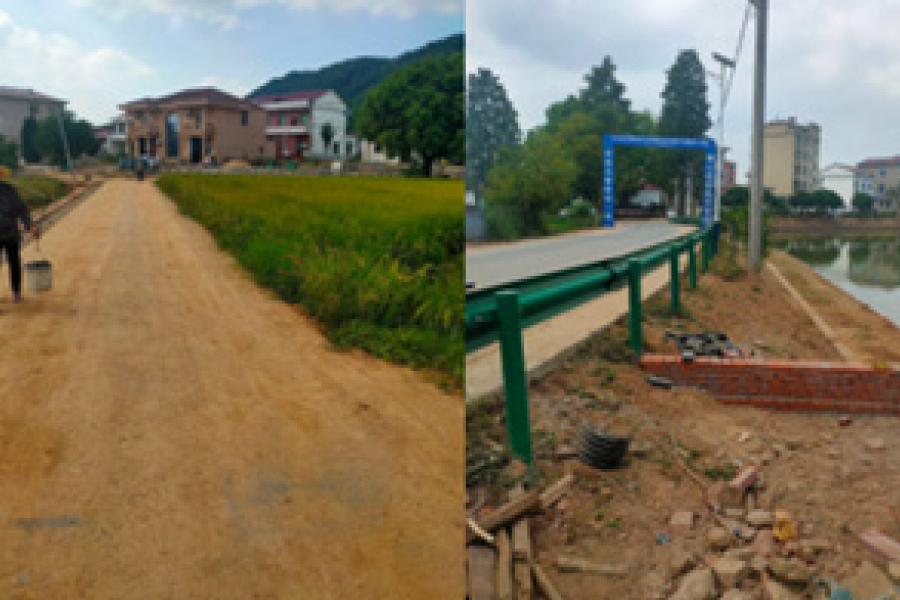
Building the Foundation for Growth During my visit to the 2024 Sanjiang Town Yuanxi Village Houxu Common Prosperity Model Village Project, I witnessed firsthand how modern infrastructure is reshaping rural life. Newly paved roads now connect villages to nearby towns, boosting trade and making transportation easier. Modern residential buildings have replaced traditional homes, offering improved living conditions with access to electricity, clean water, and sanitation facilities. Additionally, public spaces such as parks and community centers have been established, fostering social interactions and enhancing the quality of life. The introduction of clean water services and waste management systems has significantly improved public health, reducing the prevalence of waterborne diseases and pollution. These developments set the stage for sustainable economic growth and social stability in rural China.

2.2 Economic Empowerment:From Agriculture to Industry

Rural urbanization in China is not just about infrastructure; it is also about economic empowerment. The villages I visited had introduced multiple income-generating projects that created local employment opportunities. Small factories and production workshops have been established, reducing the need for villagers to migrate to cities for work. In addition, modern agricultural techniques, such as smart farming and high-yield crop cultivation, have increased productivity and profitability for farmers. These advancements have transformed villages into self-sustaining economic hubs, ensuring long-term prosperity for residents.

2.3 Tourism and Cultural Preservation: A New Economic Driver

and tourism-friendly infrastructure. The project includes the construction of visitor-friendly facilities and the promotion of eco-tourism and cultural heritage sites. By integrating tourism Another key aspect of China’s rural transformation is the promotion of tourism as an economic driver. In Anyi countryside, I observed a government-led initiative focused on developing recreational activities into rural development, villages are diversifying their economies and attracting new sources of income. This strategy not only boosts local revenue but also preserves traditional cultures, ensuring that modernization does not erase historical and cultural heritage. Figure 5.Future tourism hubs are being designed to attract visitors while boosting local economies

2.4 Lessons for Ethiopia’s Rural Development

Ethiopia can draw several valuable lessons from China’s approach to rural urbanization. First, investing in infrastructure especially roads, clean water, and sanitation can significantly enhance living standards and economic productivity. Second, supporting small industries and modern agricultural practices can reduce migration to cities and create self-sufficient rural communities. Third, integrating tourism into rural development can diversify local economies and generate new revenue streams. By adopting a similar model, Ethiopia can bridge its urban-rural divide, foster economic growth, and improve the overall well-being of its rural population.

Conclusion

China’s rural transformation is a testament to the power of strategic government policies and investments in infrastructure, industry, and tourism. The rapid urbanization of villages like Sanjiang Town Yuanxi and Anyi countryside showcases how rural areas can become self-sufficient, economically vibrant, and sustainable. Ethiopia stands to gain from these lessons by adapting similar strategies to fit its own rural development agenda. By prioritizing infrastructure, economic empowerment, and tourism, Ethiopia can ensure a balanced development approach that uplifts its rural communities. As global examples like China demonstrate, the future of rural development lies in modernization, innovation, and inclusive economic growth.

By Tsegay Haftu Gebremeskel [2025/02/25]

Jiangxi Normal University, School of City Construction

AUTO MARINES

Braving Addis Abeba’s flooded streets like seasoned sailors, these cars navigate murky puddles and sudden waves with ease. Each splash exposes the city’s drainage problems, turning morning commutes into off-road adventures through urban waterscapes that challenge both patience and suspension systems. As the rain pours, vehicles become submarines sailing through floods caused by infrastructural failures. Prolonged exposure to these floods risks serious damage to engines, brakes, and electrical systems, adding costly repairs to the daily struggle.

DOMESTIC MUMMY

In the city’s daily scramble, a lone porter hauls six stubborn black barrels meant to hold water but not so great at holding second chances. Like mummies wrapped in dark plastic, these containers conceal their hidden fate: hard to recycle, easy to forget, yet still pressed into service. Mercato, the country’s largest market, holds these barrels and many more appliances.

INFINITE FEATURES

Temesgen Gebrehiwot (PhD), Founder and CEO of ETTA Solutions, Asfaw Alemu, president of Dashen Bank, and Seid Aragaw, chief marketing officer of Ethio telecom, officially launched ‘Zoorya’ on July 12, 2025, at the Sheraton Addis Hotel. Zoorya is an ERCA-compliant business automation platform that generates official receipts for the Revenues Office and can be customised for different business needs. The platform is expected to modernise Ethiopian enterprises through a partnership between Ethio telecom, Dashen Bank, and ETTA Solutions.

Lessons in Bureaucracy

Navigating bureaucracy often feels like moving through a labyrinth, where logic falters and clarity dissolves. The rules change with baffling frequency, and what once made sense quickly becomes irrelevant. Frustration builds not only from inefficiency but also from the emotional toll of chasing paperwork through systems that seem designed to resist resolution. Procrastination in such an environment becomes more than a personal flaw, it becomes a liability.

Hard lessons have revealed the cost of delaying official tasks, especially documentation and registration. Putting things off, even momentarily, frequently spirals into compounded complications. Lost paperwork, misplaced files, and chaotic retrieval efforts turn minor tasks into major crises. These challenges expose the fragile relationship between personal habits and systemic dysfunction.

The dynamic nature of administrative regulations adds yet another layer of difficulty. Permissible actions today may fall afoul of new rules tomorrow, catching even the well-intentioned off guard. This reality underscores the urgency of acting swiftly, rather than waiting for deadlines to approach. Being ahead of bureaucratic demands has become less a matter of efficiency and more a strategy for survival.

Consider the case of birth certificates, often delayed until the child nears school age. Many parents, like myself, wait years to apply, by which time original hospital records may be lost or incomplete. This avoidable delay frequently results in drawn-out and stressful application processes. Securing such documents immediately would preserve vital records and reduce the likelihood of future complications.

A similar mistake marked the retrieval of my university degree. I postponed the task for years, only to face long queues, misplaced records, and endless frustrations. What should have been a simple process turned into a series of complaints and wasted visits. This experience reinforced the principle that administrative obligations demand prompt attention.

In Addis Abeba, identification requirements have recently become more convoluted. New policies now require both the traditional Kebele ID and the digital Fayda ID for basic services. This contradicts the original purpose of the Fayda system, which was meant to consolidate identification processes. The requirement to present both has deepened confusion and undermined faith in digital reform.

Inconsistencies extend beyond identification and into financial transactions. While officials promote a shift towards cashless payments, several offices still insist on cash-only policies. This contradiction creates logistical headaches for residents who try to comply with modern reforms. The absence of consistent implementation leaves citizens stranded between two irreconcilable systems.

Institutional inefficiency further compounds the problem. Taking time off work to finalise documentation, only to discover that receipts have run out or forms are unavailable, reflects a startling disregard for people’s time. Offering stamped notices or temporary letters of acknowledgement could ease such burdens. Small measures would enhance both efficiency and public goodwill.

Though these offices must operate within legal frameworks, the absence of practical adjustments remains puzzling. Citizens are expected to comply meticulously, while institutions often display minimal flexibility. This rigid attitude suggests a disconnect between policy and reality. It leaves one questioning whether rules serve the public or simply maintain bureaucratic inertia.

More troubling is the contrast between this inflexibility and the leniency shown toward larger infractions. Petty rules are enforced with unwavering rigidity, while institutional corruption or negligence often escapes scrutiny. This inconsistency breeds mistrust and further erodes confidence in public systems. A shift in priorities could go a long way in restoring credibility and fairness.

Though initial encounters with these obstacles sparked intense frustration, they also prompted reflection. Realising that external inefficiencies lie beyond my control helped redirect focus to what can be changed. The deeper lesson emerged not in anger, but in understanding the value of promptness and responsibility. Acting early has proven to be the most reliable defence against bureaucratic turmoil.