
Editorial | Mar 23,2019



Mar 14 , 2026.
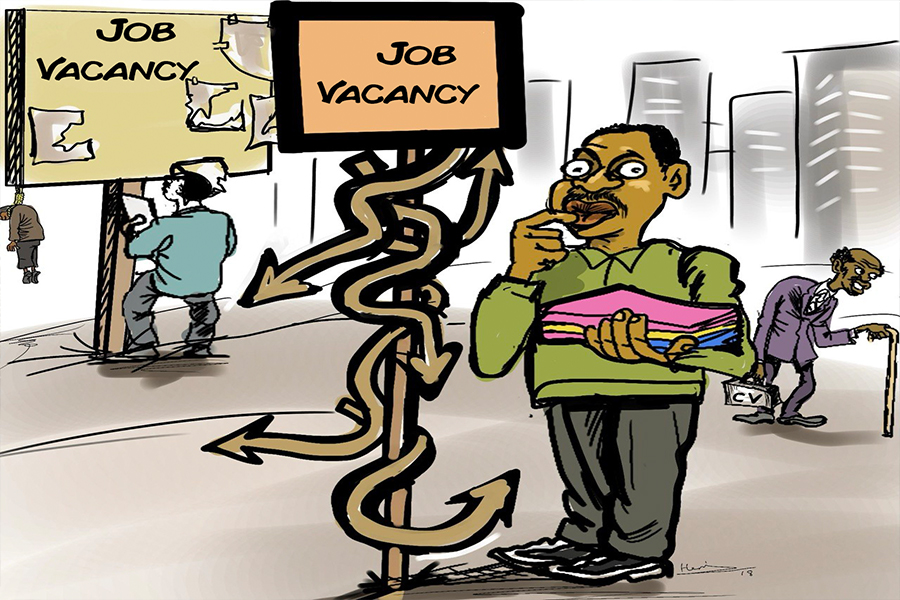
Policymakers have pulled off a remarkable feat. They have found a way to demand more cash from taxpayers precisely when businesses have the least room to breathe.
Taken one by one, each of the government’s recent policy choices has a respectable pedigree.
The National Bank of Ethiopia’s (NBE) cap on credit growth is meant to cool inflation and contain monetary excess. The new quarterly advance tax system is intended to smooth fiscal cash flow and reduce the annual ritual of tax procrastination. The new minimum alternative tax, set at 2.5pc of turnover, aspires to catch habitual loss-declarers and serial underpayers.
In theory, each measure addresses a real weakness. In practice, together, they amount to a three-finger squeeze on the same throat that is business liquidity.
Ironically, this is not happening in a buoyant private sector flush with retained earnings and easy bank finance. It is happening at a moment when private capital accumulation is scraping the bottom of a 25-year arc.
Private gross fixed capital formation, which had climbed to 24.51pc of GDP in 2017, fell to about 14.8pc in 2024. The economy is now running roughly 10 percentage points below its pre-crisis private investment peak. In plain terms, the Administration of Prime Minister Abiy Ahmed (PhD) is asking businesses to sprint while quietly removing their shoes.
The scale of the retreat is not academic. In nominal terms, private investment may have risen with inflation to around 1.7 trillion Br in 2023/24, but ratios tell the more honest story. The economy has grown, while private capital formation has not kept pace. The result is a shortfall in annual private investment estimated at 700 billion Br to 900 billion Br compared with what the economy might have seen had the 2017 investment rate held.
That is a very large hole to dig while wearing fiscal ankle weights. Now enter the taxman, quarterly.
Under the latest income tax amendment, Category A and B taxpayers are required to make quarterly advance payments equal to 25pc of the previous year’s tax liability. Category A taxpayers have only five days after quarter-end to pay. Previously, companies could hold that tax cash inside the business until year-end, using it as working capital to finance inventory, supplier payments, payroll, and expansion. That informal tax float has now vanished.
For a state trying to increase tax-to-GDP from the 7.3pc to 8.5pc range toward an 11pc medium-term goal, the reform could be understandable, if an uphill task, for it focused exclusively on squeezing the maximum from those in the tax-net. Tax authorities find it convenient to ignore the difficult task of bringing on board the majority of those who generate income outside the tax system.
The nominal GDP in 2025/26 is roughly 15 trillion Br to 16 trillion Br. At 8.5pc of GDP, tax revenue would be about 1.3 trillion Br. At 11pc, it would rise to around 1.7 trillion Br. The difference, about 380 billion Br to 440 billion Br, is no rounding error. That kind of money can fund budgets, calm creditors and impress the technocrats from the International Monetary Fund (IMF).
But governments do not collect percentages. They collect cash. And cash arrives from businesses that must first survive long enough to remit it.
That is where the second squeeze tightens. The Central Bank’s credit growth cap, first introduced at 14pc in August 2023, was later raised to 18pc in January 2025 and 24pc in September 2025. Yet the policy still restricts banks’ room to extend working capital, especially to firms outside the safest and best-connected circles. The IMF has already noted tight liquidity conditions, with reserve money falling by half by the end of October 2024, from six percent of GDP at the end of 2022/23, and excess reserves to deposits at only 0.8pc.
In a country where banks often require 100pc collateral, telling businesses to “just borrow” is rather like advising a thirsty man to open a bottle after confiscating the corkscrew.
The third squeeze is the nastiest because it taxes not success, but activity. The minimum alternative tax (MAT) requires a company to pay at least 2.5pc of turnover if its normal income tax falls below that threshold. For a thin-margin business, that could be brutal.
A company earning a three percent net margin on 100 million Br in sales would owe the state 900,000 Br in corporate income tax at the 30pc rate. Under the MAT, it owes 2.5 million Br. The tax bill is nearly triple, even though profitability is weak. For businesses hit by exchange-rate losses, high import costs, or conflict disruptions, MAT turns the tax code into a machine that mistakes motion for margin.
The sectors most exposed are the very ones the Administration claims it wants to nourish. Manufacturing needs working capital for imported inputs and long production cycles. Exporters often depend on domestic suppliers who, in turn, rely on bank finance. Construction and real estate live on lumpy revenues and rolling credit. Small and medium enterprises, meanwhile, have almost no cushion at all.
Fewer than one percent of SMEs have bank loans, while roughly 70pc rely on personal funds. They are being hit by quarterly extraction and turnover taxation without any credible financing backstop.
This is where policy stops being technocratic and becomes theatrical. One arm of the state says it wants more private investment, more exports, more industrialisation and more jobs. Another arm limits credit. A third shortens the tax leash—a fourth taxes turnover even when profits are meagre. The orchestra is playing four different songs, and the private sector is expected to dance in time with them.
The irony is especially rich because the broader tax problem is real. The tax-to-GDP ratio has fallen from 12.4pc in 2014/15 to about 7.5pc in 2022/23, one of the steepest declines recorded anywhere in the world. Corporate income tax has underperformed not because the statutory rate is low (it is 30pc, near the sub-Saharan African average) but because compliance is weak. The economy shifted away from easier-to-tax sectors.
Corporate income tax efficiency is now near the bottom decile in the region. Admittedly, reform was overdue. Yet overdue reform can still be badly sequenced.
The sensible path would have been to pair advance tax collection with a fast, trusted refund mechanism, and to phase down the credit cap as the tax changes took effect. Instead, taxpayers face a synchronised cash call. Taxes are pulled forward; turnover is taxed regardless of profits; and bank credit remains rationed.
The state is effectively vacuuming liquidity from companies while simultaneously telling banks not to refill the room too quickly. That might be tolerable in a stable and low-inflation economy. Ethiopia’s economy is not one.
Inflation has remained elevated. The Birr has sharply depreciated since the 2024 foreign-exchange reform. Imported inputs cost more. Margins are under pressure. Security conditions in several parts of the country remain fragile. This is not the season to confuse endurance with excess liquidity.
There is, of course, a pro-policy argument. Quarterly instalments are normal in many countries. The U.S., Germany, Australia, India and Britain all use instalment-based corporate tax systems.
True enough, but these countries generally rest on mature tax administration, predictable refund practices, deeper banking systems and lower macroeconomic volatility. Importing the schedule without importing the plumbing is like buying a German dashboard for a car whose brakes are still optional.
Policymakers do not need to abandon tax reform. They need to stop treating liquidity as an infinite natural resource.
A business can survive low margins for a time. It can survive expensive credit. It can survive higher taxes if collections are predictable and profits remain intact. What businesses are now struggling with is to survive all three at once.
Lower internal cash generation, reduced access to borrowing, and faster state extraction are the real dangers of a triple squeeze. It does not merely inconvenience taxpayers. It discourages capital formation at the precise moment when the domestic economy most needs private accumulation to recover from war, a foreign-exchange crunch, and years of underinvestment. A country cannot tax its way into dynamism if the tax architecture helps suffocate the firms meant to create it.
PUBLISHED ON
Mar 14,2026 [ VOL
26 , NO
1350]
Editorial | Mar 23,2019

Agenda | Nov 29,2025
Commentaries | Jul 17,2022

Fortune News | Feb 14,2026
Editorial | Dec 25,2021
Fortune News | Apr 03,2023
Election 2026 coverage | Jun 03,2026
Editorial | Dec 31,2022
Fortune News | Jul 04,2026
Fortune News | Oct 21,2024

Photo Gallery | 193371 Views | May 06,2019

Photo Gallery | 183256 Views | Apr 26,2019

Photo Gallery | 180064 Views | Oct 06,2021

My Opinion | 145496 Views | Aug 14,2021
















Dec 22 , 2024 . By TIZITA SHEWAFERAW
Charged with transforming colossal state-owned enterprises into modern and competitiv...

Aug 18 , 2024 . By AKSAH ITALO
Although predictable Yonas Zerihun's job in the ride-hailing service is not immune to...

Jul 28 , 2024 . By TIZITA SHEWAFERAW
Unhabitual, perhaps too many, Samuel Gebreyohannes, 38, used to occasionally enjoy a couple of beers at breakfast. However, he recently swit...

Jul 13 , 2024 . By AKSAH ITALO
Investors who rely on tractors, trucks, and field vehicles for commuting, transporting commodities, and f...
Aug 15 , 2026 . By NAHOM AYELE
Federal prosecutors have charged seven defendants over a set of foreign-trade deals t...
Aug 15 , 2026 . By BEZAWIT HULUAGER
Ethio-post is preparing to turn its thousands of branches into banking agents, allowi...
Aug 18 , 2026 . By BEZAWIT HULUAGER
Kassahun Gofe (PhD), minister of Trade & Regional Integration (MoTRI), is prepari...
Aug 16 , 2026 . By NAHOM AYELE
Justices at the Federal Supreme Court widened the shield they are holding over lawyer...








 Loading your updates...