
Sunday with Eden | Aug 08,2026



Jan 24 , 2026
By Kidist Yidnekachew
People tend to protect identities that are mostly borrowed from others, creating invisible limits on potential. Whether it’s adhering to social expectations or following learned rules, these constraints can paralyze creativity and risk-taking. Anecdotes illustrate that ignorance of such limits often produces greater confidence and experimentation. A rigid identity can prevent authentic evolution. Embracing repeated self-loss may be the only path to meaningful growth.
I came across a video the other day that has been quietly vibrating in the back of my mind ever since. It was a content creator on TikTok discussing the concept of identity, but not in the way we usually hear it. Usually, we are told to
His point was that we have spent years meticulously building a "brand" of ourselves. We tell ourselves, "I am the kind of person who likes this," or "I would never be the type of person to do that." We draw these invisible lines in the sand and then refuse to cross them. Over time, these preferences harden into a rigid shell. We don’t step out of what we think our identity is because we are afraid of the incoherence that comes with change. We become curators of a museum dedicated to a version of ourselves that might already be obsolete.
This resonated with me because I’ve often wondered if a sense of identity is truly as unique as we claim. We like to think of our personalities as "original works," but if you were to really sit down and dissect what makes you you, the results might be humbling.
If we look closely, we are mostly a mosaic of other people. We are a collection of phrases we heard a favorite teacher use, a temperament inherited from a parent, a fashion sense influenced by a friend we admired in high school, and a set of values shaped by the culture we happened to be born into. How much of a person is genuinely, fundamentally "original"? I’d venture to say it’s less than 10pc.
The rest is a borrowed perception. We are a "remix" of every person we have ever crossed paths with. This isn’t to say we don’t have genuine preferences, we certainly know what we like and dislike, but it raises a deeper question: Do we even know ourselves well enough to stay "faithful" to an identity? And if that identity was mostly built by external influences, why are we so protective of it?
I had a conversation that mirrored this idea a few days later. I was in a cab on the way to visit family, and the driver and I started talking about the burden of knowledge. He proposed a radical idea: that sometimes, knowing something actually keeps you from becoming successful or innovative.
"Look at math," he said. "Because we are taught from birth that 1+1=2, we never question it. We stick to that knowledge and never look further. But if you found someone who didn’t know the ‘rules,’ they might come up with a completely different way of seeing the relationship between those two units."
He was talking about the "box." People who think outside the box are often lauded, but the driver argued that the most creative people are those who aren’t even aware the box exists in the first place.
He used language as the perfect example. Have you ever noticed that people who know absolutely nothing about a language’s grammar are often the ones who learn to speak it the fastest? They are brave enough to stumble, to use broken sentences, and to look "foolish" as long as they are communicating. Meanwhile, the students who know a "thing or two", those who have studied the rules and the syntax, are often paralyzed. They are so afraid of breaking a rule or looking "wrong" that they stay silent. They wait until they are "perfect," which is a day that never comes.
In this sense, confidence doesn’t come from "knowing thyself." Sometimes, confidence comes from a total lack of self-consciousness, a freedom from the identity of being "someone who is correct."
It makes me wonder: What would happen if we woke up tomorrow with a total "clean slate"?
If you had no memory of your past failures, no concept of your "reputation," and no social circle expecting you to act a certain way, would you still make the same choices? If you weren’t expected to be "the quiet one," "the funny one," or "the reliable one," who would you choose to be in that vacuum?
I suspect that much of what we call "personality" is actually just us performing a role to meet the expectations of the people around us. Our identity is a social contract we signed years ago and forgot we had the power to renegotiate. It is an illusion, a comfortable, familiar box that keeps us from the terrifying, beautiful risk of true growth.
Of course, there is a reason we cling to these boxes. Experimenting with identity is inherently risky.
There’s a biological safety in the known. If you don’t know you’re incapable of flying, you might jump off a roof. You won’t fly; you’ll likely end up broken or dead. Our identities function as a sort of psychological "gravity." They keep us grounded and safe, preventing us from making social or professional leaps that could lead to failure.
But there is a difference between a safety net and a cage. When we treat our identities as rigid, unchangeable facts, we stop evolving. We get surprised when we do something "out of character," feeling a sense of guilt or confusion. But perhaps those "out of character" moments are the only times we are actually growing. They are the moments when the 10pc of our true self pushes through the 90pc of our borrowed perceptions.
Perhaps the goal in life isn’t "finding yourself" at all. Maybe the goal is to be brave enough to keep losing yourself, over and over again, until only the growth remains.
PUBLISHED ON
Jan 24,2026 [ VOL
26 , NO
1343]

Radar | Feb 08,2026

Fortune News | May 27,2023
Radar | Mar 21,2026
Radar | Aug 13,2022
Radar | May 03,2026

Photo Gallery | 193371 Views | May 06,2019

Photo Gallery | 183256 Views | Apr 26,2019

Photo Gallery | 180064 Views | Oct 06,2021

My Opinion | 145496 Views | Aug 14,2021








Dec 22 , 2024 . By TIZITA SHEWAFERAW
Charged with transforming colossal state-owned enterprises into modern and competitiv...

Aug 18 , 2024 . By AKSAH ITALO
Although predictable Yonas Zerihun's job in the ride-hailing service is not immune to...

Jul 28 , 2024 . By TIZITA SHEWAFERAW
Unhabitual, perhaps too many, Samuel Gebreyohannes, 38, used to occasionally enjoy a couple of beers at breakfast. However, he recently swit...

Jul 13 , 2024 . By AKSAH ITALO
Investors who rely on tractors, trucks, and field vehicles for commuting, transporting commodities, and f...
Aug 14 , 2026
Aschalew Fetene, known as “Ardi” and admired for his poetic depth, has built a ti...

Aug 8 , 2026
The World Bank asks readers to picture a mother in rural Ethiopia who has never held...

Jul 31 , 2026
Weldu Yiheysh has not read the Pacific temperature charts. He does not need to. In Shibta District of Enderta Wereda, in...

Jul 25 , 2026
Ideally, citizens who have paid income tax all year should not have to reach for thei...
Aug 15 , 2026 . By NAHOM AYELE
Federal prosecutors have charged seven defendants over a set of foreign-trade deals t...
Aug 15 , 2026 . By BEZAWIT HULUAGER
Ethio-post is preparing to turn its thousands of branches into banking agents, allowi...
Aug 18 , 2026 . By BEZAWIT HULUAGER
Kassahun Gofe (PhD), minister of Trade & Regional Integration (MoTRI), is prepari...
Aug 16 , 2026 . By NAHOM AYELE
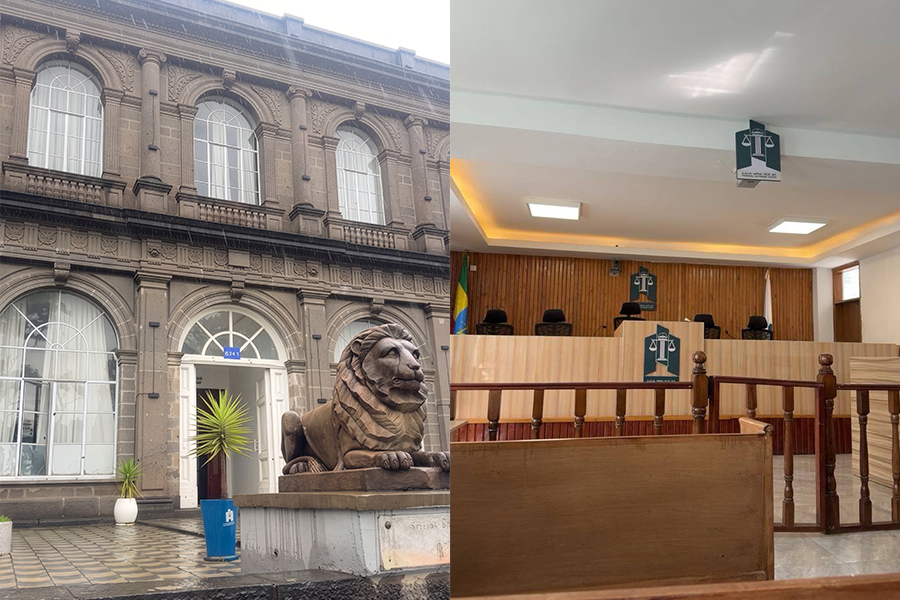
Justices at the Federal Supreme Court widened the shield they are holding over lawyer...







 Loading your updates...