
Radar | Jun 07,2026



Kassahun Follo’s plan to keep an eye on the national polls set for Monday, June 1, 2026, ended before the vote began.
The Confederation of Ethiopian Trade Unions (CETU), which he leads as the country’s national trade union platform, had been accredited to observe tomorrow's polls. The organisation represents more than one million workers through nine industrial federations and about 2,500 trade unions. It had observed elections before and planned to monitor this one through a labour-rights lens. But the money did not arrive.
"We're trying to secure financing and observe the election," Kassahun told Fortune. "But because we couldn't obtain the resources, we'll not observe this election."
CETU's withdrawal captures the mood around the general election, the seventh since the constitutional order was established in the mid-1990s, a contest expected to send representatives to regional councils and the federal legislative house for the next five years, but unfolding in a cold and subdued atmosphere. Hours before voters head to polling stations, the question is less who will win than what kind of political order follows the election.
According to senior officials of the National Election Board of Ethiopia (NEBE), the machinery is ready.
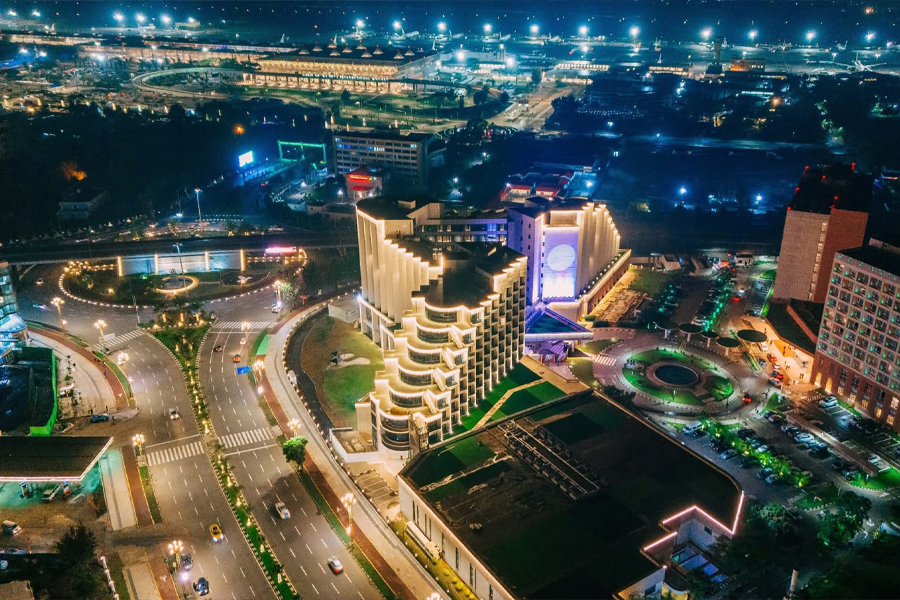
Ballot papers have reached designated locations, election materials have been distributed, and polling stations are prepared. The Board's chief, Melatwork Hailu, used a final briefing on May 27, 2026, at Skylight Hotel on Africa Avenue (Bole Road) to urge voters to participate. She has registered 10,438 candidates from 39 political parties, two coalitions, one front and 80 independent candidacies. One coalition includes eight parties, another includes four, and the front consists of four parties.
More than 250,000 candidate representatives have received badges, while 68 media organisations, including 56 local and 12 international outlets, have been accredited.
Yet the scale on paper masks a quieter election. The number of registered political parties fell by six to 42. The candidate list dropped by 451 from the initial list, including about 80 candidates removed for failing to submit required documents. Elections will not be held in 46 of the 547 constituencies, including all 38 in Tigray Regional State and eight in Amhara Regional State, where security conditions remain difficult.
The Board disclosed that over 50 million voters were registered when rosters were closed in April, with women accounting for 54.2pc. After reassessments allowed voter registration to resume in 40 previously suspended constituencies, 3,367 polling stations added 3.3 million voters, bringing the number to 53.8 million. Special polling stations also registered 20,122 university students, 28,632 internally displaced people and 126,498 military personnel.
"University-student registration figures were lower than expected, though some students may already have used the regular digital channel," said Melatwork.
When she addressed the media last week, the total tally of voters was 54 million. Although a digital voter-registration platform was introduced, only 10.9pc of registrants used it.
Registration itself showed the Board’s caution. Security assessments initially suspended registration in 48 constituencies, mainly in Amhara regional State with 38 rated red and 10 yellow. After reassessment, 40 were reopened for registration. That has made the vote feel as much administrative as political, with the hours expected to show whether Ethiopia can hold an election whose reach is broad but whose competitive energy has narrowed. Observation, once a major measure of the electoral credibility, is narrower this time.
According to Melatwork, 114 organisations received support from funds allocated by the UNDP, the European Union and the federal government budget provided to the Board, while acknowledging the money was insufficient.
CETU is not alone in struggling with funding shortages, which have hit several domestic groups even as NEBE disclosed local observation groups have expanded by more than 32pc compared with the previous national elections. The Board has accredited 55 civil society organisations to deploy 64,770 stationary and mobile observers, with 1,572 coordinators. Its officials expect this number to increase on polling day.
Around 169 organisations were certified for voter education, though another figure from the Board put the active number at 143, nearly eight percent lower than in the previous cycle.
The accredited domestic groups include women’s associations, youth federations, disability advocates, peace and development organisations and legal professional associations. NEBE has also organised training workshops for civic groups involved in election work. Among those still preparing are the Ethiopian Youth Federation, the Federation of Ethiopian Associations of Persons with Disabilities, the Amhara Region Youth Associations Federation, the Oromia Women Federation, and the Gondar Development & Peace Association.
Diplomatic missions based in Addis Abeba have also requested permission to observe and have been granted observer badges. More than 220,000 party representatives have been accredited to observe voting on election day, adding another layer to the observation framework, though the Board has issued more than 250,000 candidate-representative badges.
The Ethiopian Women Lawyers Association (EWLA) chose to stay in despite the shortfall in funding. According to its Programme Manager, Wondimneh Mola, the Association, which deployed 178 observers during the last election with 15 million Br support from the National Democratic Institute (NDI), now depends on roughly 500,000 Br from internal resources.
"Due to severe shortages in funding resources, it has become extremely difficult for us to provide training and cover transportation and other operational expenses for our observers," he said. "The funds we used to receive have been almost entirely reduced."
The Association trained only 70 short-term observers to monitor election-day activities, who are expected to operate in the Amhara, Oromia, Gambella, Benishangul-Gumuz, Sidama, and Afar regional states, as well as in Dire Dawa.
The Coalition of Ethiopian Civil Society Organisations for Elections, the largest domestic observer alliance, is better positioned. Representing 180 member organisations, it plans to deploy more than 4,100 observers nationwide, with more than half serving as stationary observers and the rest operating as mobile monitors.
"The short-term observers are now in training," Abera Hailemariam, the director general, told Fortune last week.
But its pre-election assessment, covering 4,990 polling stations, documented serious problems, particularly in the Amhara Regional State. It cited the killing of an election official in East Gojjam Zone, attempted attacks in Awi and Wag Himra, and risks to election workers and voters. It also reported voter registrations in prohibited locations such as military camps, police stations, religious institutions, health facilities, hotels, and private homes, as well as registrations without voters physically present or with invalid identification.
Elderly voters and persons with disabilities faced accessibility barriers.
International observation has also narrowed. The European Union (EU), whose past reports shaped international views of Ethiopian elections, is visibly absent. According to sources close to the EU Commission in Addis Abeba, "the EU doesn't have an interest in participating, and budgets are not allocated."
Board officials played down the shrinking footprint of election observers.
"The freedom, fairness, and credibility of any election are best reflected by the ability of observers to conduct independent monitoring and provide meaningful findings," the Board stated. "The effectiveness and quality of observation matter more than relying on figures alone."
So far, only the African Union (AU) and the Intergovernmental Authority on Development (IGAD) have confirmed participation. The AU mission, led by former Kenyan President Uhuru Kenyatta, arrived on May 26. It plans to deploy observers from 37 African countries, including ambassadors accredited to the AU. One Board account put the AU delegation at 59 members; another AU disclosure said it would deploy 73 short-term observers.
"The observers will be deployed across various regions of Ethiopia to observe election-day procedures, including the opening of polls, voting, closing, counting and tabulation at polling stations," the AU said.
IGAD’s mission, led by former Ugandan Vice President Speciosa Wandira-Kazibwe (MD) and deputised by Mohamed Ali Houmed, includes 26 short-term observers from Djibouti, Kenya, Somalia, South Sudan, Sudan and Uganda.
"We're preparing to observe the election in Ethiopia by deploying experts from the region," a senior IGAD official said.
The decline marks a departure from earlier cycles. Observers from 23 countries monitored elections when the current political order began in 1992. The 2005 election drew missions from the EU, the AU, and the Carter Centre and remains one of the country’s most closely observed contests. In 2021, after Prime Minister Abiy Ahmed (PhD) came to power, the EU and USAID sought to participate, but disagreements over operational conditions kept them out. The AU and the International Republican Institute observed that vote.
This year’s electoral content is also uneven. Political parties in Tigray Regional State, including the Tigray Democratic Solidarity Party, a.k.a. "Simret," linked to former Tigray Interim Administration President Getachew Reda, are effectively excluded from the contest because voting will not take place in the region. The Social Democratic Party, founded by the late Beyene Petros and now led by Rahel Bafe (PhD), also left amid internal disputes.
Security has limited campaigning in parts of Oromia and Amhara regional states. Still, the Oromo Liberation Front (OLF), led by Dawud Ibsa, is participating for the first time. The Oromo Federalist Congress (ODF), led by Merera Gudina (Prof.), also joined, partly to avoid deregistration after missing the last contest.
The ruling Prosperity Party (PP) and the Ethiopian Citizens for Social Justice (EZEMA) are the only parties that fielded enough candidates to realistically form a government. Even EZEMA’s President, Eyob Mesfin, has admitted his party does not expect to win and form one. Prosperity did not field parliamentary candidates in 48 constituencies, a decision watched closely after its Chairman, Abiy, told Parliament in January that opposition seats would increase "five to ten times" and that his party would deliberately work toward that outcome.
For his critics, leaving seats open does not guarantee a fair contest. Prosperity is running unopposed in 65 Parliamentary seats, mostly in Oromia Regional State (46) and Amhara Regional State (11). It will also stay out of 284 regional council seats. In many regions, those seats represent eight to 15pc of council positions; in Oromia, only one percent. In Addis Abeba, Central Ethiopia, Dire Dawa and Somali, the share is about 15pc.
Eyasped Tesfaye, a Horn of Africa political analyst, called the contest "unusually weak."
"This election is the weakest of all elections Ethiopia has held so far," he told Fortune. "Officially, this is an election where no real hope is visible."
The ruling party, the opposition, and the public largely know the result before the polls open. He criticised the government for failing even to make the process appear competitive and the opposition parties for failing to connect with voters.
"They can’t sell themselves," he said. "Some parties look too similar to the ruling party, while others with stronger programmes have campaigned too cautiously."
Eyasped credited NEBE with better preparation and digital initiatives, but noted it struggled to respond to complaints. Arrests of politicians for campaigning, insecurity, uneven conditions and budget shortages deepened the pressure. He expects limited change, and the governing structure is likely to continue, perhaps with a somewhat stronger opposition voice in Parliament.
"The greater risk is that the election reinforces the belief that governments in Ethiopia can't be changed through ballots, encouraging armed groups to seek other routes," Eyasped told Fortune.
NEBE officials hope to hold elections in constituencies that cannot take part in the country's polls tomorrow, later in the year.
"Once a suitable and conducive environment is established, the election will take place," Melatwork said.
She recalled the sixth general election, when many constituencies in Benishangul-Gumuz did not vote until 2024.
For Kassahun and others, the issue is more immediate. The observers may be accredited, the badges printed, and the polling stations prepared. But an election that looks orderly from the centre is being tested at the edges by money, security and public apathy.
PUBLISHED ON
May 31,2026 [ VOL
27 , NO
1361]
Radar | Jun 07,2026
Editorial | Jun 27,2026
Delicate Number | Jul 15,2023

Fortune News | Jan 03,2026
Fortune News | Sep 03,2022

Life Matters | Jul 18,2026
My Opinion | Aug 10,2024
Radar | Mar 07,2026

Editorial | Jan 17,2026
Viewpoints | Jun 13,2026

Dec 22 , 2024 . By TIZITA SHEWAFERAW
Charged with transforming colossal state-owned enterprises into modern and competitiv...

Aug 18 , 2024 . By AKSAH ITALO
Although predictable Yonas Zerihun's job in the ride-hailing service is not immune to...

Jul 28 , 2024 . By TIZITA SHEWAFERAW
Unhabitual, perhaps too many, Samuel Gebreyohannes, 38, used to occasionally enjoy a couple of beers at breakfast. However, he recently swit...

Jul 13 , 2024 . By AKSAH ITALO
Investors who rely on tractors, trucks, and field vehicles for commuting, transporting commodities, and f...

Aug 14 , 2026
Aschalew Fetene, known as “Ardi” and admired for his poetic depth, has built a ti...

Aug 8 , 2026
The World Bank asks readers to picture a mother in rural Ethiopia who has never held...

Jul 31 , 2026
Weldu Yiheysh has not read the Pacific temperature charts. He does not need to. In Shibta District of Enderta Wereda, in...

Jul 25 , 2026
Ideally, citizens who have paid income tax all year should not have to reach for thei...








 Loading your updates...