
Commentaries | Jul 31,2026



A chorus of Ethiopian writers reflected, skeptically and often intimately, on why they write at all. Across novels, poetry, short stories, and memoirs, few claim the grand ambition of changing society outright.
Writing, for many of them, is driven instead by impulse, imagination, or emotional necessity.
Henock Bekele dismissed the idea of literature as a tool for engineered social change, framing his work as a personal record of feeling rather than a historical document. Others echo this modesty, describing fiction as a space for asking questions, exploring inner worlds, or capturing the spirit of a moment rather than prescribing answers or reforms.
Freedom, a recurring theme in the conversations, is treated less as a slogan than a problem. Some writers resist defining it altogether, wary of turning the word into an abstract ideal detached from lived experience. Others described freedom as situational and subjective, emerging from self-awareness or from having little left to lose.
Money is rarely presented as a reliable path to liberation; at best, it offers partial agency shadowed by anxiety. Mesfin Wondwessen argued that true freedom, if it exists at all, is tangled in contradictions and shaped by context, consciousness, and constraint rather than wealth or deprivation alone.
Questions of language and censorship reveal a striking consensus. Almost all the writers reject the idea of banning words from everyday Ethiopian vocabulary, even when acknowledging that language can wound. Words, they argue, carry collective memory and social psychology; suppressing them risks reaction rather than progress.
Change, in their view, comes not through linguistic policing but through shifts in mentality, empathy, and cultural maturity. Letting harmful terms fade through social evolution is seen as more honest and durable than imposing bans from above.
When it comes to readers’ reactions, attitudes diverge but converge on one point. Once published, a book no longer belongs to its author. Henock admitted to mistrusting comments, questioning their sincerity, while others embrace how readers reshape texts with their own experiences.
Henock recalled nearly abandoning writing after doubting its usefulness, only to be pulled back by the intensity of reader connection. Another insists that interpretation is entirely the reader’s domain, refusing to revise his own perspective in response. In different ways, they describe literature as a shared space where meaning is negotiated rather than fixed.
The act of writing itself is portrayed as both torment and refuge. For some, the technical grind - plotting, editing, revising - is exhausting and even painful, compounded by the vulnerability of exposing inner thoughts. For Esubalew Abera, writing is a joyful exploration, with frustration arising only at the margins, such as finding the right title or surviving periods of creative block.
Several writers frame literature as a confrontation with human flaws and social injustice, a process that sharpens cynicism even as it offers catharsis. Pleasure and pain, they suggest, are inseparable in the craft.
On reading habits, the tone turns quietly anxious. Social media, cheap entertainment, rising book prices, and the pace of modern life are widely blamed for thinning readership, particularly among the young. Yinager Getachew argued that contrasts between past and present print runs indicate a decline in reading, while others note pockets of resistance and young readers who still choose discipline and depth over distraction.
The verdict is mixed but uneasy. Reading persists, but under pressure, its future is bound up with broader cultural shifts rather than individual will alone.
The portrait of these literary voices is marked by introspection, ambiguity, and a subtle but powerful defiance. These writers are not disengaged. They are disillusioned with slogans, sceptical of mandates, and drawn to the nuances of feeling over the machinery of reform. Their reflections revealed not defeat, but a recalibration, an insistence that literature should remain honest to its uncertainties, even when the world demands certainties.
In resisting the pressure to mean too much, they may be asserting the most radical position of all. That art matters because it refuses to be instrumentalised.
You can read the full story here
PUBLISHED ON
Jan 03,2026 [ VOL
26 , NO
1340]
Commentaries | Jul 31,2026

Fortune News | May 23,2026
Money Market Watch | Nov 08,2025

Radar | May 25,2026
Fortune News | Jan 14,2023

Radar | Dec 01,2024
Fortune News | Aug 16,2026

Commentaries | Jun 13,2026

Exclusive Interviews | Apr 10,2026
Viewpoints | Jul 27,2024

Dec 22 , 2024 . By TIZITA SHEWAFERAW
Charged with transforming colossal state-owned enterprises into modern and competitiv...

Aug 18 , 2024 . By AKSAH ITALO
Although predictable Yonas Zerihun's job in the ride-hailing service is not immune to...

Jul 28 , 2024 . By TIZITA SHEWAFERAW
Unhabitual, perhaps too many, Samuel Gebreyohannes, 38, used to occasionally enjoy a couple of beers at breakfast. However, he recently swit...

Jul 13 , 2024 . By AKSAH ITALO
Investors who rely on tractors, trucks, and field vehicles for commuting, transporting commodities, and f...
Aug 22 , 2026
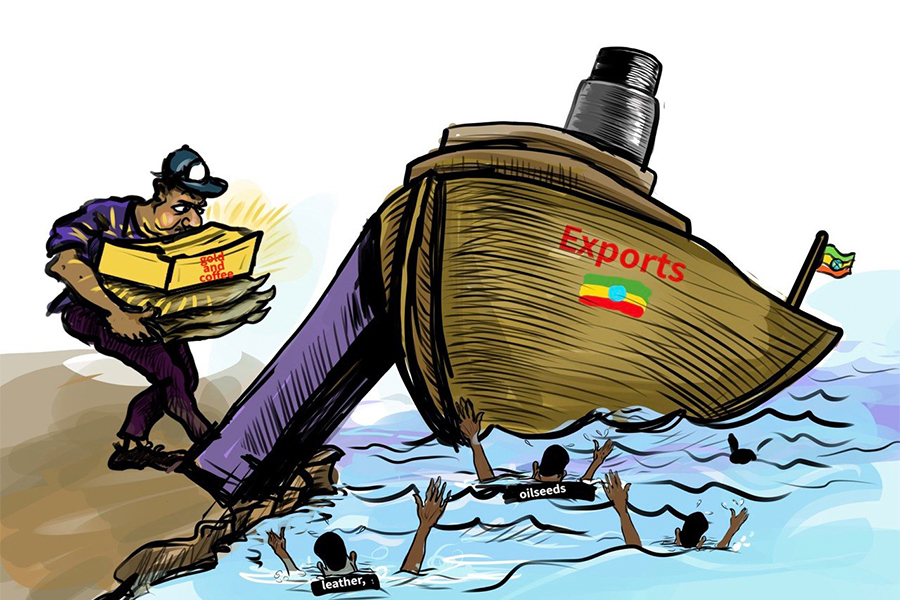
A record is a strange thing to worry about. Federal trade officials have booked the b...

Aug 14 , 2026
Aschalew Fetene, known as “Ardi” and admired for his poetic depth, has built a ti...

Aug 8 , 2026
The World Bank asks readers to picture a mother in rural Ethiopia who has never held...

Jul 31 , 2026
Weldu Yiheysh has not read the Pacific temperature charts. He does not need to. In Shibta District of Enderta Wereda, in...










 Loading your updates...