
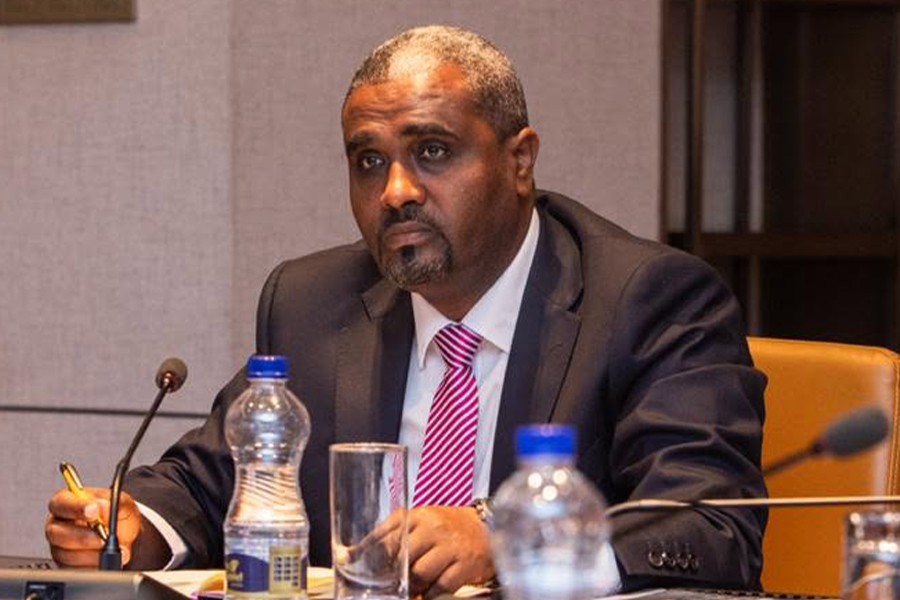
Radar | Aug 01,2026



Fortune: The finance sector remains a male-dominated space. How does it feel to be one of the women recalibrating that balance as you rise?
Enye B. Kidanu: In finance, advancement is often something women must claim, not simply receive as an opportunity. It is a space where you have to assert your value through multiple layers of challenge, regulatory, cultural and professional. But I find energy in navigating that complexity. Recalibrating the balance is not simply about securing my own seat at the table. It is about changing the institutional energy so that the next generation of women does not have to fight for what should already be an open door.
Q: Beyond the statistics, why do you think this industry has remained so stubbornly monochromatic for so long?
While many women enter the sector in junior roles, the drop-off at the executive level reflects a systemic failure. We still rely too heavily on opinion-based discussions about gender instead of action-based structural change. McKinsey research has found that companies with gender-diverse executive teams are 25pc more likely to outperform on profitability. Institutions have to move beyond rhetoric and build support systems that address the double burden many women carry.
Q: What are the unwritten constraints you have had to overcome as a woman to secure your seat at the executive table?
The assumption that a woman’s priorities or tolerance for risk may somehow be different. I have countered that by insisting on data, structure and logic rather than opinion. When you bring system-based solutions to the table, gender becomes secondary to the value you deliver. I chose to become a thought partner, proving in a masculine landscape that inclusive leadership is not a social nicety but a strategic asset for financial stability.
Q: Was there a sliding-doors moment that steered you towards the C-suite?
My certification in transformational leadership was a turning point. It shifted my mindset from simply managing tasks to transforming people and, ultimately, institutions. That transition enabled me to work not merely as a problem-solver but as someone intent on changing the system that produced the problem. Once that happened, the move from participant to system architect made the C-suite feel like the only logical destination.
Q: There is a persistent myth that a career in finance requires exceptional mathematical ability. How much of that is reality, and how much is branding?
Mathematics is the language of finance, but logic is the story. Being good with numbers is only the baseline. The real executive skill lies in financial literacy - understanding the wider economic system - and in leadership, which means seeing the strategic narrative inside the numbers. The field often overstates calculation, when leadership in finance is really about understanding the system behind the maths, anticipating risk and spotting opportunities for growth.
Q: If you could sit down with your 20-year-old self, what is the one piece of non-career advice you would give her?
I would tell her to walk more, worry less, and become the architect of her own ideas. I have learned that peace of mind is the foundation of success. I would tell her to stop seeking external validation, because structured logic is a more reliable compass than the noise of public opinion. I would want her to become a true idea person, someone bold enough to design her own future. Most of all, I would tell her that vision is not static but a living document. You must follow your design, but also have the humility and agility to revise it as you gain knowledge and skills.
Q: Whom do you credit most for the architecture of your success?
My family. My father was my foundation. He raised me with total freedom and always told me I was destined for greatness, a person of stature, someone meant to lead. That early removal of any mental ceiling gave me the confidence to move from my business roots into a professional career without hesitation.
Q: When was the last time you saw another woman in action and thought, "I want to be like her?"
I look at global leaders such as Kristalina Georgieva at the IMF. Her boldness and the way she handles global stability under pressure are deeply inspiring. She does not simply manage a fund. She manages global impact. Seeing a woman lead at that level reinforces my determination to bring world-class strategic thinking to Ethiopia’s financial sector.
Q: Did you always visualise yourself in this position, or was it a destination you discovered along the way?
In some ways, I was raised for it. But I made a deliberate choice to become a professional rather than simply run the family business. I did not just want to participate in the economy. I wanted to help build the systems that govern it. My postgraduate studies in leadership were part of that decision. I wanted to ensure that, when I reached this level, I had a structured approach to problem-solving and action. I have always preferred systems thinking to polarised thinking. The skills that enable ambition are as indispensable as ambition itself.
Q: Beyond the balance sheets and professional accolades, what would you secretly love to be famous for?
Mentoring the next generation. I want to equip young girls and boys with the confidence to converse, the depth to understand the wider ecosystem, and the tools to avoid becoming victims of circumstance. I want them to learn how to shape circumstances and design their own futures. Young people need structured logic to bridge the gap between potential and reality. I would like to be known for creating leaders, not followers.
Q: How do you unplug and find your centre after a demanding day at the office?
I use conceptual journalling to move stress from my heart to my head, categorising problems as governance gaps, alignment issues or framing challenges. That allows me to deconstruct multiple layers of pressure objectively, almost as a case study for my own development. After that, I take a conscious walk and have coffee with my family. It resets my perspective and protects my health.
Q: Which fashion trend from your youth do you look back on with the most regret?
The classic 80s and 90s styles make me smile now. But regret is probably too strong a word. I believe in the same freedom I was raised with. I have two sons, and as long as they carry themselves with dignity, I would let them choose their own path, just as I was allowed to choose mine.
Q: If you could host a dinner party for any one person, past or present, who would you want sitting across from you?
Michelle Obama. She is a woman of immense professional substance, someone who has navigated multiple layers of challenge while remaining grounded and protecting her family’s well-being. I would love to talk to her about that action bias, the ability to combine thought, discipline and impact.
Q: What is your signature dish, the one you are genuinely known for in the kitchen?
I take great pride in my Doro Wot and Kik Wot. In many ways, making a proper Doro Wot is like leadership. It cannot be rushed and requires layers of preparation and precise timing to produce a balanced result.
Q: Is there a traditional holiday food you secretly dislike but find yourself eating every year?
I would not say I hate any food, but the very heavy and fatty meat dishes during holidays can sometimes feel like too much. I prefer lighter and simpler flavours such as Shiro and Kale. Still, I eat the traditional dishes because they honour social connections. Leadership is often about participating in the social harmony of the table.
Q: What is your armour, the one piece of clothing that makes you feel invincible in a boardroom?
A well-tailored and structured blazer. It reflects the structured logic I bring to the table and acts as a physical reminder of the professional claim I am making.
Q: What is the one holiday tradition you have kept since childhood that would surprise your colleagues?
The Ethiopian New Year is my sacred window for reflection and collective design. I still carry the childhood joy of new clothes and Adey Abeba flowers, but I have reimagined it as a ritual of renewal - from the curtains in my home to the table settings - to clear the space for new professional and personal blueprints. I bring my brothers, sisters and sons together to share their vision for the year, so that we move forward as idea people guided by internal logic rather than external noise.
But the tradition that grounds me most is the slow, patient preparation of holiday spices with my mother and sisters. In a fast-moving world, that meditative ritual is my sanctuary. It reminds me that the most meaningful outcomes, whether in family life or complex professional work, require time and intention. It is the season when I unplug, revise my plans in light of new knowledge, and design a future that honours both heritage and ambition.
Q: Which book or film has most accurately captured the reality of your world?
Two books bridge my professional and leadership worlds. "The Fifth Discipline" by Peter Senge speaks to my belief in systems thinking; "How Women Rise" by Sally Helgesen captures the habits and barriers women must navigate to reach the executive level. Together, they reflect my dual focus on building robust institutions while also investing in the human capital that sustains them.
PUBLISHED ON
Apr 10,2026 [ VOL
27 , NO
1354]
Radar | Aug 01,2026
Radar | Jun 22,2024
Viewpoints | May 30,2026

View From Arada | Feb 07,2026

Agenda | May 09,2026

Commentaries | Jun 13,2026
Fortune News | Jun 07,2025

Fortune News | Jul 17,2022

Fortune News | Nov 15,2025
Fortune News | Jun 07,2026

Dec 22 , 2024 . By TIZITA SHEWAFERAW
Charged with transforming colossal state-owned enterprises into modern and competitiv...

Aug 18 , 2024 . By AKSAH ITALO
Although predictable Yonas Zerihun's job in the ride-hailing service is not immune to...

Jul 28 , 2024 . By TIZITA SHEWAFERAW
Unhabitual, perhaps too many, Samuel Gebreyohannes, 38, used to occasionally enjoy a couple of beers at breakfast. However, he recently swit...

Jul 13 , 2024 . By AKSAH ITALO
Investors who rely on tractors, trucks, and field vehicles for commuting, transporting commodities, and f...

Aug 22 , 2026
A record is a strange thing to worry about. Federal trade officials have booked the b...
Aug 14 , 2026
Aschalew Fetene, known as “Ardi” and admired for his poetic depth, has built a ti...

Aug 8 , 2026
The World Bank asks readers to picture a mother in rural Ethiopia who has never held...

Jul 31 , 2026
Weldu Yiheysh has not read the Pacific temperature charts. He does not need to. In Shibta District of Enderta Wereda, in...









 Loading your updates...