
Radar | Oct 23,2023



May 30 , 2026.
Tomorrow, millions of Ethiopians are expected to vote in the seventh national elections. According to the national electoral agency, more than 50 million voters are registered. Yet the poll may be the strangest since the constitutional order began in the mid-1990s.
Tigray Regional State, a founding member of the federation, remains outside the contest, denying its citizens the constitutional right to vote. More than 60pc of federal seats face no challenger from parties other than the incumbent Prosperity Party, the Properitians. Voter apathy is visible in Addis Abeba and other towns. Armed insurgencies in Amhara and Oromia, the two largest regional states, are likely to keep many voters from polling stations.
For a government that came to power promising openness, this is a sobering turn. The vote is a test of whether official confidence can survive the public mood beneath it. In the capital, campaigns feel muted, while in conflict-affected areas, insecurity competes with ballots. In Tigray Regional State, the absence of voting is a sign that constitutional practice and political reality have parted ways. It was not supposed to be so. Nearly eight years ago, Prime Minister Abiy Ahmed's (PhD) Administration promised political “reform” and economic “renewal.”
Ethiopia now approaches another milestone as the government prepares for its second general election under his leadership. If one feature has come to define this period, it is a flow of forums, events, consultations, and public discussions with groups that party officials describe as different sections of society. These gatherings have become a political trademark, but their purpose is often unclear.
The criteria for choosing participants are rarely explained. It is uncertain whether those invited reflect the views, frustrations and priorities of the communities they are said to represent. The forums look less like places where hard public questions are debated and more like managed stages for messages the Prime Minister already plans to deliver.
In recent weeks, the Prime Minister and Addis Abeba's Mayor, Adanech Abiebie, have spent much of their time inaugurating projects, launching facilities and cutting ribbons for development achievements. Such ceremonies have become platforms for wider claims about economic progress. But many are compelled to ask whether the speeches are about the ordinary Ethiopians or a parallel country detached from daily hardship.
A few weeks ago, while inaugurating an industrial park in Gelan Gura, on the outskirts of Addis Abeba, the Prime Minister criticised Ethiopians for failing to recognise what he described as the country's remarkable transformation. He complained that visitors from Europe and the United States were impressed by Ethiopia's development, while Ethiopians themselves did not appreciate it.
Although such remarks recur, the gap between official language and household reality is harder to ignore. Growth figures mean little if they do not translate into affordable food, steady work and better living standards. The citizens faulted for not recognising government achievements are facing rising poverty, unemployment and a cost of living beyond many wages.
Surveys by multilateral institutions such as the International Monetary Fund (IMF), the World Bank, and the World Food Programme (WFP) depict a far grimmer picture than that projected by senior officials. The government points to macroeconomic growth, infrastructure and investment projects. International reports point to widening hardship among ordinary households. World Bank estimates put Ethiopia's GDP per capita at about 979 dollars a year, or roughly 2.7 dollars a day. In practical terms, that is far short of what is needed to cover food, transport, fuel, rent and utilities in cities such as Addis Abeba.
Poverty is also rising. World Bank estimates indicate that Ethiopia's abject poverty rate increased from 27pc to 32pc between 2016 and 2025, compared with the sub-Saharan average of 30.2pc. Millions more have fallen below the poverty line in a country repackaged as one of Africa's fastest-growing economies. Evidently, the gains from that growth are not reaching much of society.
Ethiopia has one of Africa's youngest and fastest-growing populations, but its economy is not creating enough work for nearly two million people entering the labour market each year. Urban youth unemployment remains high, and many university graduates find few real opportunities. For many households, informal and unstable work has become the main means of survival.
Even where jobs exist, worsening security makes mobility difficult. Many citizens are unwilling to move to unfamiliar regions because they fear for their safety. In a country facing repeated militarised conflict and instability, opportunity alone does not guarantee movement.
Recent reforms have added pressure on households already struggling to cope. Measures meant to stabilise the economy, restructure debt, attract foreign investment and implement macroeconomic reform have helped push up inflation and the cost of living. Prices of basic goods and services have risen sharply, eroding the purchasing power of low- and middle-income families whose wages have barely moved.
International lenders, especially the IMF, continue to urge the Administration to maintain fiscal discipline, reduce subsidies and pursue market-oriented reforms. Supporters argue these steps are needed to stabilise the economy and avert a deeper economic crisis. Critics warn that they place a heavy burden on citizens already unable to afford basic needs.
The disconnect is visible in Addis Abeba. While inaugurating feeding centres in Lideta District, Mayor Adanech came under fire for saying she did not understand the reason anyone would beg on the streets of Addis Abeba. She made the statement while promoting the city administration's 29 feeding centres, which reportedly provide one meal a day to about 40,000 people. The claim sounded detached from the distress visible across the capital.
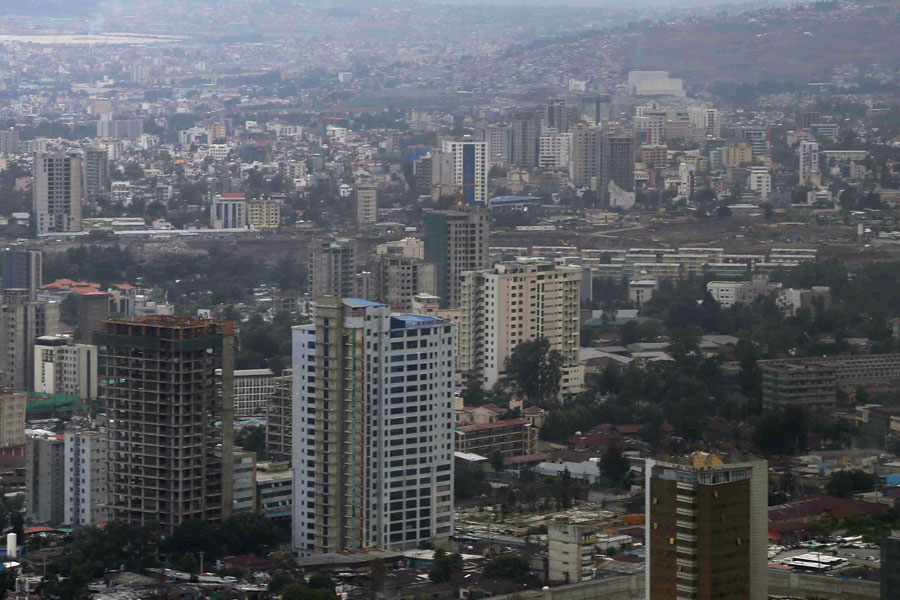
Indeed, a casual visitor driving along Africa Avenue (Bole Road) can see Addis Abeba changing. Roads are wider, bike lanes have expanded, new asphalt roads have been built and decorative lights brighten major corridors. The city's appearance is changing.
Behind the infrastructure, however, many residents face deep poverty and growing food insecurity. For thousands of households, even one meal a day has become difficult to put on the table.
For people on stagnant salaries or unstable income, the cost of living has become unbearable. Food, fuel, transport and utility prices have risen far beyond what many households can afford. Food insecurity is among the country's gravest problems. The WFP estimates that more than 10 million Ethiopians face severe food insecurity, while nearly 15 million rely on humanitarian food assistance. Conflict, inflation, climate shocks and disruptions to agricultural production have worsened conditions.
Against this background, claims that there is “no reason” for begging sound remote from the streets of the capital. The question is not whether roads, industrial parks or feeding centres are being built. It is whether citizens feel secure enough to benefit from them. Poverty, joblessness, inflation and insecurity keep many Ethiopians from sharing the optimism in official speeches.
Feeding centres may ease hunger for a day, but they cannot replace durable work, safe mobility and income that covers basic needs. The task is to create conditions in which citizens can work safely, earn steady incomes and afford necessities without emergency support.
In the week when citizens are urged to express their political views, there is a political lesson here. The EPRDF under Abiy's predecessor, Hailemariam Desalegn, fell to popular discontent after nearly 30 years in power, only seven months after it declared a “popular mandate” through the fifth national elections. Failing to read the undercurrent and mistaking electoral results for public confidence, and conflating officials' speeches with reality on the ground, can be grossly, if not costly, misleading.
PUBLISHED ON
May 30,2026 [ VOL
27 , NO
1361]
Radar | Oct 23,2023
Radar | Nov 24,2024

Commentaries | Nov 01,2025
Fortune News | Oct 18,2025

Radar | Jan 03,2026

Radar | Jun 07,2026

Radar | May 27,2023

Radar | Jul 04,2026
Fortune News | May 29,2023
Fortune News | Apr 03,2023

Photo Gallery | 193683 Views | May 06,2019

Photo Gallery | 183578 Views | Apr 26,2019

Photo Gallery | 180407 Views | Oct 06,2021

My Opinion | 145832 Views | Aug 14,2021









Dec 22 , 2024 . By TIZITA SHEWAFERAW
Charged with transforming colossal state-owned enterprises into modern and competitiv...

Aug 18 , 2024 . By AKSAH ITALO
Although predictable Yonas Zerihun's job in the ride-hailing service is not immune to...

Jul 28 , 2024 . By TIZITA SHEWAFERAW
Unhabitual, perhaps too many, Samuel Gebreyohannes, 38, used to occasionally enjoy a couple of beers at breakfast. However, he recently swit...

Jul 13 , 2024 . By AKSAH ITALO
Investors who rely on tractors, trucks, and field vehicles for commuting, transporting commodities, and f...
Aug 22 , 2026 . By BEZAWIT HULUAGER
The forthcoming strategy for interest-free finance will place Sharia-compliant financ...
Aug 22 , 2026 . By NAHOM AYELE
Wegagen Capital Investment Bank (WCIB) has completed its first full year in profit an...
Aug 25 , 2026 . By NAHOM AYELE
Judges at the Federal High Court, sitting on a limited basis to hear only urgent matt...
Aug 22 , 2026 . By BEZAWIT HULUAGER
Federal authorities are about to find out whether they can make a single payment wind...











 Loading your updates...