


Jul 11 , 2026.
At a market stall, reform arrives without a communique. It comes as a higher transport fare before sunrise, a smaller bag of onions at midday, a pharmacy bill that would not wait for payday, and a property owner who has discovered “market pricing.”
For the officials, it may mean credibility, discipline for creditors, and a programme in review for the International Monetary Fund (IMF), as its experts did a few weeks ago. For citizens, however, it is a daily renegotiation with hunger, fear and uncertainty.
The IMF's Executive Board has completed the fifth review of a 48-month Extended Credit Facility, unlocking about 464 million dollars for Ethiopia and lifting total disbursements to about 2.65 billion dollars, with a further 200 million dollars brought forward to address the war in the Middle East and costlier fuel.
The programme, approved in July 2024 at about 3.4 billion dollars, is meant to correct imbalances, restore external stability and enable private-sector-led growth. However, such a programme with the IMF could steady the books, but it is hard to see how it can stabilise a country at war with itself.
The Birr was floated (technically, it is still managed), exchange restrictions eased, credit is tightening, fuel subsidies are being phased out, revenue is rising, and debt is being restructured. The IMF feels that this performance is broadly in line with Ethiopian policymakers’ commitments, in the familiar language of “price discovery” and “fiscal sustainability.”
Ironically, the country in which this programme is imposed is not a spreadsheet. Ethiopia is a state still fighting for legitimacy in parts of its territory, where political disputes have hardened into armed rebellions that block roads, empty and destroy schools and make investment a wager against violence.
International technocrats such as Nigel Clarke, deputy managing director and chairman of the IMF Board, and Alvaro Piris, who leads the IMF staff team visiting Ethiopia, chose to treat the war in the Middle East as an external shock. But they say far less about the internal wars bleeding the economy from within.
That silence should matter. Stabilisation is not wrong because it is painful. It is wrong when it mistakes the source of the bleeding. No doctor prescribes a treatment to a patient losing blood on the table and calls it recovery.
Ethiopia's wounds are real, caused mainly by a distorted exchange rate, dwindling reserves, galloping inflation, debt distress and a growth model long dependent on public borrowing. But they cannot be separated from the political economy of war. Conflict, such as one waged at an industrial scale, is not a footnote to the balance of payments. It should be seen as one of its causes.
The IMF’s own figures show the scale of the adjustment.
Public debt jumped from 35.5pc of gross domestic product (GDP) in 2023/24 to 50.5pc the following year. Revenue is meant to rise from 7.3pc to 12.3pc by 2030/31, while reserves, barely 0.7 months of imports, to reach 3.8 months; inflation to fall to 11.7pc this year from an average of 26.6pc a few years ago.
A calculation of hope, this assumes the state can raise revenues in trillions, tighten credit, remove subsidies, free the exchange rate (truly), and protect the vulnerable while armed conflicts eat away at the foundations of trade. It is no less than a heroic assumption.
Depressingly, the pain remains visible, with headline inflation climbing from 9.4pc in March 2026 to 13.4pc in May, and food inflation at 15pc. For Messrs Clarke and Piris, the rebound argues for tight money.
However, the promised disinflation has not reached the kitchen table for tens of millions of households. People experiencing poverty do not experience inflation as an index but as substitution. Meat becomes lentils, the bus becomes walking, and medicine becomes delay.
Undoubtedly, excess liquidity in the economy does feed inflation, and Ethiopia had to move from directed credit to a modern monetary system. Yet the restrictions fall unevenly. Large firms can bargain, delay or borrow abroad. But small and medium businesses, dependent on bank credit for inventory and payroll, cannot.
IMF data show credit to the private sector and state firms contracted by 9.7pc in 2024/25, before a projected surge of 55.9pc this year. This has presented a lingering dilemma for policymakers. If they choke lending too hard, it leads to productive firms failing before inflation is tamed. Nonetheless, reopening it too quickly revives the liquidity the IMF-prescribed programme is meant to suppress.
Their answers, adjusting salary for the public sector, social spending and gradual subsidy reform, are necessary but not sufficient. Targeted support works only where the state has reach, reliable data, fiscal room, and legitimacy to govern. Unabated conflicts have undermined all of these.
In parts of the Amhara, Oromia, and Tigray regional states, a safety net cannot reach people where roads are unsafe and markets are disrupted.
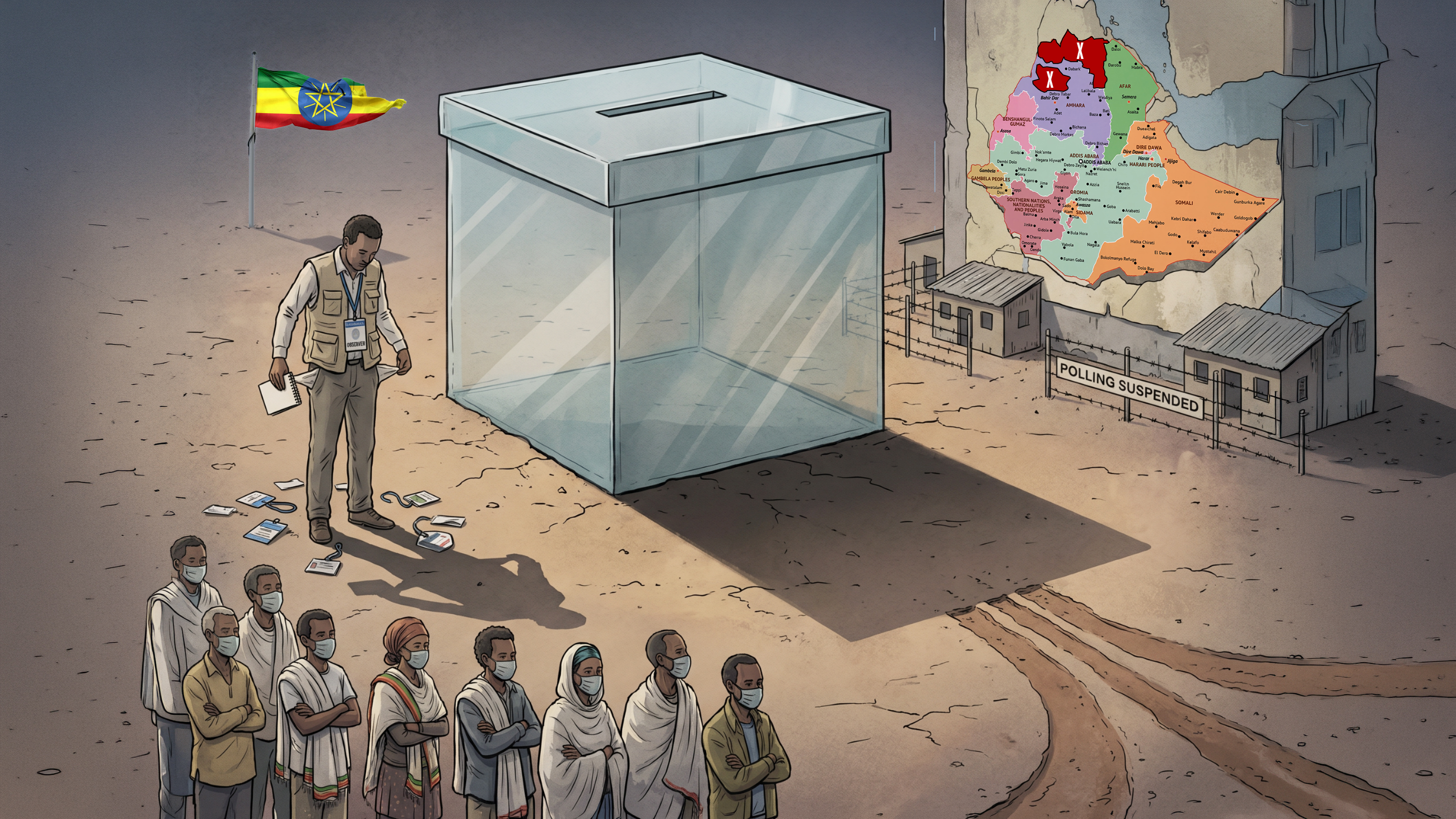
The Armed Conflict Location & Event Data Project (ACLED) data records more than 7,400 attacks between January 2022 and May 2026. In the Amhara Regional State alone, these conflicts account for more than half, while humanitarian agencies warn of rising need and hundreds of thousands displaced.
This is the elephant in the IMF programme room. Piris and his team may model fuel prices and reserves. They cannot wish away roads closed by insecurity, factories idle because workers cannot travel, banks carrying hidden credit risk, and money diverted to the military.
Industrial-scale conflict is a macroeconomic variable that moves inflation, revenue, investment and debt. To treat it as background risk is to misread the economy. It is also a crisis of legitimacy. A government asking citizens to bear devaluation, subsidy cuts and tighter credit needs a reservoir of trust, and Ethiopia's is depleted.
Austerity then looks less like discipline than extraction by a ruling class whose legitimacy to govern is contested, and the bargain behind every programme the IMF negotiates, pain now for stability later, breaks down.
To be certain, Ethiopia’s leaders had little choice. The EPRDF-era political-economic model was unsustainable, with a parallel-market premium punishing exporters, foreign-exchange queues distorting production, and debt in default after the country missed payment on a one-billion-dollar Eurobond.
Without financing, the adjustment would have been harsher still. To be fair to the IMF, it did not invent the crisis. But necessity is not absolution. The question is not whether Ethiopia needed reform, but whether it is sequenced for a country in political fragmentation.
A programme that frees prices faster than it rebuilds trust becomes a technocratic accelerant, lifting official indicators while deepening the sense that the state no longer protects citizens under its responsibilities.
Argentina, Egypt, Pakistan and Tunisia have lived through versions of this drama, with many returning to the IMF, living costs higher and wages lower. Ethiopia should not join this list.
A tight monetary policy should be paired with a domestic debt market that absorbs liquidity without starving firms, and deposit rates that reward saving rather than flight into goods or foreign currency. Fiscal adjustment should broaden the tax base while protecting small firms, rather than conflating mobilisation with harassment. The social floor should be real, with subsidy cuts phased in against reliable compensation.
Above all, Ethiopia needs a peace premium, and it cannot get one from 19th St., N.W., in Washington, D.C. A political settlement is not a sentimental add-on to reform but the missing macroeconomic anchor. Negotiations with armed actors and credible political inclusion are conditions for the success of macroeconomic policy reforms, not distractions from it.
The decisive figure is one that the IMF does not publish on the number of Ethiopians willing to believe that today's pain leads to a shared better tomorrow. Without it, the surgery continues on a patient who is still bleeding.
PUBLISHED ON
Jul 11,2026 [ VOL
27 , NO
1367]
Fortune News | May 31,2026

Life Matters | Jul 31,2026

View From Arada | Jun 13,2026
Exclusive Interviews | Apr 10,2026

Fortune News | Jan 19,2024

Photo Gallery | 193441 Views | May 06,2019

Photo Gallery | 183340 Views | Apr 26,2019

Photo Gallery | 180147 Views | Oct 06,2021

My Opinion | 145577 Views | Aug 14,2021










Dec 22 , 2024 . By TIZITA SHEWAFERAW
Charged with transforming colossal state-owned enterprises into modern and competitiv...

Aug 18 , 2024 . By AKSAH ITALO
Although predictable Yonas Zerihun's job in the ride-hailing service is not immune to...

Jul 28 , 2024 . By TIZITA SHEWAFERAW
Unhabitual, perhaps too many, Samuel Gebreyohannes, 38, used to occasionally enjoy a couple of beers at breakfast. However, he recently swit...

Jul 13 , 2024 . By AKSAH ITALO
Investors who rely on tractors, trucks, and field vehicles for commuting, transporting commodities, and f...
Aug 15 , 2026 . By NAHOM AYELE
Federal prosecutors have charged seven defendants over a set of foreign-trade deals t...
Aug 15 , 2026 . By BEZAWIT HULUAGER
Ethio-post is preparing to turn its thousands of branches into banking agents, allowi...
Aug 18 , 2026 . By BEZAWIT HULUAGER
Kassahun Gofe (PhD), minister of Trade & Regional Integration (MoTRI), is prepari...
Aug 16 , 2026 . By NAHOM AYELE
Justices at the Federal Supreme Court widened the shield they are holding over lawyer...









 Loading your updates...