

Radar | Apr 05,2026



May 9 , 2026.
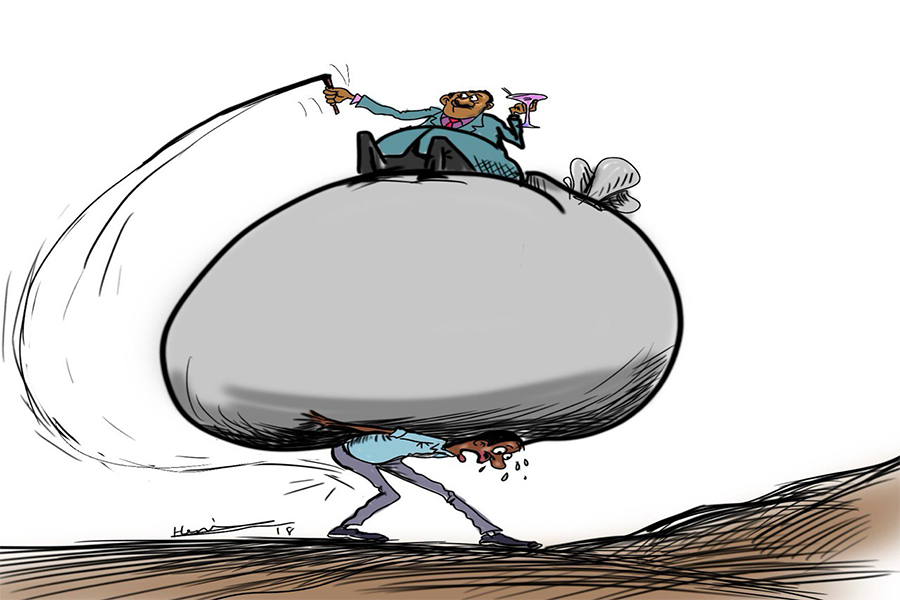
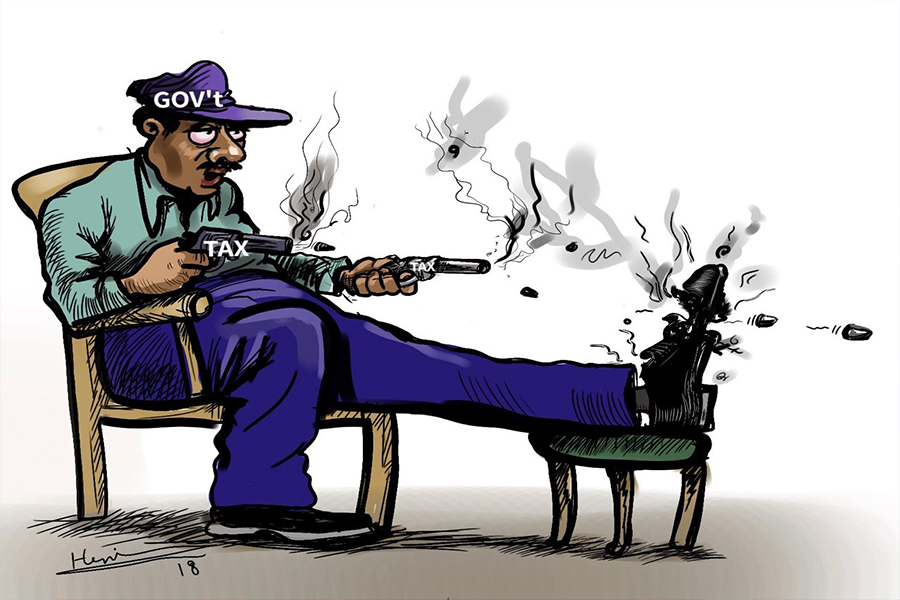
The Ethiopian state appears to have discovered a fiscal instrument that is politically convenient and administratively tempting yet economically burdensome for its citizens. It has gotten itself into an addiction where mandatory contributions behave like a tax while avoiding the name.
Take the latest cybersecurity bill before federal lawmakers, one of a series in the legislative grail, which would extend this model to owners of critical infrastructure, requiring them to finance the protection of systems deemed vital to the economy, national security, and public order. The bill follows a growing legislative pattern in which disaster response, aviation security, telecom access and urban emergency funding are pushed into dedicated fund offices sustained by compulsory payments from citizens, businesses and public institutions.
Ironically, it appears that a seductive logic has emerged from this approach.
Addis Abeba’s emergency fund can serve as a case study in the politics of cumulative extraction. Civil servants surrender a slice of wages, households pay through water bills, firms pay through tax categories, and asset transfers trigger yet more levies. Each charge may appear modest in isolation. Together, they collide with the realities of ordinary life, where rent, food, transport, utilities, school fees, medical bills, taxes and service fees already leave little room for patriotic abstraction.
The federal disaster-response fund extends the same instinct across digital banking, telecoms, insurance, loans, dividends, passport and visa services, trade licences, fuel suppliers and other everyday transactions. This is administratively ingenious, but politically a slippery slope. The more routine the transaction, the easier the collection; the more unavoidable the collection, the more citizens begin to feel less like members of a republic than like subscribers to an overdrawn state.
Granted, Ethiopia faces a widening catalogue of public risks. Cyber threats are real, and aviation security should not be optional. Rural telecom access requires investment. Humanitarian emergencies have grown costlier as foreign aid has become less generous and domestic fiscal space has tightened. No responsible government would pretend that these obligations will disappear because budgets are strained.
Nonetheless, the issue is not whether these public goods matter. They do. The question is whether the state can repeatedly outsource the financing of its core obligations to the same exhausted public without weakening the social contract it claims to defend. A government that cannot protect critical infrastructure, respond to disasters, secure airports or expand basic connectivity without creating separate compulsory charges should admit that it is not merely innovating. It is fragmenting public finance.
The danger lies in the architecture. Dedicated funds are often sold as efficient, targeted and urgent. In practice, they can become fiscal bypass roads. They allow the state to raise money through narrow channels, ring-fence revenues and avoid the harder politics of taxation, prioritisation and accountability.
A tax must be debated as a tax. It must be justified against competing demands. It must sit within the wider fiscal framework.
A “contribution,” by contrast, appears smaller, more technical and more tolerable. But to the household paying through water bills, telecom fees, digital banking charges, insurance premiums, airline tickets or business licence obligations, the distinction is semantic.
This is where public frustration begins. Citizens already carry a heavy burden through formal taxation, indirect taxes, loss of currency parity, and inflationary erosion. They are subject to pay when they earn, consume, transact, travel, and seek basic public services.
The new wave of compulsory contributions adds another layer to an already thickening fiscal crust. Each charge may appear modest in isolation. Together, they form a quiet accumulation of obligations that compresses disposable income and deepens the feeling that every encounter with the state has become an invoice.
Officials may argue that the amounts are small. But small charges are not small when they are frequent, unavoidable, and imposed on households whose incomes have been battered by rising rents, transport fares, school fees, healthcare costs, and food prices.
The claim of macroeconomic stabilisation sits uneasily with the lived experience of families whose monthly budgets no longer balance. A single-digit inflation headline, even when statistically defensible, does not pay rent, refill a prescription or reduce the cost of commuting.
This is the deeper policy failure. Fiscal policy is being designed from the perspective of institutional needs rather than citizens’ household capacity or affordability. The state sees a funding gap and identifies a revenue source. Citizens see the same state collecting more while delivering unevenly. In between lies a breakdown in reciprocity.
Taxation rests on a moral bargain. Citizens surrender part of their income because the state promises public goods such as security, infrastructure, justice, education, health, and stability. Compliance is sustained not only by law but by perceived fairness.
Citizens tolerate high tax burdens only when they see visible returns in public transport, healthcare, education, social protection and institutional reliability. The burden is legitimised by service.
Political leaders and policymakers’ problem is not only that the burden is rising. It is difficult to see the return with comparable clarity. Public schools remain strained. Healthcare is costly and uneven. Housing affordability has become one of the most punishing pressures on urban households. Transport systems are inadequate for the scale of demand. Administrative services remain cumbersome.
Yet, citizens are asked to finance security and access, yet often continue to experience fragility, insecurity and exclusion.
This does not mean public funds are unnecessary. Nor does it mean every dedicated fund is illegitimate. A well-designed emergency fund, transparently governed and professionally audited, can strengthen preparedness. A universal access fund can help close the digital divide. A cybersecurity fund may be defensible if it protects systems whose collapse would hurt the wider economy.
But design matters. So does trust. Without clear governance, independent audit, public reporting and measurable service outcomes, these funds risk becoming fiscal reservoirs into which citizens pour money without knowing what comes out.
There is also a risk of moral hazard. If every risk to the public produces a fund office, and every fund office produces compulsory contributions, the budget ceases to be the main instrument for national priorities.
Ministries and agencies may be encouraged to seek earmarked revenue rather than compete transparently within the budget process. This weakens fiscal discipline. It also fragments accountability. Citizens may know they paid, but not which institution failed, when outcomes do not improve.
The federal government’s fiscal predicament is understandable. Debt pressures, conflict-related spending, declining concessional flows and expanding social demands have narrowed choices. It is being asked to stabilise its macroeconomy while protecting vulnerable citizens and investing in growth.
No government would find this easy. But difficult conditions do not justify opaque instruments. The harder the fiscal environment, the greater the need for transparent prioritisation.
The state should begin by publishing a consolidated account of all mandatory contributions, fees and levies imposed outside the conventional tax structure. Citizens have the right to know the total burden, not merely the purpose of each charge.
Parliament should require every new fund bill to include a fiscal incidence analysis, sunset clauses, annual audit obligations and public performance indicators. Contributions should expire unless renewed after evidence of effectiveness. Fund offices should report not only how much they collect but what changed because they collected it.
More importantly, the Administration of Prime Minister Abiy Ahmed (PhD) should resist the temptation to treat citizens as the first resort for every institutional shortfall. Public spending discipline should come before public fundraising. Wasteful expenditure, weak and unaccountable procurement, inefficient state enterprises and overlapping bureaucracies impose hidden costs as real as any levy.
A state that asks citizens to pay more should first demonstrate that it spends better.
PUBLISHED ON
May 09,2026 [ VOL
27 , NO
1358]
Radar | Apr 05,2026

Viewpoints | Jun 27,2026

Advertorials | May 09,2026
Viewpoints | Dec 20,2025

Advertorials | Jun 12,2023
Editorial | Nov 29,2025
Fortune News | Jul 12,2026

Addis Fortune | Jul 03,2025

Fortune News | Jun 08,2025
Life Matters | May 31,2025

Photo Gallery | 193569 Views | May 06,2019

Photo Gallery | 183463 Views | Apr 26,2019

Photo Gallery | 180288 Views | Oct 06,2021

My Opinion | 145713 Views | Aug 14,2021











Dec 22 , 2024 . By TIZITA SHEWAFERAW
Charged with transforming colossal state-owned enterprises into modern and competitiv...

Aug 18 , 2024 . By AKSAH ITALO
Although predictable Yonas Zerihun's job in the ride-hailing service is not immune to...

Jul 28 , 2024 . By TIZITA SHEWAFERAW
Unhabitual, perhaps too many, Samuel Gebreyohannes, 38, used to occasionally enjoy a couple of beers at breakfast. However, he recently swit...

Jul 13 , 2024 . By AKSAH ITALO
Investors who rely on tractors, trucks, and field vehicles for commuting, transporting commodities, and f...
Aug 22 , 2026 . By BEZAWIT HULUAGER
The forthcoming strategy for interest-free finance will place Sharia-compliant financ...
Aug 22 , 2026 . By NAHOM AYELE
Wegagen Capital Investment Bank (WCIB) has completed its first full year in profit an...
Aug 22 , 2026 . By NAHOM AYELE
Judges at the Federal High Court, sitting on a limited basis to hear only urgent matt...
Aug 22 , 2026 . By BEZAWIT HULUAGER
Federal authorities are about to find out whether they can make a single payment wind...











 Loading your updates...