

My Opinion | Jul 18,2026



Jan 3 , 2026
By Mekala Krishnan , Annabel Farr and Kanmani Chockalingam
In sub-Saharan Africa, the cost of developed-economy standards for protection could reach three percent of projected GDP in exposed areas, a burden about 50pc higher than what governments in the region spent on external debt service in 2024. In this commentary provided by Project Syndicate (PS), Mekala Krishnan, a partner, Annabel Farr, a senior fellow, and Kanmani Chockalingam, a senior fellow at the McKinsey Global Institute, warn that without intervention, the absence of adaptation can reshape economic futures.
Humanity has long learned to live with extreme weather. Much of the Netherlands would be under water were it not for centuries of ingenious adaptation to the constant threat of flooding. Likewise, ancient communities on the banks of the Tigris and Euphrates developed ways to capture and direct excess water to nourish and protect fields.
But the number of places exposed to extreme weather will only grow. According to new research from the McKinsey Global Institute, "Advancing Adaptation: Mapping Costs from Cooling to Coastal Defences", the world spends 190 billion dollars a year on investments in 20 key adaptation measures that protect roughly 1.2 billion people. But three billion more people, over three-quarters of whom live in low-income regions, have only limited protection.
Extending developed-economy standards of protection to all exposed places would require 540 billion dollars annually. That means there is a 350 billion dollar gap, 60pc of which is needed to help low-income areas build greater resilience. Adaptation costs will rise. On current emissions trajectories, the world is likely to reach 2° Celsius above pre-industrial levels by about 2050, exposing an additional 2.2 billion people to heat stress and another 1.1 billion to drought, for example.
Our analysis finds that at 2°C warming, the world would need to spend 1.2 trillion dollars annually to protect everyone exposed to climate hazards at developed-economy standards, or almost one percent of GDP in affected places, by 2050. More than three-quarters of that spending would go toward protecting against heat and drought.
That may sound expensive, but the benefits of that adaptation would exceed the cost by roughly seven times. Air conditioners not only protect but also improve the productivity of indoor workers. Cooling shelters save lives in heat waves. Irrigation prevents crops from dying in hot and dry conditions. Sea dikes shield assets along coastlines from flooding. If deployed effectively, such solutions deliver immense value.
But recognising that adaptation is a good investment does not guarantee that the money will be spent. After all, the world spends only one-third of what is required today, and achieving developed-economy standards of protection at 2°C by 2050 will require 6.2 times as much as what is spent today. A lack of capacity to spend, competing priorities, and collective-action problems all threaten to hamper implementation.
The challenges of scaling up adaptation could look very different in developed and developing countries. For example, the costs would be highest by far in Sub-Saharan Africa, reaching three percent of projected GDP in exposed places, or about 50pc more than governments in the region spent as a share of GDP to service their external debt in 2024. The shares of GDP needed for protection at developed-economy standards by 2°C in the Middle East and North Africa and in India are somewhat lower. In North America, they are lower still, totalling around 0.3pc of GDP in exposed places.
Economic development can help improve the capacity to spend, but even if adaptation spending grew in lockstep with GDP growth, only about 60pc of what is needed would be covered globally at 2°C. If lower-income regions were to increase spending in line with their anticipated economic growth, it would cover only one-quarter of the costs of adapting at 2°C. The presence or absence of adaptation measures can itself influence the pace of economic development. Drought or flooding can slow income growth for smallholder farmers, and heat stress can affect the productivity of outdoor workers.
What can be done, and what role do different actors play?
The good news is that many households can implement some adaptation measures on their own, particularly for heat. If made affordable, solutions like passive cooling (shade and natural ventilation), reflective roofs, fans, or air conditioners can offer meaningful protection in many cases.
But governments also have an important role to play, especially in lower-income areas and communities. They can finance critical infrastructure like coastal protection and establish cooling shelters to protect the public. They can also create incentives to adapt by setting and enforcing standards that enhance resilience, while raising awareness of risks. And they can deploy targeted subsidies or procurement programs to make adaptation more affordable for households and small firms.
At the same time, businesses, particularly large ones, can manage their own exposures, both directly and indirectly through their supply chains. They can also innovate to make adaptation measures more affordable and effective, such as offering better, cheaper cooling systems to address heat stress.
Finally, financial institutions can leverage existing instruments to fund adaptation, such as providing project-level finance for infrastructure like sea dikes. Blended-finance approaches also could prove helpful in bridging viability gaps and attracting private capital, though more work is needed to scale these up. For developing economies, there are also opportunities to integrate adaptation into broader investments relating to energy infrastructure, transportation systems, or urbanisation.
Embedding adaptation early in these projects is far cheaper than retrofitting or rebuilding down the road.
Effective adaptation can strengthen resilience, protect vulnerable communities, and support economic growth. The world has the tools, and the benefits are undeniable. The decisions we make today will shape our ability to thrive in the long term.
PUBLISHED ON
Jan 03,2026 [ VOL
26 , NO
1340]
My Opinion | Jul 18,2026

Films Review | Nov 21,2018
Radar | Mar 21,2026
Sunday with Eden | May 31,2025

Money Market Watch | Jan 17,2026
Fortune News | Aug 18,2024
Fortune News | Nov 02,2025
Fortune News | Nov 24,2024
Radar | Feb 24,2024
Agenda | Aug 25,2024

Photo Gallery | 193371 Views | May 06,2019

Photo Gallery | 183256 Views | Apr 26,2019

Photo Gallery | 180062 Views | Oct 06,2021
My Opinion | 145494 Views | Aug 14,2021







Dec 22 , 2024 . By TIZITA SHEWAFERAW
Charged with transforming colossal state-owned enterprises into modern and competitiv...
Aug 18 , 2024 . By AKSAH ITALO
Although predictable Yonas Zerihun's job in the ride-hailing service is not immune to...
Jul 28 , 2024 . By TIZITA SHEWAFERAW
Unhabitual, perhaps too many, Samuel Gebreyohannes, 38, used to occasionally enjoy a couple of beers at breakfast. However, he recently swit...
Jul 13 , 2024 . By AKSAH ITALO
Investors who rely on tractors, trucks, and field vehicles for commuting, transporting commodities, and f...
Aug 14 , 2026
Aschalew Fetene, known as “Ardi” and admired for his poetic depth, has built a ti...

Aug 8 , 2026
The World Bank asks readers to picture a mother in rural Ethiopia who has never held...

Jul 31 , 2026
Weldu Yiheysh has not read the Pacific temperature charts. He does not need to. In Shibta District of Enderta Wereda, in...
Jul 25 , 2026
Ideally, citizens who have paid income tax all year should not have to reach for thei...
Aug 15 , 2026 . By NAHOM AYELE
Federal prosecutors have charged seven defendants over a set of foreign-trade deals t...
Aug 15 , 2026 . By BEZAWIT HULUAGER
Ethio-post is preparing to turn its thousands of branches into banking agents, allowi...
Aug 18 , 2026 . By BEZAWIT HULUAGER
Kassahun Gofe (PhD), minister of Trade & Regional Integration (MoTRI), is prepari...
Aug 16 , 2026 . By NAHOM AYELE
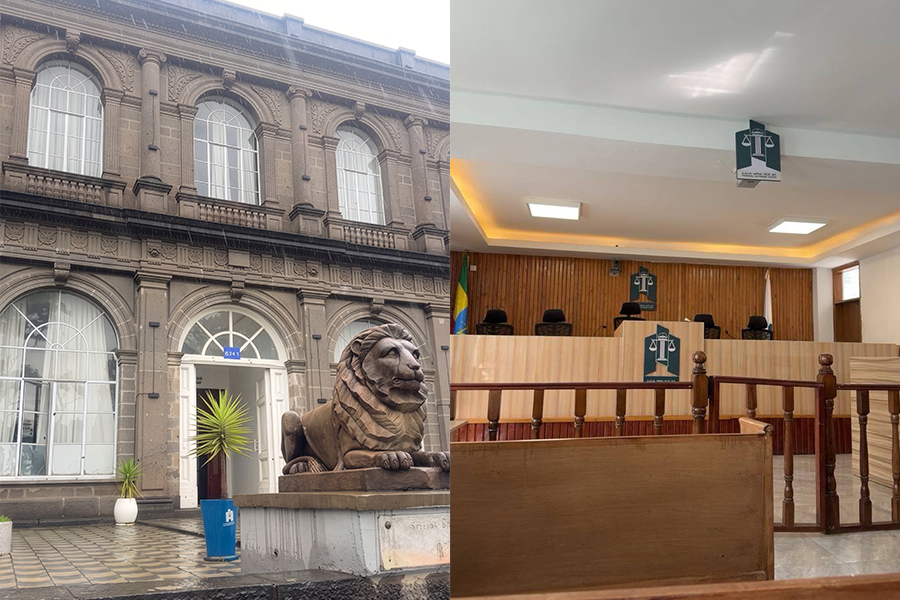
Justices at the Federal Supreme Court widened the shield they are holding over lawyer...





 Loading your updates...