

Commentaries | Dec 13,2025



Jul 9 , 2022
By Mohamed Adow
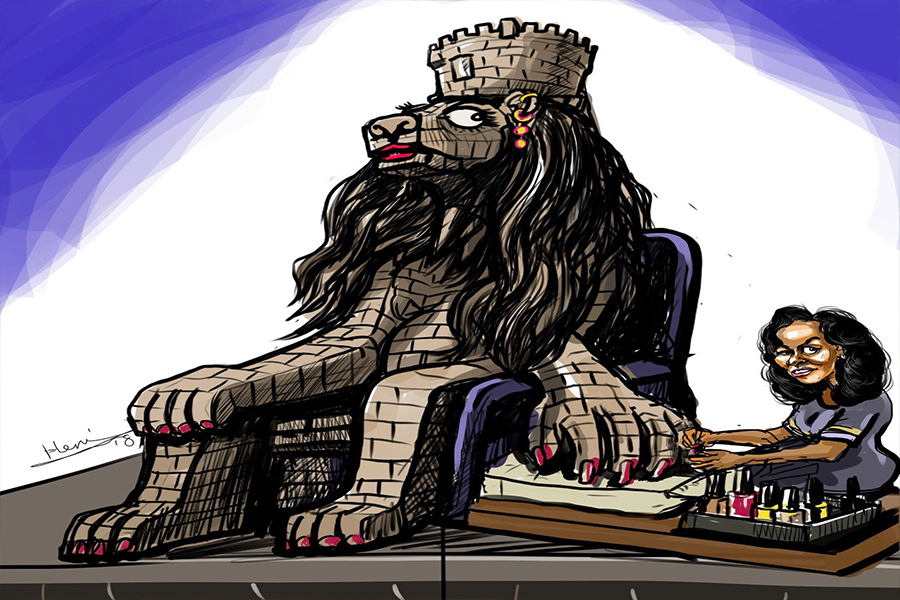
Having been thrust to the front lines of a climate crisis we did not cause, Africans have long urged rich countries to wean themselves off fossil fuels and slash their greenhouse-gas emissions. But, instead of heeding our calls, the rich have remained addicted to oil and gas – much of which, in Europe’s case, has come from Russia. Now they are taking this insult a step further: in their drive to end their dependence on Russian energy, the world’s wealthiest economies are turning to Africa.
Over the past few months, Italian Prime Minister Mario Draghi has been working tirelessly to secure new gas deals with Algeria, Angola, Egypt, and the Republic of the Congo. The closing of every single deal – the terms of which remain opaque – was attended by the CEO of Eni, the largest fossil-fuel company active on the African continent.
In other words, Draghi, a public servant, has been using government resources to deliver overwhelmingly private gains to an Italian company. Similarly, in May, German Chancellor Olaf Scholz started his first official trip to Africa in Senegal, where he announced plans to pursue energy projects “intensively.” Talks on gas extraction and liquefied natural gas (LNG) production have already begun, with Scholz expressing willingness to offer technical investments in power-plant infrastructure in Senegal.
It is not only those seeking to import the continent’s fossil-fuel resources who believe that Africa should extract more of them. Mary Robinson, a former president of Ireland and United Nations high commissioner for human rights, recently argued that Africa should be exploiting its vast natural-gas reserves. Robinson believes this would be just: by boosting energy access and spurring development on the continent, natural-gas extraction would help the hundreds of millions of Africans whom the fossil-fuel system has so far failed.
But, ultimately, what she is advocating is not much different from Draghi and Scholz’s strategy: use European taxpayers’ money to help massive corporations expand gas exploration and exploitation on African lands.
Robinson envisions the gas (and profits) going to Africans, but it is far more likely to be sent to Europe. As the Ugandan climate activist Vanessa Nakate recently pointed out, fossil-fuel development is nothing new for Africa, and it has long failed to reduce energy poverty or bring prosperity. In fact, African economies that depend on fossil-fuel exports suffer slower rates of economic growth – sometimes up to three times slower – than those with diversified economies.
In Mozambique, foreign companies, led by Eni and TotalEnergies, have invested nearly 30 billion dollars in developing offshore natural-gas reserves and LNG capacity. Yet 70pc of people still live without access to electricity.
It is unacceptable, not to mention unjust, that Germany and Italy are pushing African countries to pour their limited financial reserves into developing a fossil-fuel extraction and export industry for European consumers, especially with European demand set to plummet in a matter of years, as investments in renewables come online.
Such investments are an integral part of the European Union’s plan for ending its dependence on Russian energy. The EU now aims to increase renewables’ share of its energy mix to 40pc – or even 45pc – by 2030, and overall gas demand is expected to fall 30pc by 2030. Moreover, Germany and Italy both plan to reach net-zero emissions within the next 30 years. The EU’s new Carbon Border Adjustment Mechanism will further accelerate the transition, as it penalizes countries stuck on fossil fuels.
Oil and gas companies are well aware of the impact this shift will have on their bottom lines. For them, the goal of expanding output in Africa amounts to a cynical effort to squeeze every drop of profit out of their declining industry while they still can. The fact that they will leave African countries holding the stranded assets is just as immaterial to them as their contributions to climate change have been.
Robinson is right about one thing: Africans need access to energy to enjoy lives of dignity. But that is no reason to invest in a system that has already failed – precisely the system from which Europe is trying to wean itself.
Instead, Africa must invest in distributed renewable-energy systems, which would bring true prosperity and security to our continent, rather than poisoning our food, polluting our rivers, and choking our lungs to profit remote shareholders. African climate-justice champions are very clear that we want to avoid locking in planetary catastrophe as much as we want to deliver universal energy access.
Unfortunately, African leaders do not seem to share our commitment to either goal. Rather than using their time with Western leaders to demand support for the renewable-energy transition, Algerian President Abdelmadjid Tebboune and Egyptian President Abdel Fattah el-Sisi agreed to increase oil and gas production and exports to Europe. Senegalese President Macky Sall appears eager to join them, establishing Senegal as a fossil-fuel supplier for Europe.
During centuries of colonial rule, when European leaders told Africa to jump, we asked, “How high?” Now Germany and Italy are telling us to saddle ourselves with fossil-fuel infrastructure that will soon become a drag on our economies and propel us toward climate disaster.
We must respond with a firm no, and instead demand that countries like Germany and Italy, and leaders like Robinson, support us in the development and implementation of renewable-energy systems.
PUBLISHED ON
Jul 09,2022 [ VOL
23 , NO
1158]
Commentaries | Dec 13,2025
Commentaries | May 21,2022
Fortune News | May 03,2026
Viewpoints | Jun 10,2023
Commentaries | May 23,2021
Commentaries | Jun 08,2019
Viewpoints | Oct 04,2025
Radar | Jun 01,2019
Radar | Feb 26,2022
Commentaries | May 31,2020

Photo Gallery | 193778 Views | May 06,2019

Photo Gallery | 183666 Views | Apr 26,2019

Photo Gallery | 180531 Views | Oct 06,2021

My Opinion | 145920 Views | Aug 14,2021






Dec 22 , 2024 . By TIZITA SHEWAFERAW
Charged with transforming colossal state-owned enterprises into modern and competitiv...

Aug 18 , 2024 . By AKSAH ITALO
Although predictable Yonas Zerihun's job in the ride-hailing service is not immune to...

Jul 28 , 2024 . By TIZITA SHEWAFERAW
Unhabitual, perhaps too many, Samuel Gebreyohannes, 38, used to occasionally enjoy a couple of beers at breakfast. However, he recently swit...

Jul 13 , 2024 . By AKSAH ITALO
Investors who rely on tractors, trucks, and field vehicles for commuting, transporting commodities, and f...
Aug 22 , 2026
A record is a strange thing to worry about. Federal trade officials have booked the b...
Aug 14 , 2026
Aschalew Fetene, known as “Ardi” and admired for his poetic depth, has built a ti...

Aug 8 , 2026
The World Bank asks readers to picture a mother in rural Ethiopia who has never held...

Jul 31 , 2026
Weldu Yiheysh has not read the Pacific temperature charts. He does not need to. In Shibta District of Enderta Wereda, in...
Aug 22 , 2026 . By BEZAWIT HULUAGER
The forthcoming strategy for interest-free finance will place Sharia-compliant financ...
Aug 22 , 2026 . By NAHOM AYELE
Wegagen Capital Investment Bank (WCIB) has completed its first full year in profit an...
Aug 25 , 2026 . By NAHOM AYELE
Judges at the Federal High Court, sitting on a limited basis to hear only urgent matt...
Aug 22 , 2026 . By BEZAWIT HULUAGER
Federal authorities are about to find out whether they can make a single payment wind...






 Loading your updates...