
Election 2026 coverage | May 07,2026



Ethiopia's external accounts are under renewed pressure as the National Bank of Ethiopia (NBE) moves to unwind its premium-based role in the artisanal gold market. It has also locked in an interest-rate-anchored monetary regime, even as the war in the Middle East lifts fuel and fertiliser import bills and keeps foreign-exchange backlogs high.
The balance-of-payments position weakened throughout the 2025/26 fiscal year, and policymakers are now leaning on tighter monetary policy, gold-market reform, and front-loaded IMF financing to hold risks in check.
The numbers show a system under load but not yet buckling. Trade deficit narrowed to 12.6 billion dollars by year-end, helped by strong coffee and gold receipts, yet the IMF warned that sustained high fuel prices could complicate the goal of lifting reserves to 3.5 months of imports by the programme's end.
Gross reserves were 5.9 billion dollars, covering 2.1 months of imports at the fiscal-year close, a slim buffer against a conflict-driven import bill, a source of immediate shock.
According to Merid Fikeremariyam, chief executive officer (CEO) of Pragma Capital, the reserves sit well below the medium-term target of 10 billion dollars to 12 billion dollars by 2028, a goal he judged "very tough" unless federal and regional authorities agree on how to share resource revenues.
“The mining proclamation had stalled partly over that dispute,” he said.
He advocated a model in which a dedicated entity buys gold nationwide, channels it to the refinery and exports it, with regional states benefiting in ways that reward formal production rather than political capture.
“Persistent premiums push producers toward the parallel market,” said Merid. “Any new buyer can’t repeat the NBE's practice of paying premiums funded by money creation.”
The war in the Middle East has disrupted trade routes and forced the government onto the spot oil market after a major supplier declared force majeure in March this year. Full-year exports offered partial relief, with coffee and gold projected to earn three billion dollars and 30tns, respectively. But, the IMF cautioned that a prolonged price spike could erase the gains.
The Birr has held in headline terms, depreciating about 1.3pc a month since October 2025, yet foreign-exchange backlogs at banks reached an estimated 1.4 billion dollars by the end of April, a sign of pressure beneath the calm.
The IMF has urged the Central Bank to commit to a long-term exit from the artisanal gold trade by December 2026, to end its role as sole buyer, and to phase out, by September 2026, the five percent to 15pc premium it pays above international prices.
According to Tobias Rasmussen, the outgoing IMF resident representative for Ethiopia, the premium scheme had helped build reserves but caused "significant liquidity injections" that sped up money-supply growth, turning what began as a formalisation tool into a source of macroeconomic risk.
Eyob Tekalign (PhD), governor of the Central Bank, briefing the media last week on the Monetary Policy Committee (MPC), disclosed his intention to shift settlement to private banks gradually.
Officials expect that opening the market to commercial banks and ending the premium will help narrow the parallel foreign-exchange spread, which swung between 10pc and 20pc before easing to about 11pc in late May 2026. Authorities attribute the spread to heavy import taxes, customs duties of up to 35pc, and excise taxes of up to 500pc. Along with bank fees of nearly four percent and the absence of hedging instruments, monetary officials claim that all these have “rewarded smuggling and dollar sourcing outside formal channels.”
The Central Bank has fully lifted the annual cap on private-sector credit growth and consolidated its move to an interest-rate framework anchored by a 15pc policy rate.
“Removing the cap will free finance for productive sectors including manufacturing,” the Governor said. “There is ‘no hidden ceiling’ on credit beyond the reserve requirement.”
IMF staff have advised against legislated sectoral quotas, warning that directed lending could weaken asset quality, and the IMF noted that 20 of 28 banks had already breached the old ceiling by March 2026, a measure of the tension between administrative control and a rules-based regime.
Total disbursements under the IMF arrangement have reached 2.6 billion dollars, with 200 million dollars rephased to ease immediate pressure from the war. Budget support under the fifth review is capped at 130.24 million dollars, while Ethiopian authorities plan to draw a further 390.71 million dollars from the sixth and seventh reviews next year.
Domestic financing is projected to cover 1.3pc of GDP next fiscal year, up from 1.1pc, as the federal government sticks to zero monetary financing of deficits and relies more heavily on the emerging local securities market.
According to the Resident Representative, tax revenue has been among the “brighter outcomes,” consistently beating projections and “creating room for priority spending without inflationary central-bank funding,” though the tax-to-GDP ratio remains below that of peer economies.
Rasmussen, to be replaced by Kyungsuk Lee in August, called the recent measures by the Monetary Committee, among them cutting the Central Bank’s foreign-exchange commission from 2.5pc to 1.5pc and lowering exporters' surrender requirement from 50pc to 30pc, “positive moves toward a more market-friendly system”. He backed holding the 15pc rate, ready to raise it if second-round inflation appears.
Despite the shock of global and domestic nature, real GDP growth for this year is projected at 9.2pc. Banking liquidity has improved after remittance inflows and 14 foreign exchange auctions held by the Central Bank, totalling 2.5 billion dollars over 11 months, though bank backlogs remain sizeable.
The Central Bank and the Ministry of Finance are to finalise NBE’s recapitalisation plan by September 2026, to restore "policy solvency" through “stronger earnings” and the eventual removal of the foreign-exchange commission by June 2028. The plan also envisages a gradual reduction in the NBE's exposure to the Development Bank of Ethiopia (DBE) and other public lenders, which are considered preconditions for a clearer and more credible split between monetary and fiscal roles.
For all the official confidence, independent voices see hard trade-offs.
Merid argued that lifting the credit cap shifts the burden of discipline onto interest rates and bank risk management.
“Most credit already flows to the private sector,” he said, “but higher rates could produce a form of crowding out as borrowing costs rise and banks grow wary of sectors facing security, land and logistics limits.”
He feared that mandating a fixed lending share for manufacturing would run counter to market-driven risk management, and "the market should note that the government should only intervene through policy, not by dictating the price through the market."
Merid urged the government to press ahead with a full exit from fuel subsidies next year and to move the Ethiopian Petroleum Supply Enterprise's (EPSE) pricing to a market basis. But he warned that removing subsidies without reforming income tax would “hurt” salaried workers.
“The current income-tax proclamation is not right," he said, characterising some measures as impoverishing wage earners, and called for tax reform to accompany subsidy removal.
“Revenue doesn’t rest on an extortive tax on salaries,” he told Fortune. “Comparisons with Kenya's system should not justify draconian measures over partial and calibrated ones.”
According to Merid, the DBE and the Commercial Bank of Ethiopia (CBE) need renewed reform, citing CBE's large long-term borrowing from the Central Bank and DBE's need for modern risk management. He pointed to reports that DBE's non-performing loans had reached “very high levels” at one universal bank.
He called for converting CBE's Treasury bonds into Treasury bills at market rates and pushing ahead with bill and bond directives to deepen the securities market. He also urged that restrictions on foreign-currency current accounts be lifted, the gold market be exited, and the NBE be recapitalised in tandem.
“The import-tax burden and the lack of hedging tools should be addressed, and the Monetary Committee’s communication strategy applied consistently,” said Merid.
Automatic fuel pricing and a new property-tax regime are among the reforms Merid expects, though he warned that plans to raise large revenue from motor-vehicle taxes risk misfiring, since many vehicles are government-owned.
Inside the Central Bank, Vice Governor Fekadu Degafe framed the overhaul around a new law that requires the NBE to increase its capital, with the Ministry of Finance injecting fresh capital to enable it to manage reserves independently.
The Vice Governor acknowledged that premiums paid for artisanal gold have affected the Central Bank's finances, but that is “being offset by interest earned” on reserves invested abroad.
"The Bank's statement has improved significantly now because we’re investing and depositing our reserves and earning interest," he told Fortune.
For the Vice Governor, NBE’s recapitalisation and the changes in the gold market turn on three questions.
“How fresh capital is injected, how gold is bought through the banking system, and what a domestic refinery can do to cut costs and build reserves,” Fekadu told Fortune. “The timeline is clear, though the size of the injection is still under study.”
The Central Bank has been buying and exporting gold through the CBE alone, leaving some producers waiting for payment.
"The issue is being through only one bank," he said.
NBE officials are weighing options to allow other banks to participate. However, the Vice Governor rejected a "neoclassical" view that gold exports could be entirely privatised, as coffee has, insisting, "this is not possible and we won't do it."
“Refining at home would cut transport and foreign-storage costs and let the country hold purified gold in its own vaults, to sell when world prices are favourable,” said Fekadu.
The fiscal backdrop is under equal pressure. Finance Minister Ahmed Shide last month detailed a reallocation for the 2026/27 year centred on rescuing the Petroleum Enterprise, with 116.4 billion Br from the treasury to raise its capital as part of a broader 286 billion Br recapitalisation authorised by Ethiopia Investment Holdings (EIH).
The largest share of the recurrent budget, 542.1 billion Br (43.8pc), goes to debt repayment; about 236.4 billion Br (19.1pc) to fertiliser and fuel subsidies and injection for the Enterprise.
The next Monetary Policy Committee meeting is set for September 2026, with officials signalling readiness to tighten the policy rate further if imported fuel and fertiliser keep inflation alive. The credibility of the shift will turn on executing the recapitalisation, exiting gold on schedule and holding tight money, while the reserve target and the federal-regional revenue split are the tests the reforms have yet to pass.
PUBLISHED ON
Jul 19,2026 [ VOL
27 , NO
1368]
Election 2026 coverage | May 07,2026
Radar | Oct 19,2024
Radar | Apr 29,2023
Radar | Jul 25,2026
Fortune News | Apr 03,2023
Radar | Nov 08,2025

News Analysis | Jan 24,2026
Commentaries | Jul 17,2022
Sunday with Eden | Aug 14,2026

View From Arada | Mar 14,2026
Dec 22 , 2024 . By TIZITA SHEWAFERAW
Charged with transforming colossal state-owned enterprises into modern and competitiv...
Aug 18 , 2024 . By AKSAH ITALO
Although predictable Yonas Zerihun's job in the ride-hailing service is not immune to...
Jul 28 , 2024 . By TIZITA SHEWAFERAW
Unhabitual, perhaps too many, Samuel Gebreyohannes, 38, used to occasionally enjoy a couple of beers at breakfast. However, he recently swit...
Jul 13 , 2024 . By AKSAH ITALO
Investors who rely on tractors, trucks, and field vehicles for commuting, transporting commodities, and f...
Aug 22 , 2026
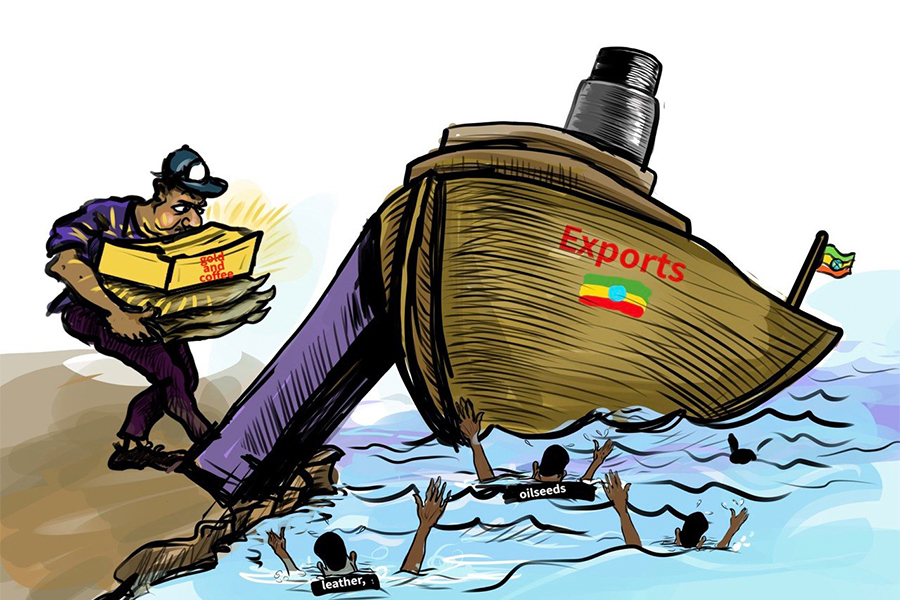
A record is a strange thing to worry about. Federal trade officials have booked the b...
Aug 14 , 2026
Aschalew Fetene, known as “Ardi” and admired for his poetic depth, has built a ti...

Aug 8 , 2026
The World Bank asks readers to picture a mother in rural Ethiopia who has never held...

Jul 31 , 2026
Weldu Yiheysh has not read the Pacific temperature charts. He does not need to. In Shibta District of Enderta Wereda, in...









 Loading your updates...