

Editorial | Mar 14,2026



Jun 21 , 2026
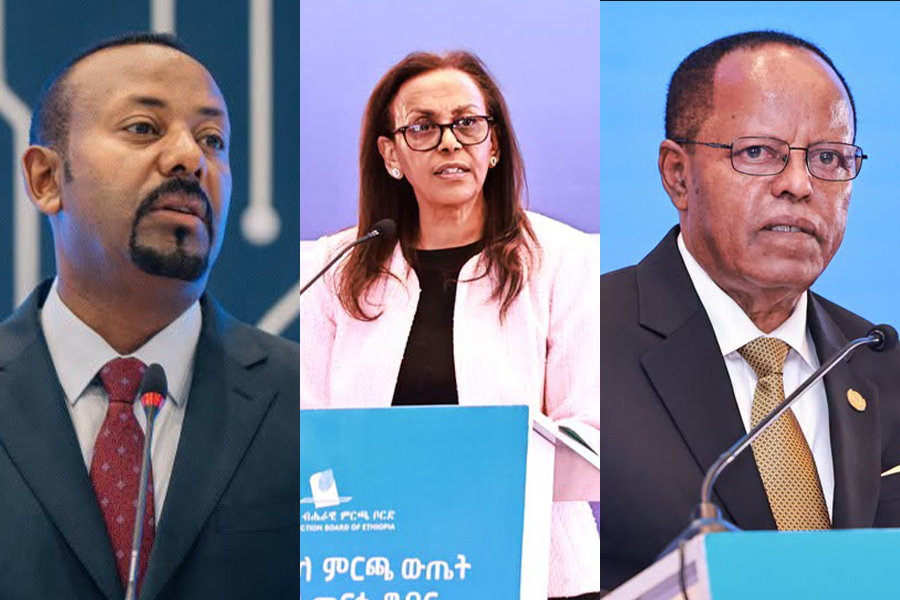
The certification arrived late, long after the printed invitations had promised. Guests had been summoned to the Skylight Hotel Ballroom on African Avenue for 2:00pm, with the official program set an hour later, yet the National Election Board of Ethiopia (NEBE) gave the formal conclusion of the country's seventh general election its decisive form only as the afternoon wore on.
President Taye Atske Selassie and NEBE Chairperson, Melatwerk Hailu, entered the ballroom, shortly before the ceremony opened today, June 21, 2026. By the time the numbers that defined the day were read aloud, the political verdict they confirmed was already familiar, even if the electoral map behind it remained unfinished.
That verdict was another victory for the incumbent Prosperity Party (PP). It secured an overwhelming parliamentary majority, according to results announced by the Board, extending its dominance over federal politics and positioning itself to form the next government from a commanding position in the federal legislative house all regions but the Tigray Regional State. The latter, which commands 38 seats in Parliament, did not see citizens vote due to political deadlock between the federal government and the TPLF, the political force that controls the regional state.
The board declared that the Prosperity Party took 90pc of the parliamentary seats across the 487 of the 547 constituencies whose results were certified, enough to govern for the next five years. Its reach did not stop at the federal contest.
NEBE reported that the incumbent also dominated regional council elections, securing on average more than 80pc of council seats across regional states where voting was conducted, confirming a political landscape in which the ruling party remains the dominant force across much of the country.
The scale of reported participation gave the announcement its most emphatic claim. NEBE disclosed that a little over 54 million voters had registered for the election, with turnout reaching 96.2pc nationwide, a figure the Board and state officials presented as the central measure of a vote that nonetheless still leaves recounts, re-elections and non-participating constituencies unresolved.
The room that received those figures was a gathering of the state's institutional weight. Tadesse Chafo, speaker of the House; Meseret Damtie, auditor general; ambassadors, diplomats, party representatives and election observers. Among the diplomats was Ervin Massinga, United States ambassador to Ethiopia.
Melatwerk opened the proceedings framing the Board's work as conducted under the law and institutional autonomy. Her remarks then moved from institutional defence to personal tribute. She became visibly emotional while paying tribute to electoral workers, singling out Dawit Daniel, a polling station worker who died in an accident while transporting election materials.
The latest outcome, 90pc of parliamentary seats from 487 certified constituencies, marks a second consecutive national election in which the Prosperity Party emerged with overwhelming dominance. The continuity runs deeper than the margins. At least 46 constituencies did not participate in this election, including those in Tigray and parts of Amhara, leaving multiple parliamentary seats vacant, with electoral officials indicating that some may vote at a later date depending on conditions.
That makes the Seventh General Election the second in a row in which not all constituencies were contested, a persistence of postponed or absent voting that points to the continued weight of political instability and security challenges on the electoral process. The election has been certified, but the parliamentary field remains partly incomplete.
The Board declared that the Prosperity Party's majority is large enough to make the outstanding contests unlikely to alter the final outcome, but they leave the final political picture administratively incomplete even as the broad outcome ceases to be in doubt.
Results from 12 constituencies remain subject to recounts, comprising eight parliamentary constituencies, three council-only constituencies and one covering both parliamentary and council elections. Re-elections will be held in a further 11 constituencies, made up of three parliamentary, six council-only and two covering both races.
The result, compared the sixth general election of 2021, when the ruling party won 95pc of the 470 parliamentary seats contested, during a period when conflict engulfed much of northern Ethiopia and voting was postponed in several constituencies.
It fell to the President to deliver the closing speech, and he used it to press the political meaning of the turnout. Taye congratulated electoral officials, political parties and voters, holding up the reported participation as evidence of a strong democratic exercise.
"Others could just wish for such a high voter turnout," he said.
He also directed a message at those he described as “seeking political power outside constitutional means,” stating that the ballot box remains the only legitimate path to political office and that the “results demonstrated” as much.
Editorial | Mar 14,2026

Radar | Apr 15,2023
Fortune News | Nov 09,2024
Fortune News | Mar 09,2024
Sunday with Eden | Jun 21,2025

Fortune News | Feb 18,2026
My Opinion | Jul 25,2026
Fortune News | Apr 15,2023

Advertorials | Sep 18,2025
Fortune News | Dec 15,2024

Photo Gallery | 193346 Views | May 06,2019

Photo Gallery | 183231 Views | Apr 26,2019

Photo Gallery | 180039 Views | Oct 06,2021

My Opinion | 145468 Views | Aug 14,2021





Aug 14 , 2026
Aschalew Fetene, known as “Ardi” and admired for his poetic depth, has built a ti...

Aug 8 , 2026
The World Bank asks readers to picture a mother in rural Ethiopia who has never held...

Jul 31 , 2026
Weldu Yiheysh has not read the Pacific temperature charts. He does not need to. In Shibta District of Enderta Wereda, in...

Jul 25 , 2026
Ideally, citizens who have paid income tax all year should not have to reach for thei...





 Loading your updates...