

Viewpoints | Aug 26,2023



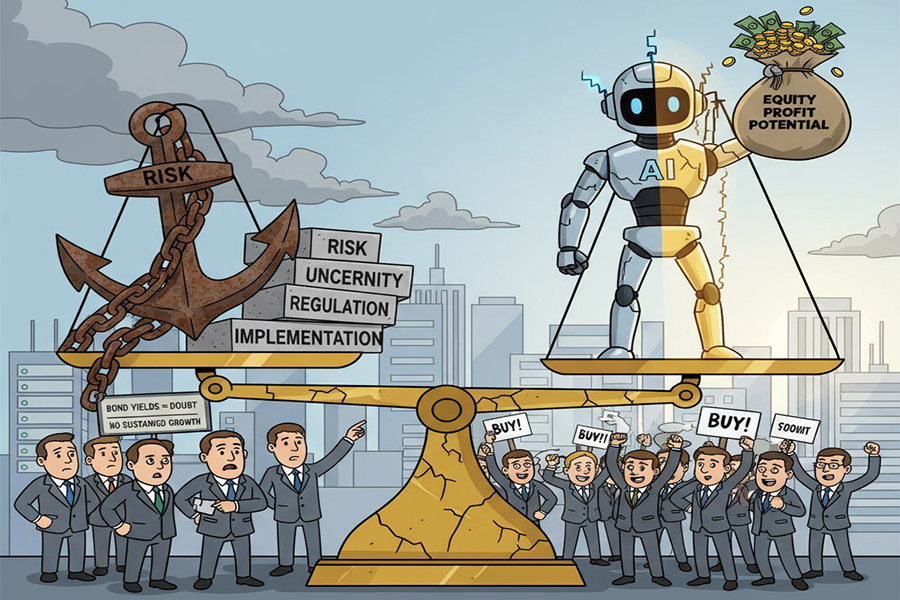
During a recent trip to Kazakhstan, I was struck by people’s enthusiasm for AI. Virtually everyone I encountered, including academics, policymakers, and entrepreneurs, seemed convinced that the technology would help solve thorny challenges, from diversifying the economy away from dependence on natural resources to expanding access to critical services, particularly for remote populations.
I had expected the diffusion of knowledge about AI to be slower, but perhaps their positivity should not have surprised me. After all, the rapid development of AI implies important opportunities for emerging economies.
As the latest United Nations Human Development Report showed, emerging-economy populations are not only well aware of these opportunities but are also more optimistic about the technology than their developed-economy counterparts. In advanced economies, conversations about AI tend to turn immediately to fears of excessive automation, job losses, and labour-market disruption. Emerging-economy populations also worry that AI will bring a wave of automation, but they anticipate even more augmentation and human-machine collaboration.
One might be tempted to highlight the risk of an “AI digital divide,” with high-income countries benefiting disproportionately from the technology, and low- and middle-income countries falling further behind. But such concerns focus on one dimension of the AI revolution. The development of an expanding set of powerful tools to be deployed, say, to advance scientific discovery, increase productivity, generate new products and services, or automate (via agents) complex tasks that involve planning, sequencing, and integration of steps.
Since few countries can fulfil the associated requirements about scale, investment, and infrastructure, such activities are currently taking place largely in the United States and China.
But model-building is not the only game in town. The AI revolution also entails the querying, adaptation, fine-tuning, and deployment of existing tools to solve context-specific problems and accelerate learning. The costs of these activities are much lower, and with the expansion of open-source models, many of which are developed in China, they will continue to decline. As a result, the field is wide open for innovation across a broad range of countries.
While this dimension of the AI revolution is far more accessible, it does require some basic infrastructure, especially a reliable electricity supply and mobile internet connectivity. Accessibility is key, and fast internet as well as affordable data plans are needed, not least to ensure that generating the data that fuels many of the most significant AI applications and use cases. To make a difference, these data should be mobile and shared, so well-designed regulatory structures, which allow for secure data mobility (subject to individual permission or control), are also essential.
India’s Unified Payments Interface, which facilitates secure payments and financial-data exchanges, offers a useful model.
Once these conditions are in place (in many emerging economies, they already are), the possibilities for implementing digital and AI-powered solutions are virtually endless. Such solutions include, for starters, financial services for previously underserved people and businesses.
For people with limited assets, virtually no accessible financial or commercial track record, and, in some cases, limited documentation, accessing financing through traditional channels is prohibitively expensive or simply impossible. But digital tools now offer affordable means to close these information gaps. As the cash economy gives way to digital payment systems, and households and small businesses acquire bank accounts and wallets, the accumulation of data, if well-managed, will solve the anonymity problem.
AI-driven credit assessment can then underpin sustainable, scalable, and profitable versions of microcredit, enabling businesses to grow and hire more people. E-commerce platforms give small businesses access to a larger market and, with the help of AI, a more addressable one, thereby supporting yet more growth, dynamism, and, potentially, innovation.
Such opportunities are not limited to finance and commerce. In healthcare and education, digital applications, many powered by AI, are used to expand access to services, particularly for those who do not live in or near high-density service areas.
AI can also support and accelerate the acquisition of knowledge and skills – the basis of human capital – such as through digital learning assistants. Sustained improvement in human capital is a key ingredient in all successful development stories. Not everyone can access a classroom or tutor, but with the right infrastructure, anyone can talk to a generative-AI model that has read and, on some level, understood the vast digital literature that exists in every field and language. This would have direct effects on productivity, growth, and development.
In certain workplaces, AI can cut down on training time and increase worker productivity. Consider customer service. AI assistants can deliver curated guidance, based on accumulated experience, to inexperienced human agents, thereby accelerating the learning process and enabling agents to deliver better support early. This effect can be achieved in a wide range of jobs and sectors, from nursing to software development.
Emerging economies might not lead the way in building AI models, but they can use the technology to advance their economic- and social-development goals. Fortunately, this is not lost on them. It is exactly what they intend to do.
PUBLISHED ON
Nov 22,2025 [ VOL
26 , NO
1334]

Viewpoints | Aug 26,2023

Life Matters | Mar 07,2026
Viewpoints | Mar 18,2023

Radar | Jul 13,2025
View From Arada | Oct 25,2025

Viewpoints | Jan 18,2025
Radar | May 17,2026

Verbatim | Oct 31,2020
Viewpoints | Jul 20,2019
Viewpoints | Jun 01,2024

Dec 22 , 2024 . By TIZITA SHEWAFERAW
Charged with transforming colossal state-owned enterprises into modern and competitiv...

Aug 18 , 2024 . By AKSAH ITALO
Although predictable Yonas Zerihun's job in the ride-hailing service is not immune to...

Jul 28 , 2024 . By TIZITA SHEWAFERAW
Unhabitual, perhaps too many, Samuel Gebreyohannes, 38, used to occasionally enjoy a couple of beers at breakfast. However, he recently swit...

Jul 13 , 2024 . By AKSAH ITALO
Investors who rely on tractors, trucks, and field vehicles for commuting, transporting commodities, and f...

Aug 22 , 2026
A record is a strange thing to worry about. Federal trade officials have booked the b...

Aug 14 , 2026
Aschalew Fetene, known as “Ardi” and admired for his poetic depth, has built a ti...

Aug 8 , 2026
The World Bank asks readers to picture a mother in rural Ethiopia who has never held...

Jul 31 , 2026
Weldu Yiheysh has not read the Pacific temperature charts. He does not need to. In Shibta District of Enderta Wereda, in...










 Loading your updates...