



.
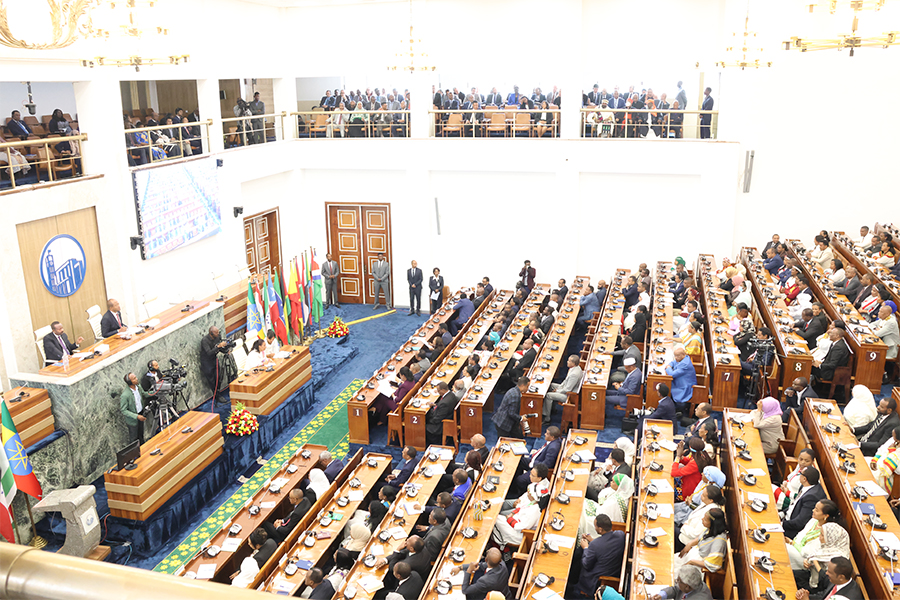
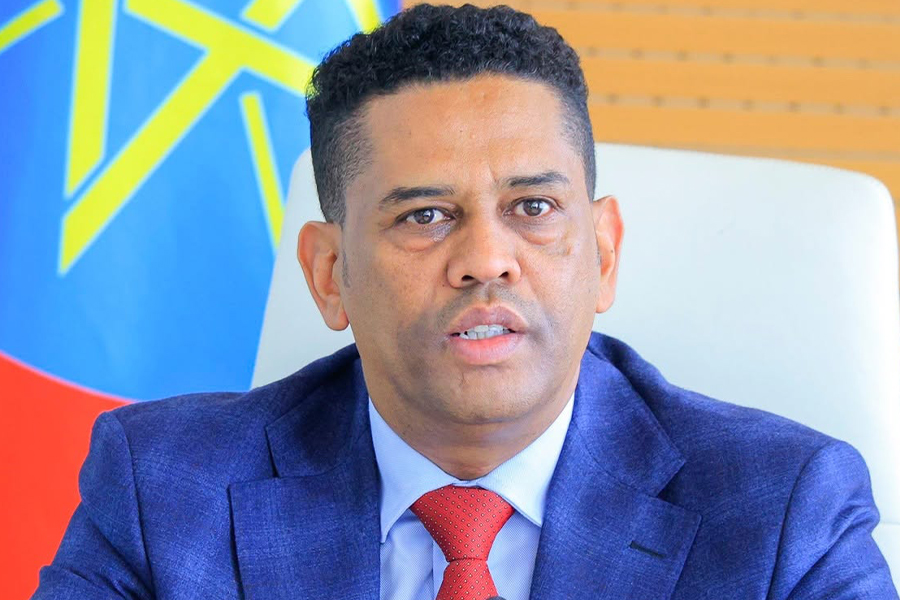
Foreign Minister Gedion Timothewos (PhD) recently spoke for nearly an hour at a foreign Policy forum, held at the Addis Abeba University.
It was an unusual public appearance for an Ethiopian top envoy. Hardly any of his predecessors have had the habit of making a major foreign policy blueprint involving matters of war and peace.
Gedion’s lecture described the Horn of Africa as a region of “turbulence, conflict and insecurity” whose human and natural wealth has been squandered by strife. He devoted most of his address to the relationship with Eritrea, tracing seven decades that swung from federation to war to the long “no-war/no-peace” stalemate that ended only briefly in 2018.
Citing the Eritrea-Ethiopia Claims Commission, the Foreign Minister recalled Eritrean forces “supported by tanks and artillery invaded the town of Badme,” breaking the UN Charter. He blamed Eritrea’s leaders for every collapse in dialogue, including the post-2018 thaw.
Gedion listed five causes of recurring conflict.
He argued that Eritrea wants “the privileges of sovereignty without responsibilities,” pointing to what he called “illicit, predatory, and exploitative trade practices” that began before 1998 and he claimed still persist. He accused outside powers - Egypt is the elephant in the room – for their alleged use of Eritrea to “make Ethiopia bleed.”
The Foreign Minister also said President Isaias Afwerki believes Eritrea’s security depends on Ethiopia’s fragmentation. He portrayed Eritrea as a highly militarised state, its indefinite national service “virtual modern-day slavery,” and its youth fleeing while the government dabbles in human trafficking instead of development.
Lastly, he acknowledged Ethiopia’s bitterness over its landlocked status, warning that a country of more than “130 million” cannot remain out of “durable and secure access” to the sea without courting economic collapse and conflict.
Although Gedion insisted that Addis Abeba exercise restraint even as Eritrean troops remain on Ethiopian soil, his speech laid out ample grounds for what he characterised as self-defence.
Ethiopia, he argued, seeks peace and growth, yet it "can’t be dominated and will not dominate,” proposing regional economic integration, including free trade, shared infrastructure, seamless movement of people and capital, as the alternative to war.
He called Ethiopia and Eritrea “virtually one people,” arguing that common markets could satisfy Ethiopia’s need for port access, and appealed to external powers to press Eritrea to halt provocations. Restraint, he warned, is not infinite.
The address landed in a climate already thick with the anxiety of escalation, at least rhetorically.
In October 2025, Berhanu Jula (Field Marshal), chief of staff of the army, told soldiers that Ethiopia “must have access to the sea,” calling it “unfair” for a “small country of two million people” to control the coastline while “130 million” Ethiopians are locked inland. Ethiopia, he said, has “three goals: peace, development, and a door to the sea.”
Days later, Prime Minister Abiy Ahmed (PhD) told Parliament that sea access was “irreversible.” However, he disavowed war and said he had discussed the issue with Washington, Moscow, Beijing, the African Union, and the European Union (EU).
Eritrea’s Information Minister, Yemane G. Meskel, retorted that leaders in Addis Abeba were engaged in “sabre rattling” and “political doublespeak and duplicity.”
Gedion’s narrative, cataloguing grievances, invoking international law, stressing existential need while promising integration, echoed how states prepare domestic and foreign audiences before drastic moves. The rhetorical pattern is not new.
When Vyacheslav Molotov justified the Soviet Union’s thrust into Poland in 1939, or when Dean Acheson outlined containment before the Truman Doctrine, each framed looming action as forced by history, legality, and national security.
However, the idea that Ethiopia’s survival requires a warm-water outlet long predates the current government.
In the aftermath of the Second World War, the question dominated Allied forces deliberations over Italy’s former colonies. At the 1946 Paris peace gatherings, Ethiopian envoys, guided by the American jurist John Spencer, told the four occupying powers - Washington, London, Moscow and Paris - that “Assab is to us the key that opens the door to progress.”
British administrators such as Stephen Longrigg floated a partition of Eritrea that would attach the Port of Assab to Ethiopia. American officials, eyeing trans-Red Sea aviation routes, leaned in the same direction, but French and Soviet diplomats baulked.
The 1947 treaty with Italy postponed a decision for one year; commissions then criss-crossed Addis Abeba and Asmara, recording petitions and tallying trade costs, yet split the same way. Britain and the United States favoured Ethiopian access; France and the Soviet Union wanted trusteeship.
When deadlock pushed the matter to the United Nations in 1949, Ethiopia circulated a booklet titled “Our Inalienable Right to the Sea,” quoting Emperor Hailesellasie’s pledge, while an Italian-backed committee lobbied for neutral supervision.
In a key committee session, Secretary of State John Foster Dulles declared, “From the viewpoint of justice and practicality, it would be inappropriate to deny Ethiopia its reasonable access to the sea.” Britain echoed him.
Statistics underpinned Ethiopia’s case. Ninety-eight percent of its exports had moved by sea but paid 100pc of port fees in Djibouti. U.S. economists projected savings of up to 20pc of export value if shipments ran through the Port of Assab.
The French had warned that Ethiopia lacked funds to modernise the port without external loans, an implicit plea for continued European leverage, but the numbers were not disputed.
An anecdote captures the passion. In a 1946 hallway at the French Ministry of Foreign Affairs in Paris, a British delegate asked Emperor Haile Selassie whether Ethiopia would accept joint control of Assab. The Emperor, adjusting the fez he wore that day, replied through an interpreter: “A shared key does not open the door at dawn if the other holder sleeps late.”
The quip, preserved in a British aide-mémoire, distilled the insistence on full sovereignty over a maritime outlet.
The coalition widened when several Latin American and Middle Eastern states swung behind the Anglo-American line. In December 1950, the General Assembly voted to federate Eritrea to Ethiopia, effective in 1952.
When the UN vote passed, Ethiopia’s delegation cabled Addis Abeba, quoting Psalm 126: “They that sow in tears shall reap in joy,” yet cautioned that “implementation demands vigilance.”
Aklilu Habtewold, one of the most revered senior officials serving the Emperor, who played the biggest role in federating Eritrea with Ethiopia, had resisted the growing temptation in Addis Abeba to abrogate the UN resolution to dissolve the federation.
History justified him and others who had issued the warning. The federation collapsed, leading to 30 years of collective agony and suffering. No one benefited from one of the longest-fought insurgencies on the continent.
Eritrea eventually gained independence, and the argument over Assab resurfaced in the 1998-2000 war. What unfolded since shaped the Foreign Minister’s policy speech, which could be called “The Gedion Doctrine.”
The Gedion Doctrine outlines Ethiopia’s attempt to frame its longstanding grievances and ambitions in a language of integration and legality. By recounting the history of conflict, accusing Eritrea of proxy behaviour and state abnormality, and emphasising Ethiopia’s demographic pressure, it crafts a narrative that positions sea access as an existential right.
The Doctrine proposes economic integration as a solution, but pairs it with warnings about Eritrea’s behaviour and Ethiopia’s right to self-defence.
The Gedion Doctrine could be interpreted as both a diplomatic opening, signalling willingness to integrate, and a preemptive justification for more forceful action.
In the current climate of hostile rhetoric, whether the Doctrine heralds war depends on how both countries and the international community keep the delicate balance between Ethiopia’s demands and Eritrea’s sovereign rights.
However, misdiagnosis and oversimplification can lead to avoidable conflicts. Whether the ongoing tension leads to negotiated corridors, economic co-dependence, or another war depends less on diplomatic eloquence than on circumstance and restraint, qualities the Horn of Africa has seldom enjoyed in tandem.
PUBLISHED ON
[ VOL
, NO
]

Viewpoints | Jun 27,2026
Radar | Nov 09,2024

Fortune News | Aug 27,2022

View From Arada | Aug 13,2022

My Opinion | Jun 28,2025

Fortune News | May 17,2026
Fortune News | Jul 07,2024

Viewpoints | Jun 20,2026

View From Arada | May 30,2026

Radar | Feb 03,2024

Photo Gallery | 193424 Views | May 06,2019

Photo Gallery | 183320 Views | Apr 26,2019

Photo Gallery | 180128 Views | Oct 06,2021
My Opinion | 145559 Views | Aug 14,2021










Dec 22 , 2024 . By TIZITA SHEWAFERAW
Charged with transforming colossal state-owned enterprises into modern and competitiv...

Aug 18 , 2024 . By AKSAH ITALO
Although predictable Yonas Zerihun's job in the ride-hailing service is not immune to...

Jul 28 , 2024 . By TIZITA SHEWAFERAW
Unhabitual, perhaps too many, Samuel Gebreyohannes, 38, used to occasionally enjoy a couple of beers at breakfast. However, he recently swit...

Jul 13 , 2024 . By AKSAH ITALO
Investors who rely on tractors, trucks, and field vehicles for commuting, transporting commodities, and f...
Aug 15 , 2026 . By NAHOM AYELE
Federal prosecutors have charged seven defendants over a set of foreign-trade deals t...
Aug 15 , 2026 . By BEZAWIT HULUAGER
Ethio-post is preparing to turn its thousands of branches into banking agents, allowi...
Aug 18 , 2026 . By BEZAWIT HULUAGER
Kassahun Gofe (PhD), minister of Trade & Regional Integration (MoTRI), is prepari...
Aug 16 , 2026 . By NAHOM AYELE
Justices at the Federal Supreme Court widened the shield they are holding over lawyer...










 Loading your updates...