

Viewpoints | Nov 14,2020



Mar 7 , 2026
By ANISHA CHUGH , LAURA LEONELLI and Teresa Zapeta Mendoza
Across the Global South, donor governments’ cuts to foreign aid are being followed by familiar domestic measures, such as benefit caps, pay freezes, and subsidy cuts. Women losing jobs, services, protections, and households are absorbing wider economic hardship. Close to 708 million women are outside the labour force due to care responsibilities. It is unpaid work that keeps systems running, yet often sits outside the ledger.
Across the Global South, painful austerity measures such as benefit caps, pay freezes, and subsidy cuts have followed donor governments' recent cuts to foreign aid. The policy shift has had an especially dramatic impact on women, costing them jobs, services, and protections. And, it is causing widespread economic hardship in many developing countries.
Against this backdrop of shortsightedness, "Give to gain," the theme of this year's International Women's Day, reminds us that investing in women yields outsize returns. As former World Bank President Robert B. Zoellick once put it, "Gender equality is the right thing to do. And it is also smart economics."
Budgets are never neutral. Policy choices, from supporting extractive industries to weakening health systems, can erode women's livelihoods, augment the burden of unpaid care work, and increase poverty rates. Today, 708 million women are outside the labour force because of care responsibilities, reflecting policymakers' failure to recognise or value such work.
The International Monetary Fund (IMF) has found that gender-responsive budgeting improves resource allocation and transparency by shifting financing away from harmful policies and toward priority areas such as income support for survivors, childcare, and workplace safety. If national budgets do not account for women's rights, fiscal frameworks will continue to create vulnerabilities.
Women's rights begin with physical security. In 2016, the United Nations Women estimated that gender-based violence cost roughly 1.5 trillion dollars a year, or around two percent of global GDP at the time. Intimate partner violence alone can drain 1.2pc to 3.7pc of GDP, more than many countries spend on education. And workplace harassment and violence against women cause six trillion dollars in global losses each year.
With the right strategies, policymakers can stem these losses and deliver shared gains. But a major obstacle is that women's rights organisations, which are best positioned to address gendered poverty and violence, face persistent funding gaps. When frontline groups lose flexible and multiyear core support, reform efforts fall short.
Providing grants to organisations that are working to dismantle barriers to decent work, economic participation, and social equality is a proven solution. With direct funding, these trusted community groups can co-design projects, respond quickly to emerging needs, ensure that essential services are maintained, support informal workers, and mobilise collective action that drives lasting structural change. This is what "give to gain" looks like in practice.
Examples of such interventions abound. The African Women's Development Fund supports rural women's groups on the continent in contesting land grabs and building cooperatives to raise incomes. In Latin America and the Caribbean, Fondo de Mujeres del Sur supports domestic workers' unions and income-generating cooperatives for former women inmates to improve access to labour rights and decent employment. The Women's Fund Asia complements efforts by migrant and informal workers to organise for fair wages and social protection. The International Indigenous Women's Forum finances campaigns to defend indigenous territory, sustain local economies, and preserve natural ecosystems.
These four women's funds manage Leading from the South, a feminist philanthropic alliance dedicated to applying this grassroots model to solve challenges that traditional aid donors often overlook. By offering patient capital for core costs, LFS bolsters continuity, which is essential to philanthropic effectiveness. This allows local organisations to look beyond immediate needs, build on cross-border learning, systematise services, and turn pilot projects into policies.
To ensure that gender equity, protection, and justice are at the core of economic policy, donors should realign their investments accordingly. This means ensuring that women's rights organisations, which currently receive well under one percent of official development assistance (and only 0.4pc of all gender-focused aid in recent years), obtain a significant share of the funding that is allocated for gender in the form of multiyear, flexible grants.
Adequate funding and platforms like LFS, with their cross-border collaboration and grassroots infrastructure, can facilitate investment where it is needed most. For example, investment in Indigenous women's leadership and economic autonomy is particularly important, given their critical role in safeguarding biodiversity and protecting land for future generations.
To this end, donors should condition their headline pledges on allocating certain percentages to core funding, Global South-led groups, and programs focused on delivering care, safety, and access to support. Frameworks for measuring the impact of gender-responsive budgeting should feature indicators that can show improved outcomes for gender-based violence, such as survivors' uptake of income support and enforcement of safe workplaces.
Policymakers, for their part, should focus on institutionalising gender-responsive budgeting. All ministries should adopt budget markers that show how spending advances gender equality; review the impact of government spending, with the results made public; and allocate a meaningful share of tax revenue and public spending more broadly toward closing the care gap and expanding women's access to assets. That means expanding benefits for survivors of domestic violence, such as income assistance, childcare, and safe transport, and categorising them as essential services.
Lastly, they should collaborate with feminist organisations to co-design policy and track outcomes.
The economic case for boosting investment in women's rights organisations, and for ensuring that financing and budget decisions strengthen women's safety and autonomy, has long been settled. According to the World Bank, every dollar spent on empowering adolescent girls in Africa could generate a tenfold return on investment. Investing in women's rights is not charity. It is a form of giving that generates outsize gains for all.
PUBLISHED ON
Mar 07,2026 [ VOL
26 , NO
1349]
Viewpoints | Nov 14,2020
Viewpoints | Apr 06,2024
Commentaries | Oct 23,2021
Viewpoints | Jul 01,2023

Radar | Jan 21,2023

Radar | Dec 27,2025
Fortune News | May 24,2021
Radar | Sep 11,2020
Radar | Oct 20,2024

Photo Gallery | 193593 Views | May 06,2019

Photo Gallery | 183493 Views | Apr 26,2019

Photo Gallery | 180316 Views | Oct 06,2021

My Opinion | 145741 Views | Aug 14,2021


Dec 22 , 2024 . By TIZITA SHEWAFERAW
Charged with transforming colossal state-owned enterprises into modern and competitiv...

Aug 18 , 2024 . By AKSAH ITALO
Although predictable Yonas Zerihun's job in the ride-hailing service is not immune to...
Jul 28 , 2024 . By TIZITA SHEWAFERAW
Unhabitual, perhaps too many, Samuel Gebreyohannes, 38, used to occasionally enjoy a couple of beers at breakfast. However, he recently swit...
Jul 13 , 2024 . By AKSAH ITALO
Investors who rely on tractors, trucks, and field vehicles for commuting, transporting commodities, and f...
Aug 22 , 2026
A record is a strange thing to worry about. Federal trade officials have booked the b...
Aug 14 , 2026
Aschalew Fetene, known as “Ardi” and admired for his poetic depth, has built a ti...

Aug 8 , 2026
The World Bank asks readers to picture a mother in rural Ethiopia who has never held...

Jul 31 , 2026
Weldu Yiheysh has not read the Pacific temperature charts. He does not need to. In Shibta District of Enderta Wereda, in...
Aug 22 , 2026 . By BEZAWIT HULUAGER
The forthcoming strategy for interest-free finance will place Sharia-compliant financ...
Aug 22 , 2026 . By NAHOM AYELE
Wegagen Capital Investment Bank (WCIB) has completed its first full year in profit an...
Judges at the Federal High Court, sitting on a limited basis to hear only urgent matt...
Aug 22 , 2026 . By BEZAWIT HULUAGER
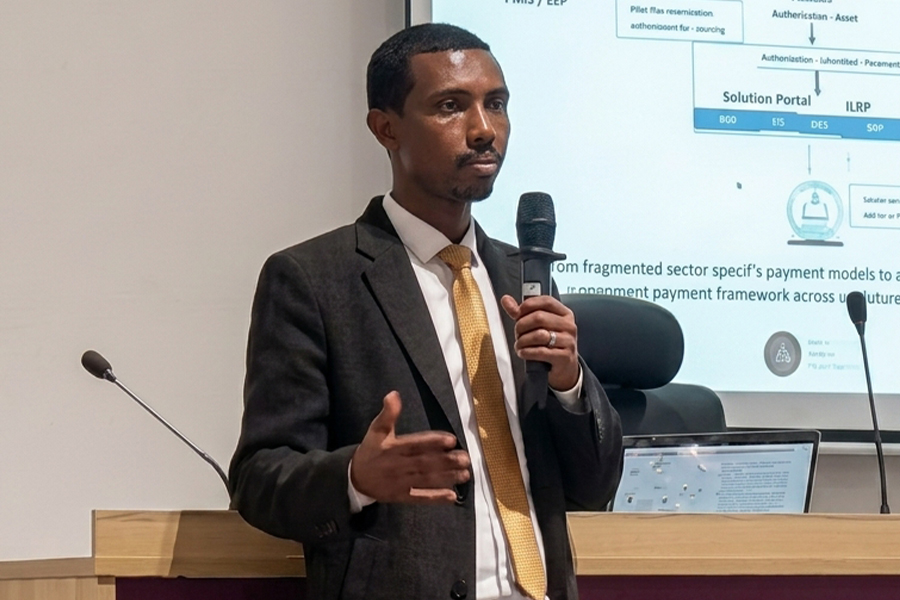
Federal authorities are about to find out whether they can make a single payment wind...






 Loading your updates...