

Editorial | Jul 25,2026



May 9 , 2026
By Mesay S. Nasir
For the new traffic laws to work, the country needs roads that speak to users, moving beyond warning signs toward infrastructure such as raised crossings, textured surfaces, and narrower lanes. Forgiving design assumes that pedestrians may cross at the wrong moment and that drivers may misjudge distances. The goal is to build a network where these mistakes do not lead to fatalities. Physical barriers and self-explanatory layouts make speeding feel uncomfortable and wrong, guiding behaviour through design rather than simply the threat of a ticket, argued Mesay S. Nasir (mesay.shemsu@aait.edu.et), a lecturer at the School of Civil & Environmental Engineering, College of Technology & Built Environment, Addis Abeba University.
For decades, Ethiopia’s roads have been described through the language of fate. The dominant word has been "accident," a term that softens responsibility and connotes a sudden and unavoidable misfortune.
The new thinking behind road safety rejects that comfort. It treats crashes not as random events, but as the outcome of choices in infrastructure design, law enforcement and public policy. The human body can absorb only a limited amount of kinetic energy. When a fast-moving vehicle hits a pedestrian, a cyclist or another object, the force can quickly exceed what the body can survive. That is why specialists frame crashes as a public health and design problem, not merely a matter of individual blame.
This is the basis of the "Safe System" approach. Its core idea is "forgiving design." People make mistakes, with drivers misjudging distance, pedestrians crossing at the wrong moment, cyclists moving through traffic and passengers forgetting to fasten restraints. A safe road network assumes these failures will happen and is built so that a lapse does not become a death sentence. Speed management, physical barriers, safer crossings and road layouts that explain themselves to users are all part of that logic.
Transport authorities are now trying to give this philosophy legal force through a traffic regulation issued in 2024. It is intended to replace a fragmented and reactive system with a more unified, preventive standard. It codifies stricter speed limits, mandatory safety restraints and a national demerit point system. More importantly, it signals that safety is not only the duty of drivers. It is shared by those who design roads, manage cities, enforce rules and use the transport system.
The harder question is whether the law can work across the country's varied regional realities. Its first tests are now visible in cities, freight corridors and post-conflict communities, where modern policy is meeting uneven capacity, local habits and infrastructure often not built with vulnerable road users in mind.
A multi-stakeholder coalition is working hard to reap the fruits of implementing the new regulation.
There is the Road Safety Insurance Fund Services (RSIFS), the federal lead agency for road safety under the Ministry of Transport & Logistics (MoTL). It is the guardian institution for regulations, public policy, and investment in road safety. The Addis Abeba University has also proven instrumental in providing scientific expertise and technical support for the RSIFS. Such technical support, in the form of road crash data and risk factor analysis, has formed the evidence base for the new regulation.
The two institutions have found a financier for this crucial initiative in the Global Road Safety Partnership (GRSP).
Together with the federal entities, regional transport agencies and regional universities have also joined this effort. Experts selected from Dire Dawa, Mekelle, Bahir Dar, and Hawassa universities have also joined Addis Abeba University to assist the transport authorities in their respective regions with all manner of technical and scientific activities that support the enforcement of the regulation. This is probably the first time universities are working in close coordination with government agencies at a national scale to effect change in road safety.
How are different areas of the country doing in enforcing the regulation?
Dire Dawa shows the promise and the limits of the new order. The city is a logistics hub where heavy freight traffic meets narrow urban streets and traditional animal-drawn carts. Its administration has pushed enforcement into the digital age by integrating traffic fine management with Telebirr. This has created a more transparent system, reduced room for informal handling of fines and generated data that can help authorities understand driver behaviour.
Yet Dire Dawa also exposes a gap between the law’s ambition and the tools available to enforce it. Breathalysers needed to detect alcohol impairment are scarce. Radar guns needed to capture "Special Grade" speeding violations are also in short supply. The result is a regulatory paradox. The law now demands precise, technology-backed enforcement, while officers on the road still rely heavily on observation. Some of the most dangerous conduct, therefore, remains difficult to measure, prove and punish.
In Amhara Regional State, the problem appears more direct. Speed is the central threat, where nearly all recorded violations involve speeds well above the legal limit, while more than half reach extreme levels that would sharply raise the chance of death in a crash. Regional transport officials have identified a "speeding culture" as a public-health danger in dense urban or market areas. Their response has focused on the "Safe Speeds" pillar of the "Safe System." They are establishing 30Km/h speed limits around schools and markets in cities such as Bahir Dar and Gondar.
For pedestrians, the risk of death rises steeply as impact speed moves from 30Km/h toward 50Km/h. A modest increase on the speedometer can mean a drastic change in survival. The experiment is not simply about ticketing drivers but separating fast traffic from people least able to survive a collision.
The Sidama Regional State offers a different lesson. There, road safety is treated as a social contract and a legal obligation. In partnership with Hawassa University, the Regional State has deployed the Road Accident Data Management System (RADMS), using Geographic Information Systems (GIS) to map "black spots" where crashes are more likely to occur. This allows the authorities to focus on high-risk locations, including the Gelana River bridge, rather than relying solely on broad patrols.
The approach is important because it brings several institutions into the same frame. Police, health professionals, educators and insurers all have roles in reducing crashes and managing their consequences. The model of the Sidama Regional State demonstrates that the 2024 regulation would gain force when communities see it not only as a punitive instrument of the state but also as a shared safeguard for lives, household incomes, and regional productivity.
The Tigray Regional State demonstrates another dimension of enforcement, aligning road safety practices with benchmarks set by the World Health Organisation (WHO) during post-conflict recovery. The new regulation’s attention to pedestrians and wheelchair users is especially relevant because it places some of the most vulnerable people on the road within the protection of the law rather than outside its practical concern.
But the Regional State also reveals a weakness that extends beyond one region. Equipment standards remain uneven. Cycling is deeply rooted in the region, yet many cyclists do not wear helmets. Many motorcyclists who wear helmets use construction-grade headgear rather than certified motor-safety equipment, creating a false sense of "compliance." A person may appear to obey the rule while receiving little of the biomechanical protection the rule is supposed to provide.
Turning the federal regulation into a life-saving system will require more than legal text. National and regional authorities need major investment in enforcement technology because a rule that cannot be measured cannot be managed. Breathalysers, speed cameras and radar guns should not be viewed as luxuries. They are the instruments that convert a written standard into a credible deterrent.
The country also needs roads that guide behaviour instead of merely warning against danger. In low-speed zones, signs alone are unlikely to be enough. Narrower lanes, raised crossings, textured surfaces, and other self-explanatory infrastructure can make speeding feel uncomfortable and wrong. The private sector also has a role. Certified helmets, child restraints and other safety gear should be affordable and available.
Import tax exemptions for traffic safety equipment deserve consideration because the fiscal cost is likely to be outweighed by the lives saved and injuries avoided.
The goal is a transport system that moves toward zero fatalities. That will require scientific discipline, institutional persistence and a willingness to confront old habits. The shift from "accident" to "forgiving design" is a test of whether every safe kilometre and every enforced speed limit can spare families grief and turn roads into pathways of progress rather than corridors of tragedy.
PUBLISHED ON
May 09,2026 [ VOL
27 , NO
1358]

Editorial | Jul 25,2026

Radar | Dec 04,2022

Radar | Mar 21,2026

News Analysis | Jan 31,2026

Fortune News | Mar 21,2026
Radar | Feb 28,2026
Radar | Dec 15,2024
Money Market Watch | May 23,2026
Radar | Oct 27,2024
Delicate Number | Jul 15,2023

Photo Gallery | 193375 Views | May 06,2019

Photo Gallery | 183260 Views | Apr 26,2019

Photo Gallery | 180069 Views | Oct 06,2021

My Opinion | 145501 Views | Aug 14,2021







Dec 22 , 2024 . By TIZITA SHEWAFERAW
Charged with transforming colossal state-owned enterprises into modern and competitiv...

Aug 18 , 2024 . By AKSAH ITALO
Although predictable Yonas Zerihun's job in the ride-hailing service is not immune to...

Jul 28 , 2024 . By TIZITA SHEWAFERAW
Unhabitual, perhaps too many, Samuel Gebreyohannes, 38, used to occasionally enjoy a couple of beers at breakfast. However, he recently swit...

Jul 13 , 2024 . By AKSAH ITALO
Investors who rely on tractors, trucks, and field vehicles for commuting, transporting commodities, and f...

Aug 14 , 2026
Aschalew Fetene, known as “Ardi” and admired for his poetic depth, has built a ti...

Aug 8 , 2026
The World Bank asks readers to picture a mother in rural Ethiopia who has never held...

Jul 31 , 2026
Weldu Yiheysh has not read the Pacific temperature charts. He does not need to. In Shibta District of Enderta Wereda, in...
Jul 25 , 2026
Ideally, citizens who have paid income tax all year should not have to reach for thei...
Aug 15 , 2026 . By NAHOM AYELE
Federal prosecutors have charged seven defendants over a set of foreign-trade deals t...
Aug 15 , 2026 . By BEZAWIT HULUAGER
Ethio-post is preparing to turn its thousands of branches into banking agents, allowi...
Aug 18 , 2026 . By BEZAWIT HULUAGER
Kassahun Gofe (PhD), minister of Trade & Regional Integration (MoTRI), is prepari...
Aug 16 , 2026 . By NAHOM AYELE
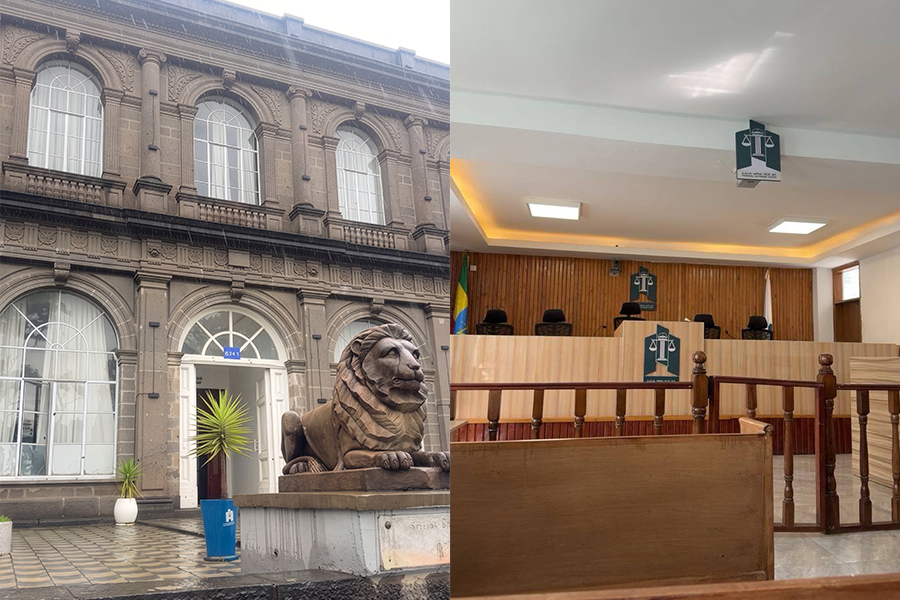
Justices at the Federal Supreme Court widened the shield they are holding over lawyer...





 Loading your updates...