
Verbatim | Apr 20,2019



May 16 , 2020
By Christian Tesfaye
This month has been attended by developments that point to an escalation of antagonism in the political space.
We saw this as a number of opposition parties came out to reject the options presented by the government for extending the time in office of lawmakers past what is stipulated constitutionally. They claimed that the Constitution has no answers on what happens in the event that an election cannot be held and argued that they should have as much a share in governing as the current lawmakers come September.
In effect, they argued that they should be put in charge of the army, the police, the bureaucracy and tax administration, among other things, in, essentially, a power-sharing deal with Prime Minister Abiy Ahmed (PhD). They promised that this is not an effort to grab power but an opportunity for creating a grand bargain.
After the Derg, a supposedly transitional military government, and the four-year-long interim government in the early 1990s, the opposition parties believed that the third time would be the charm and the output would be legitimate.
The Prime Minister, on the otherhand, gave a televised statement recently to dissuade any notions of a transitional government. He rightly argued that there is a constitutional way out of the current conundrum. Unfortunately, he seemed to believe that this political and constitutional problem could only be addressed legally. He failed to stress that, without the opposition on board, it may mean very little in the eyes of the public, regardless of the details of the plan.
For a government that will be getting to extend its time in office, it should have been more humble. Indeed, the circumstances justify what the lawmakers and the administration are doing, but as representatives that would add perhaps a year to their time in office, they should have offered to bring in the opposition at least as an organised consulting body.
Instead, the opposition and the government find themselves on the opposite spectrum of the same political space – a cliché in Ethiopian political history. What is more daunting is the militant tone of rhetoric that is being employed. It is without a doubt symptomatic of Ethiopia’s politics, but it is no less astounding to see it in action time after time.
The political discourse, which had tapered off for a few months as COVID-19 took the attention away in almost every bit of public life, is back in its full, ugly form.
The politicians, as we can see from the statements and interviews they give out, are once again angry and deterministic. If it is not their way, they are then sure that it will end in absolute chaos.
They have brought back the militancy in their advocacy. This is the only way they know how to engage. They understand that there is no currency, not even attention, to be gained from being sober-minded. Sensibility is for losers they seem to be saying. They are here to win, and they will do whatever they can to get us to sympathise with their respective causes, at almost any expense.
If the only way they can get their point across is by making us become suspicious of our neighbours, they are not above doing it.
They say they are militant in their discourse because they care and feel so passionately. But this is, in fact, done without remorse for the public, without the concern that the scariest thing of all is their constant rhetoric of war.
They are not trying to engage or make a point. They are trying to frighten one another into submission. This is what has become of political discourse in Ethiopia over almost half a century of exercise.
There is an academic discussion taking place, but what the masses are exposed to is what is on the surface, the mainstream expression of political views. All one could get from the latter is a heavy dose of cynicism, a simplistic overview of history and a misunderstanding of political theory.
There is, for the most part, nothing new here. What we need as a country is a reinvention of our politics and a new generation of politicians that are not informed by the old, and largely male, remnants of the student movement of the late 1960s and early 1970s. We need a new breed of politicians who are less idealistic but also far less cynical about the possibility of a progressive and ordered society.
This, I admit, is a lot to ask for.
PUBLISHED ON
May 16,2020 [ VOL
21 , NO
1046]

Verbatim | Apr 20,2019

My Opinion | Mar 19,2022

Life Matters | Jul 04,2026
Sunday with Eden | Jan 25,2020
Fineline | Dec 14,2019

Life Matters | Dec 24,2022
Sunday with Eden | Nov 21,2018
Viewpoints | Sep 06,2020

Agenda | Dec 06,2025
Fortune News | Jan 21,2023

Photo Gallery | 193880 Views | May 06,2019

Photo Gallery | 183776 Views | Apr 26,2019

Photo Gallery | 180676 Views | Oct 06,2021
My Opinion | 146022 Views | Aug 14,2021







Dec 22 , 2024 . By TIZITA SHEWAFERAW
Charged with transforming colossal state-owned enterprises into modern and competitiv...

Aug 18 , 2024 . By AKSAH ITALO
Although predictable Yonas Zerihun's job in the ride-hailing service is not immune to...

Jul 28 , 2024 . By TIZITA SHEWAFERAW
Unhabitual, perhaps too many, Samuel Gebreyohannes, 38, used to occasionally enjoy a couple of beers at breakfast. However, he recently swit...

Jul 13 , 2024 . By AKSAH ITALO
Investors who rely on tractors, trucks, and field vehicles for commuting, transporting commodities, and f...

Aug 28 , 2026
Every year, the Ministry of Education (MoE) sets a national examination. Every year,...
Aug 22 , 2026
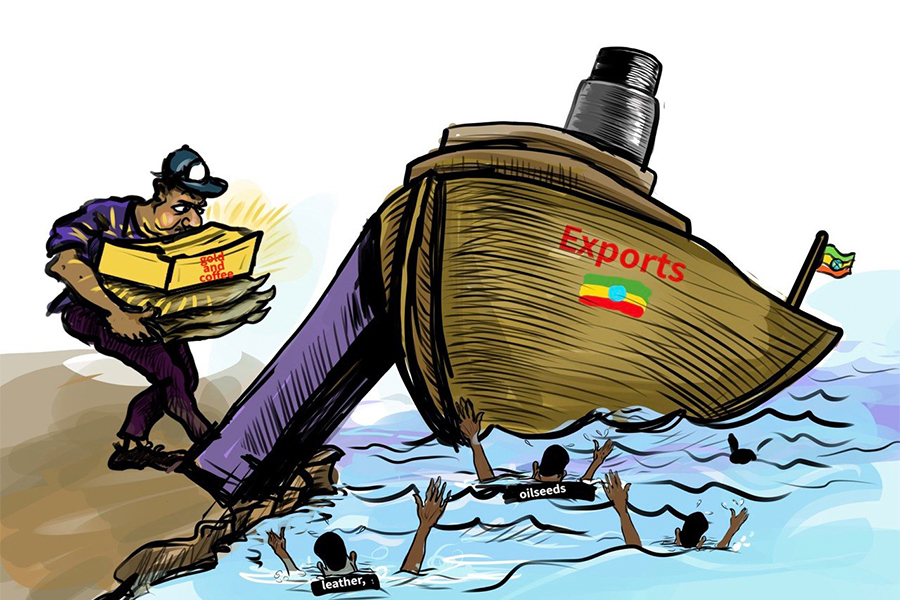
A record is a strange thing to worry about. Federal trade officials have booked the b...
Aug 14 , 2026
Aschalew Fetene, known as “Ardi” and admired for his poetic depth, has built a ti...

Aug 8 , 2026
The World Bank asks readers to picture a mother in rural Ethiopia who has never held...
Aug 29 , 2026 . By BEZAWIT HULUAGER
The federal government is increasingly relying on Treasury bills (T-bills) to repay T...
Aug 29 , 2026 . By NAHOM AYELE
Judges on a Federal High Court bench have ordered D'Afrique, one of Addis Abeba's old...
Sep 1 , 2026 . By BEZAWIT HULUAGER
The Ministry of Revenues wants to know not just who a taxpayer is but almost everythi...
Aug 29 , 2026 . By BEZAWIT HULUAGER
Electricity supplied from Ethiopia has helped halve Djibouti's power production costs...






 Loading your updates...