

Viewpoints | Sep 08,2024



Feb 4 , 2023
By Andrew Sheng , Xiao Geng
Unless the world's leading powers credibly commit to a more cooperative and inclusive future, teh world may find living an irrevocably divided, roiled by climate change, and hurtling toward global conflict, warn Andrew Sheng, a distinguished fellow at the Asia Global Institute at the University of Hong Kong; and, Xiao Geng, a professor and director of the Institute of Policy and Practice at the Shenzhen Finance Institute at the Chinese University of Hong Kong, Shenzhen.
At the latest annual meeting of the World Economic Forum in Davos, United Nations Secretary-General Antonio Guterres offered an unusually frank assessment of the international order's current predicament. With the world "plagued by a perfect storm on a number of fronts," he said, "we need cooperation, yet we face fragmentation."
The perfect storm is better likened to a tsunami. Its components – including supply-chain disruptions, an energy crunch, a cost-of-living crisis, slowing global growth, and a lurch toward climate disaster – are all at least partly consequences of the tectonic rift between China and the United States.
If what Guterres calls the "Great Fracture" plays out, the world will have "two different sets of trade rules, two dominant currencies, two internets, and two conflicting strategies on artificial intelligence." The costs would be tremendous. World GDP would shrink by 1.5pc, or more than 1.4 trillion dollars in annual terms; prices would rise virtually across the board; and the delivery of global public goods would be severely diminished.
It is not difficult to understand why.
Since the end of World War II, the world has been reaping unprecedented peace dividends. With the US overseeing a relatively stable rules-based world order, globalization took off, enabling Europe's post-war recovery in the 1950s and 1960s, the East Asian miracle in the 1970s and 1980s, Central and Eastern Europe's development in the 1990s and 2010s, and China's precipitous economic rise.
While this transformation was enabled by US global leadership, it also gradually diluted American hegemony, as other countries rose to prominence. This dynamic helps to explain the backlash in the US against globalization and the countries that have benefited from it. Americans who felt left behind romanticized the era of US-centered unipolarity, and blamed "revisionist" rising powers – especially China – for supposedly eroding their prosperity. This set the stage for the Great Fracture.
But the East-West split is not the only rift jeopardizing our collective future. Guterres also highlighted the risks raised by the deepening North-South divide, noting that inhabitants of the wealthier North seem not to grasp "the degree of frustration and even anger in the Global South." After all, while the North enjoys all the benefits of industrialization and cutting-edge technology, the resource-endowed South remains beset by poverty and instability, not least to colonialism's legacy.
In fact, S&P Global Vice Chairman Daniel Yergin casts the North-South divide as fundamentally an energy-transition challenge. From the coal-fueled Industrial Revolution to the electricity-enabled Information Age, energy has been integral to the West's rise to global dominance. Now, the North is seeking to shift away from fossil fuels, without sacrificing the wealth gained from its past emissions, while urging the South to pursue climate-friendly development.
"The new North-South divide," Yergin concludes, "reflects disagreement over climate and transition policies, their impact on development, and who is responsible for cumulative and new emissions and who pays."
This illustrates a broader reality: the interests of the North's smaller, wealthier, aging populations diverge sharply from those of the larger, poorer, younger populations of the South. Most countries in the Global South attempt to avoid taking sides in geopolitical conflicts – most notably in the Sino-American rivalry – because they are more concerned with ensuring their own development. For these countries, the senseless East-West conflict appears set to lead to mutual assured deflation, if not to mutual assured destruction. So, they try to stay out of it.
But the South cannot escape the consequences of the North's actions. For example, just as the Ukraine War left Europe scrambling for alternative energy supplies, it has created major food and fertilizer shortages in the Global South. As Western (or Western-led) institutions increase environment-related conditionality on development funding, the South may be forced to look elsewhere.
If the Great Fracture is completed, if nuclear powers lock horns in a hot war, and if the North fails to get its climate house in order, the South will become collateral damage. After all, no country in the Global South – not even India – has the economic, political, or military heft to challenge the North.
The global North often touts its democratic credentials. But the case for democracy is founded on the system's ability to represent diverse opinions, cultures, and values – not only those of the wealthiest or most powerful. If the world order is to survive, it will have to function essentially as a global democracy – and that means balancing the needs and priorities of the North with those of the South.
At the same time, closing the East-West rift is crucial. The Great Fracture implies a vicious cycle: when we externalize blame for our problems, we divert valuable resources away from effective solutions, exacerbating the problems and increasing the amount of wasted resources. This reduces our chances of addressing the interconnected challenges we face – not least climate change – while raising the risk of conflict.
Given this, it is good news that Chinese Vice Premier Liu He recently met with US Treasury Secretary Janet Yellen to discuss restoring macroeconomic policy cooperation between the two countries. But national-security hawks still dominate the global agenda, so defense considerations continue to distort economic policy. Unless the world's leading powers credibly commit to a more cooperative and inclusive future, we may find ourselves living in an irrevocably divided world, roiled by climate change, and hurtling toward global conflict.
PUBLISHED ON
Feb 04,2023 [ VOL
23 , NO
1188]
Viewpoints | Sep 08,2024
Commentaries | Jul 25,2026
Commentaries | Nov 22,2025
Commentaries | Aug 30,2025
Viewpoints | Apr 13,2024
My Opinion | Oct 28,2023
Radar | Jul 29,2023
Commentaries | Oct 15,2022
Radar | Jun 18,2022

Viewpoints | Jun 24,2023

Photo Gallery | 193687 Views | May 06,2019

Photo Gallery | 183581 Views | Apr 26,2019

Photo Gallery | 180421 Views | Oct 06,2021

My Opinion | 145835 Views | Aug 14,2021








Dec 22 , 2024 . By TIZITA SHEWAFERAW
Charged with transforming colossal state-owned enterprises into modern and competitiv...
Aug 18 , 2024 . By AKSAH ITALO
Although predictable Yonas Zerihun's job in the ride-hailing service is not immune to...

Jul 28 , 2024 . By TIZITA SHEWAFERAW
Unhabitual, perhaps too many, Samuel Gebreyohannes, 38, used to occasionally enjoy a couple of beers at breakfast. However, he recently swit...
Jul 13 , 2024 . By AKSAH ITALO
Investors who rely on tractors, trucks, and field vehicles for commuting, transporting commodities, and f...
Aug 22 , 2026
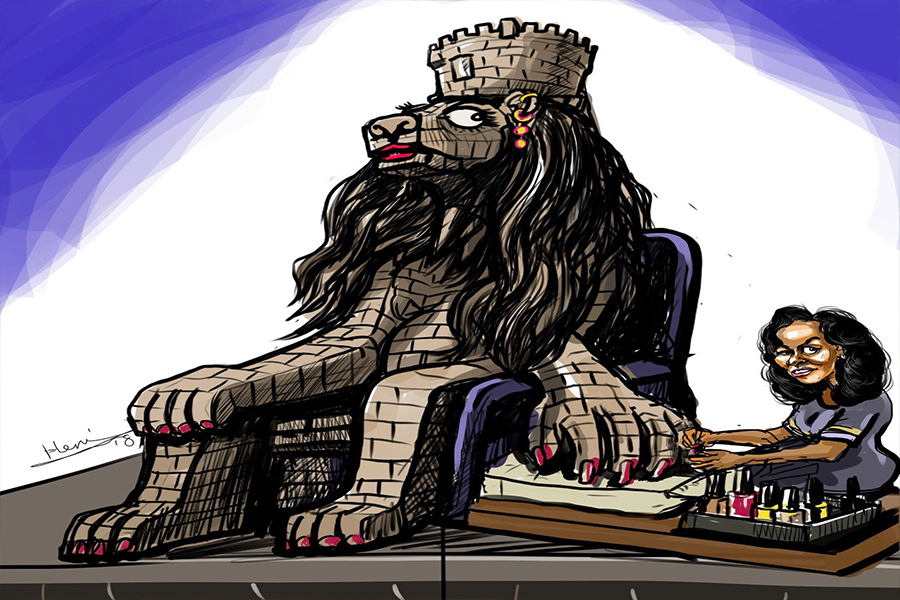
A record is a strange thing to worry about. Federal trade officials have booked the b...
Aug 14 , 2026
Aschalew Fetene, known as “Ardi” and admired for his poetic depth, has built a ti...

Aug 8 , 2026
The World Bank asks readers to picture a mother in rural Ethiopia who has never held...

Jul 31 , 2026
Weldu Yiheysh has not read the Pacific temperature charts. He does not need to. In Shibta District of Enderta Wereda, in...
Aug 22 , 2026 . By BEZAWIT HULUAGER
The forthcoming strategy for interest-free finance will place Sharia-compliant financ...
Aug 22 , 2026 . By NAHOM AYELE
Wegagen Capital Investment Bank (WCIB) has completed its first full year in profit an...
Aug 25 , 2026 . By NAHOM AYELE
Judges at the Federal High Court, sitting on a limited basis to hear only urgent matt...
Aug 22 , 2026 . By BEZAWIT HULUAGER
Federal authorities are about to find out whether they can make a single payment wind...







 Loading your updates...