



Oct 4 , 2025
By Kidist Yidnekachew
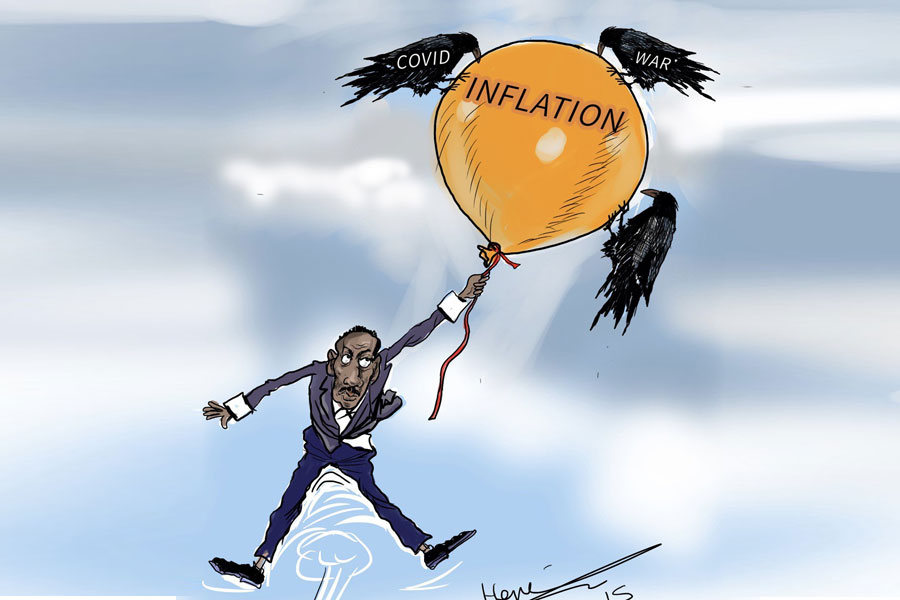
Inflation has blurred the line between choice and extortion in daily life. Identical goods vary in price by hundreds of birr, while high-end consumption soars unchecked. From a 25,000 Br grocery bill to a 313 Br spice bottle, absurdity defines the marketplace. Democracy feels hollow where survival is uncertain. A regulated market emerges as not only economic necessity but moral obligation.
From daily observations I can no longer ignore, one truth has become impossible to shake: the very structure of our economic life needs urgent rethinking. What passes for progress today feels less like growth and more like escalation, a capitalism so manic it no longer creates a gap between rich and poor but digs a canyon. The wealthy are scaling financial Everests, while the rest of us remain stranded in the valley, fighting over the dust.
Let’s not pretend we are immune to the allure of sudden wealth. If an ethical shortcut to comfort existed, a potion, a golden ticket, we would all be in line, myself included. But reality offers no such spell. Instead, what we have is a system that allows a handful to squeeze unimaginable profits out of basic necessities, fueling inflation that burns everyone else alive.
We have long accepted the small fluctuations of price as part of market rhythm. Five to fifty birr here or there makes sense. Taxes, brands, and genuine quality justify variation. But what we now witness, particularly with everyday goods, has moved far beyond normal market play. Identical items, same fabric, same stitching, appear in neighboring shops with prices that differ by hundreds of birr. This isn’t competition. It is opportunism dressed up as business. A merchant’s unrestrained pursuit of margin has become indistinguishable from daylight robbery.
It forces a hard question: what is the point of wealth if its only expression is opulence? The cars, the compounds, the boutiques, they tower above a workforce whose sweat and labor form the foundation of every fortune. Across Addis Abeba, high-end stores multiply, signaling profits for some but nothing but exclusion for most. The absurdity stings most in small, ordinary moments. When a school uniform shirt for my son cost 750 birr in one shop and 350 in another, the difference felt less like choice and more like economic vandalism. And so the question presses: why does the government not step in to stabilise prices of essentials?
Everyday life now carries a price tag that feels surreal. I remember when flowers could be bought for under 1,000 birr. Recently, I overheard an arrangement selling for 7,000. A few days later, I watched a man at the supermarket casually pay 25,000 Br for a holiday grocery run; more than many earn in a month. Meanwhile, I found myself agonising over a 313 Br bottle of spices. That, I thought, was the height of absurdity, until reality kept finding ways to raise the bar.
The middle class, once a stabilising pillar, now feels like a ghost. We drift between indignation and resignation, trapped in a system where even survival feels precarious. I would happily forgo the fantasy of becoming individually rich for a society where the majority can live decently. There comes a point where hoarding fortunes in the face of mass struggle ceases to be just greedy, it becomes corrosive, a moral failure that erodes the fabric of community itself. What dignity exists in eating a gourmet meal while your neighbor starves?
This is why the market must be reined in. Before inflation became a daily chokehold, I believed democracy was the ultimate measure of freedom. Yet what is free speech to someone who cannot afford food or shelter? The stomach protests louder than the tongue. Until basic survival is secured, rights remain abstract luxuries, hollow in practice.
So yes, if it came to choosing between expressing my opinions and affording to live, I would pick survival. That is how urgent the moment feels. And it brings us to the words so many recoil from: capitalism, command economy, communism.
We are living in capitalism, a system built on private ownership and driven by profit and competition. Its darker truth is plain: capital climbs upward while labor is squeezed downward. In contrast, a command economy, where the state regulates production, pricing, and distribution, offers at least a framework of stability and equity. And communism, while often dismissed as utopian, imagines a society without class divides, where need determines distribution rather than greed.
Perhaps communism in its pure form is beyond reach, and capitalism in its pure form is proving a ruthless master. But a heavily regulated economy, where price stability is treated as social necessity rather than sacrilege, should not be dismissed. Watching neighbors fall into debt over school uniforms and groceries makes the argument plain.
We must stop treating regulation as an enemy of growth. Stability itself is justice. Unless the economy begins to work for the majority, the game we are all forced to play will no longer be worth its entry fee.
PUBLISHED ON
Oct 04,2025 [ VOL
26 , NO
1327]

Featured | Apr 22,2022
Fortune News | Aug 09,2025
Money Market Watch | Feb 15,2026

Fortune News | Jan 14,2023
Fortune News | Jun 24,2023

View From Arada | Nov 14,2020
Agenda | Nov 22,2025

Commentaries | Mar 25,2023
Editorial | Dec 04,2022
Radar | Mar 09,2019

Photo Gallery | 193424 Views | May 06,2019

Photo Gallery | 183320 Views | Apr 26,2019

Photo Gallery | 180128 Views | Oct 06,2021

My Opinion | 145559 Views | Aug 14,2021









Dec 22 , 2024 . By TIZITA SHEWAFERAW
Charged with transforming colossal state-owned enterprises into modern and competitiv...

Aug 18 , 2024 . By AKSAH ITALO
Although predictable Yonas Zerihun's job in the ride-hailing service is not immune to...

Jul 28 , 2024 . By TIZITA SHEWAFERAW
Unhabitual, perhaps too many, Samuel Gebreyohannes, 38, used to occasionally enjoy a couple of beers at breakfast. However, he recently swit...

Jul 13 , 2024 . By AKSAH ITALO
Investors who rely on tractors, trucks, and field vehicles for commuting, transporting commodities, and f...

Aug 14 , 2026
Aschalew Fetene, known as “Ardi” and admired for his poetic depth, has built a ti...

Aug 8 , 2026
The World Bank asks readers to picture a mother in rural Ethiopia who has never held...

Jul 31 , 2026
Weldu Yiheysh has not read the Pacific temperature charts. He does not need to. In Shibta District of Enderta Wereda, in...

Jul 25 , 2026
Ideally, citizens who have paid income tax all year should not have to reach for thei...
Aug 15 , 2026 . By NAHOM AYELE
Federal prosecutors have charged seven defendants over a set of foreign-trade deals t...
Aug 15 , 2026 . By BEZAWIT HULUAGER
Ethio-post is preparing to turn its thousands of branches into banking agents, allowi...
Aug 18 , 2026 . By BEZAWIT HULUAGER
Kassahun Gofe (PhD), minister of Trade & Regional Integration (MoTRI), is prepari...
Aug 16 , 2026 . By NAHOM AYELE
Justices at the Federal Supreme Court widened the shield they are holding over lawyer...






 Loading your updates...