

Photo Gallery | 192822 Views | May 06,2019



Jul 18 , 2026.
Pressed in Parliament on jobs and household incomes, Prime Minister Abiy Ahmed (PhD) offered a striking diagnosis. Jobs exist, he asserted; the workforce is missing.
Ethiopians, he went on, should get used to holding two or three jobs through shift work to lift their incomes. It is a vision of a busier and more productive country.
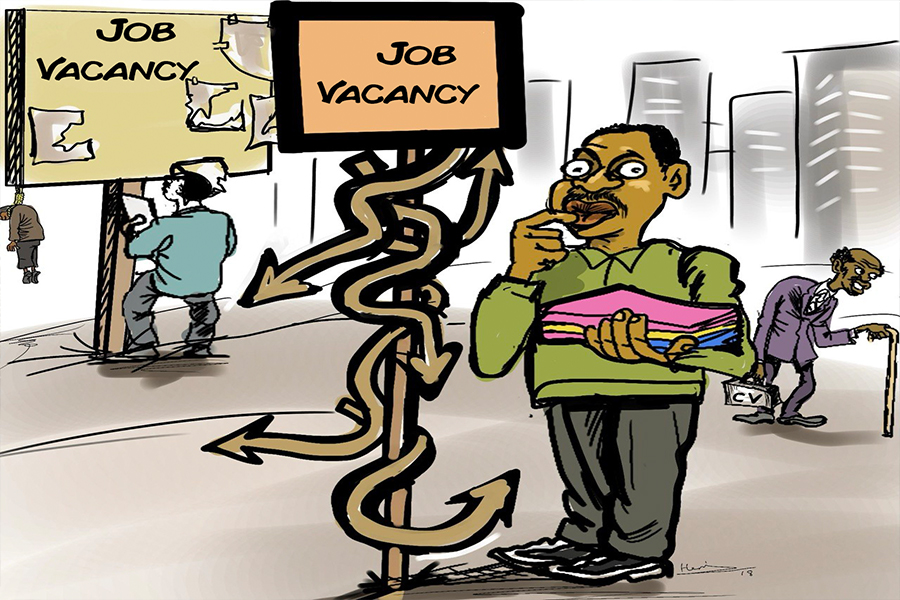
The reality is a labour market that turns education into waiting, vacancies into frustration and abundant labour into scarce productivity. The paradox is real, but it is not a mystery, and urging people to work three jobs mistakes a system failure for a shortage of effort.
Consider the engineering graduate, interviewed by a researcher a couple of years ago, who described his working life as a bricklayer. His degree was in engineering; his days were filled with earthworks, drainage ditches, sheds, and cobblestones.
Employers told the same researcher that recruits who looked impressive on paper often could not manage simple tasks without one to six months of retraining. Graduates retorted that jobs went through family circles, and that engineers ended up in sales, hotel reception or storekeeping.
This is Ethiopia's labour market in miniature. Workers say there are no jobs; employers say there are no workers. In a country with a youthful population, a long queue of graduates and millions unemployed, underemployed, or trapped in subsistence work, construction firms, factories, banks, hotels, and technology businesses still struggle to find people who can perform from day one.
Managers complain of weak technical preparation, poor communication, a lack of problem-solving and little initiative. Workers reply that firms demand experience they were never allowed to gain, pay wages eroded by inflation and recruit through closed networks. Both sides may be telling the truth.
The contradiction dissolves once unemployment is separated from employability.
A person can be educated yet lack job-ready skills; a vacancy can exist yet pay too little to accept; a capable worker can live too far from information, lack the fare for transport, or fail to signal competence. Ethiopia does not merely have too few jobs or too few skills. It has a broken matching system sitting atop weak labour demand, uneven schooling and a volatile economy.
The employment rate grew from 70pc in 1999 to 75pc in 2013, then slid to 61pc by 2021, according to an estimate from the International Growth Centre. Agriculture's share of jobs fell from 45pc to 31pc; services increased from 20pc to 25pc, too little to absorb the displaced. Manufacturing, the supposed engine of transformation, stayed stuck at around four to five percent. Labour left the farm, but productive industry was not there to receive it.
Higher education, meanwhile, outran the economy's ability to use it. The country went from two universities in the 1990s to 44 by 2016, and 46 this year. Undergraduate enrolment nearly doubled, from 420,387 in 2009 to over 800,000 in 2026, with policy steering 70pc of students into science and technology.
Quantity became a political triumph, while quality became somebody else's problem. The country minted credentials without the laboratories, workshops, internships, career guidance and employer involvement to make them mean something.
A subtler failure surfaces in the capital. Sifting more than 20,000 online applications in Addis Abeba, researchers found over 70pc of jobseekers applying for posts for which they were overqualified.
Employers prized experience and soft traits such as integrity, teamwork and reliability, while applicants advertised degrees and intelligence. The result was not only a skills gap but a language gap, each side using its own definition of merit and blaming the other when hiring failed.
Firms want workers already trained; few will pay to train them. Graduates cannot gain experience without work, or work without experience. This is not a skills market but a revolving door with no entrance.
The waiting exposes the human cost. At Debre Markos University's Burie campus, graduates waited an average of 44 weeks for a first full-time job, with a median of 35 weeks; after 78 weeks, 38.6pc were still searching. Internships lifted prospects, grades mainly helped survive the first cut, and only four percent became self-employed.
A degree sold as a bridge to prosperity had become a ticket to a queue that itself eroded skill, confidence and bargaining power.
Neither are employers innocent bystanders. Many are faulted for relying on informal referrals, hazy job descriptions and unrealistic wish lists. A job fair experiment that brought together 1,006 job seekers and hundreds of firms produced many meetings but only 76 offers, of which 14 were accepted.
It revealed not an absence of people or posts, but clashing expectations and poor information, which only costly contact began to correct.
Nor is refusal mere idleness. In the control group of one urban experiment, only 30pc of the employed held permanent positions, two in five earned under two dollars a day, and temporary workers routinely lost weeks to idle time. When pay fails to cover transport and food, when contracts are insecure, and when inflation eats salaries, declining or leaving a job can be rational, not seen as laziness.
Construction firms spend months retraining graduates, sometimes for substandard work, and some outsource at least 15pc of operations for want of staff. Foreign-owned firms import engineers and hire Ethiopians for semi-skilled tasks.
The country pays three times over, financing education, then remedial training, then lost output. Skill mismatch is not a social inconvenience but a tax on every balance sheet, invisible in the jobless count yet plain in delayed projects, defective output and managers reluctant to expand.
The countryside compounds it. Rural youth on subsistence plots face fragmentation, poor roads, limited markets and scarce finance. Many are underemployed rather than counted jobless, and migrate to cities that cannot absorb them, draining ambition from the land without leaving machines behind.
Climate and conflict make matters worse, with one study linking extreme weather to a 9.1-percentage-point fall in agricultural employment and intense conflict to a 9.9-percentage-point drop.
A market cannot build skill when firms close, workers scatter, and each shock forces a restart from zero. Political leaders and policymakers counted heads and neglected the machinery that turns education into productivity.
To be sure, the government's instinct to expand supply was not foolish. A young country needs graduates, and more schooling is better than less. The trouble is that a labour market is not a warehouse, with people stacked on one side and vacancies on the other. It is an institution that should generate trusted information, credible signals, practical skills, mobility and reasons for firms to train.
The repair should begin by making employers partners in education rather than their occasional critics. Sector councils should set up and revise occupational standards, and every technical and university programme should carry supervised work experience, assessed jointly by colleges and firms.
Public money should follow completion, competence and employment, not mere enrolment, and companies enjoying tax breaks, public contracts or industrial-park plots should offer apprenticeships and disclose whom they hire, train and keep.
None of this substitutes for demand. No amount of résumé coaching can offset stagnant manufacturing, starved private investment, foreign-exchange shortages, unreliable power, and conflict. Macroeconomic stability, finance, predictable rules, working logistics and peace are labour-market policies, and so are better wages and safer contracts, since productivity grows through retention and learning within firms.
Everyone has to give ground. Universities should stop treating criticism as an insult, and firms should stop treating training as charity.
Managers cannot demand apprentices at local wages, having invested nothing in apprenticeship. The academics cannot defend courses whose graduates never touch equipment. And policymakers cannot celebrate placements they do not track. Accountability has to run the length of the chain, from classroom to workshop, with productivity, not certificates or announcements, as the test.
The Prime Minister was right, but by half. The country does have people to spare and firms that cannot fill posts. But the answer is not for each worker to hold down three jobs. It is to build the institutions that turn potential into work.
Ethiopia's missing workforce is not missing at all. It is waiting at home, riding to vacancy boards, laying bricks with an engineering degree, or boarding a plane. The task is not to find these people. It is to stop losing them.
PUBLISHED ON
Jul 18,2026 [ VOL
27 , NO
1368]
Photo Gallery | 192822 Views | May 06,2019

Photo Gallery | 182725 Views | Apr 26,2019

Photo Gallery | 179485 Views | Oct 06,2021

My Opinion | 144968 Views | Aug 14,2021







Aug 8 , 2026
The World Bank asks readers to picture a mother in rural Ethiopia who has never held...

Jul 31 , 2026
Weldu Yiheysh has not read the Pacific temperature charts. He does not need to. In Shibta District of Enderta Wereda, in...

Jul 25 , 2026
Ideally, citizens who have paid income tax all year should not have to reach for thei...
Jul 18 , 2026
Pressed in Parliament on jobs and household incomes, Prime Minister Abiy Ahmed (PhD)...







 Loading your updates...