

Photo Gallery | 192822 Views | May 06,2019



Jan 24 , 2026. By YITBAREK GETACHEW ( FORTUNE STAFF WRITER )
Pledging to modernise tax administration and curb evasion, tax authorities introduced QR code receipts, a system intended to enhance transparency, streamline compliance, and eventually digitise the issuance of tax documents across the country. However, the implementation has produced a bottleneck that many business owners say is paralysing their operations and weakening trust in the system, reports YITBAREK GETACHEW, FORTUNE STAFF WRITER
In recent months, traders have flocked to the Berhan ena Selam Printing Enterprise, on Adwa St., hoping to obtain the mandatory QR Code receipts. Many have arrived carrying official letters from local tax offices, urging the printing of receipts, some for their initial requests, others for subsequent phases, and a number simply seeking to reissue or verify previous requests. At the printing offices, the atmosphere has grown tense, with clients expressing frustration and, at times, anger as they vie for attention in the hope of securing their receipts.
Those travelling from cities as far-flung as Debre Berhan, Shashemene, Gonder, and Wollega describe days spent queuing, enduring emergency printing schedules, and, all too often, returning home empty-handed. Many traders remain silent, unwilling or unable to challenge the system, and are left with little recourse as the backlog mounts. Some business owners have found themselves unable to sell goods during power outages because QR-based register systems depend entirely on electricity.
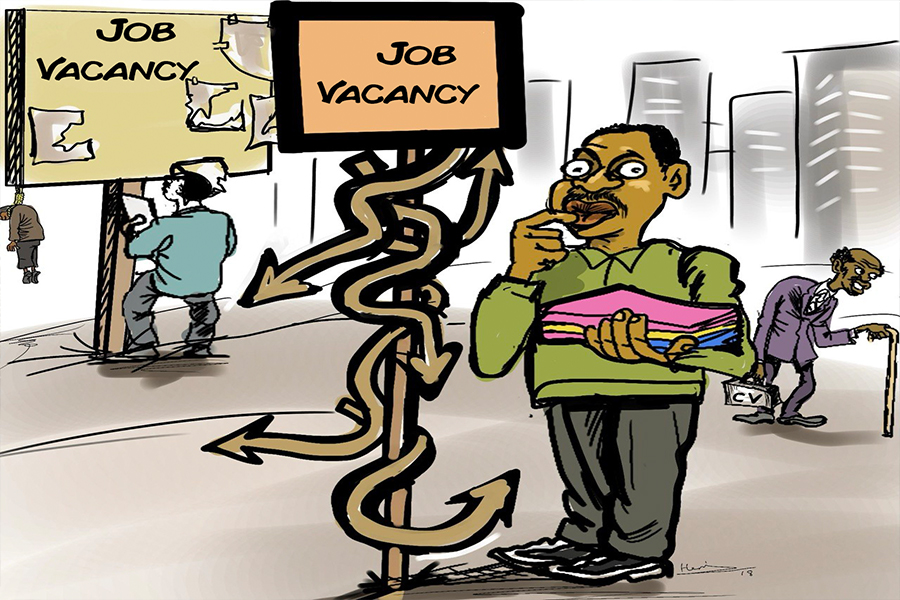
Across the country, the rollout of QR code receipts, designed to bring the country’s tax system into the digital era, has instead left many traders and business owners frustrated and exhausted. The new system, intended to modernise receipt issuance and clamp down on tax evasion, has placed a new burden on businesses. They now find themselves caught in a web of delays, bureaucracy, and unyielding technical requirements.
While regional and federal tax officials have issued warnings and set deadlines, businesses argue that their current predicament is less about reluctance to comply and more about being caught in an institutional deadlock not of their making. Centralising receipt printing has exacerbated these delays.
Among the many affected is Yordanos Goushe, a former journalist who now runs two businesses, a restaurant and a cosmetics manufacturing enterprise. Yordanos is the CEO and founder of Malaika African Grill, a restaurant on Egypt St., in the Mekanisa neighbourhood, which she has operated for over four years. She is also the founder of Secret Organic Entrepreneurs Mentorship, a TV show on EBS, and CEO of Ethiopian Skin Beauty Secret, which she has run for more than a decade.
Last year, Yordanos paid 2.5 million Br in taxes and purchased five receipt pads. She needs the QR code receipts for her restaurant and cosmetics business, but she says the delay is less urgent for the cosmetics side, which operates mainly by order.
“For my restaurant, receipts are mandatory,” she told Fortune.
Yet she has had to temporarily close her restaurant, not for lack of customers but because power outages made her QR code-based register inoperable.
“I close the restaurant when the electricity goes off because I fear a penalty, and I've had to do that many times,” Yordanos told Fortune. “A restaurant is a very fast-moving business.”
Her restaurant, which employs 10 staff, serves African cuisine and caters to the diplomatic community, located close to the African Union and embassies. Last week, she was anxious about being penalised for issues beyond her control, as these disruptions undermine her business. Her establishment is in an area designated for development and is subject to ongoing land lease issues, which compound her difficulties.
Yordanos keeps a receipt from Commercial Bank of Ethiopia (CBE) as proof of the 5,000 Br she paid to the state-owned printing enterprise. However, this payment should be submitted to the Ministry of Revenue and approved before printing can proceed. Each time she approached the end of her receipt supply, she feared the looming threat of business suspension and the subsequent need to start over.
Over the past year, Yordanos encountered information gaps while awaiting her receipts. Even after recent follow-ups, she found herself still waiting for an appointment date, with no receipts issued. Last week, the printing press gave her a Telegram channel username so she could track updates for those on the waiting list.
“When we go to the tax office, we don’t get direct responses, but we still trust the system,” she said. “Customers need my services, and it isn't acceptable to stop serving them because of receipt issues.”
The situation is not unique to the hospitality industry.
According to the Ministry of Revenue and its affiliates, orders for QR pads climbed to over 2.2 million. Although 2.1 million QR pads were printed, distribution did not keep pace. The initial target was increased to 2.5 million, further straining the printers, whose daily output had been 10,000 pads until recently wchich is 20,000. Of 291,435 taxpayers who placed orders, 289,291 received their receipts. The remaining 2,144 are still waiting.
Berhanu Abebe, director of Tax System Optimisation & Regional Support, insisted that the printing of QR code receipts is almost complete, save for some teething problems during the transition period. He describes the initiative as a foundation of government plans to tackle illegal activity and to modernise tax administration by leveraging new technology. The plan was shared with all regional and municipal administrations to ensure its implementation across the country.
The Ministry of Revenues awarded the printing contract to Berhan ena Selam Printing. The initial deal was for 700,000 receipt pads to be printed by February of last year, but this proved insufficient as demand quickly rose. According to Berhanu, who chairs the QR Reciepts Implementation Task Force, demand soon surpassed expectations.
"QR code receipts are not required for all taxpayers," he told Fortune. "They're mostly intended for use when cash register machines malfunction or for those who don't have such machines."
In some withholding tax cases, they are mandatory. Tax officials' goal is to promote the widespread adoption of cash register machines, using QR receipts as an alternative for specific sectors such as consultants and construction.
Berhan ena Selam Printing Enterprise’s daily output was eventually doubled with the acquisition of new machinery, following a coordinated effort between the Federal Tax Authority, the government, and the printing office. Importing the new machine and getting it running took about three months. During this period, the QR Reciepts Implementation Task Force was set up under the State Minister of Revenue, bringing together experts from the Ministry and the printing enterprise to manage the process.
However, it was not enough for taxpayers like Temesgen Gebre, who works for a construction firm. He visited Berhan ena Selam Printing Enterprise last week to collect QR code receipts. Seven months earlier, he had placed an order for the receipts, met the requirements, and submitted the paperwork. Up until last week, he had received nothing. Wary of jeopardising his business, he prefers not to disclose the company’s name, which is involved in city administration projects and residential housing construction.
He recently completed a contract but has not been paid because he was unable to issue the required receipts. The shortage of receipts meant to him that various clients, including city government offices and private construction firms, currently withhold 2.35 million Br. However, his company remains responsible for paying hundreds of employees, many of whom are paid daily due to the nature of construction work.
“In the construction sector, there is no money to keep waiting," Temesgen told Fortune. "If the money is withheld, we can't pursue another project.”
He saw how his peers in the construction sector face the same problem. Despite their ongoing tax obligations, their businesses are stalled.
“All matters aside, I shouldn’t even be here," he said. "I should be at the sites. I understand that repeated visits don't bring receipts."
Temesgen acknowledged that problems are to be expected during transitions, but believes a stronger commitment from the authorities is necessary. Initially, Temesgen thought he might have made an error, so he rechecked his submission multiple times. After being told at the revenue office that his order was incomplete, he resubmitted all documents a month ago. Still, nothing changed. The process remains as opaque and slow as before.
"The revenue bureau should issue a letter for immediate action,” said Temesgen.
Classified as a medium taxpayer, Temesgen generally trusts the good faith of tax officers, but he feels recent office visits have become less helpful as staff are overwhelmed. He now finds himself appealing directly to senior officials, trying to resolve matters quickly.
“They told me to wait a week, but by then my work had already been disrupted because it needed a budget,” he said. “In construction, you have to pay today for the work done today.”
According to Berhanu, while printing is now continuous and runs round the clock, occasional machine malfunctions still cause interruptions. The leading causes of ongoing delays, says Berhanu, are incomplete or incorrect data submitted by businesses, late orders, and weak coordination among affiliated tax offices.
Implementation has been hampered by logistical hurdles and inconsistent compliance by regional offices, despite a shared understanding of the new policy. In some cases, businesses were slow to order receipts, compounding the issue. Following a temporary suspension of implementation, the Revenue Minister, Aynalem Nigussie, convened review meetings with 11 supervision teams. Inspections revealed misplaced receipt pads in multiple regions, except Tigray, Gambella, and Benishangul-Gumuz regional states that have not yet been inspected.
The frustration is not limited to businesses in the capital. In the Amhara National Regional State, local revenue offices are working to distribute QR receipts, often relying on air transport due to time and security constraints. Similar problems are reported elsewhere.
The Ministry took direct control of transporting receipts from the printing press to local tax offices. In high-risk or remote areas, receipts were flown. Receipts were airlifted to Mekelle, Kombolcha, Bahir Dar, and Gonder, and customs and revenue officials used eight vehicles to distribute them further. Even so, getting pads to district-level offices, especially in rural areas, remains difficult.
“Some pads didn't reach their intended destinations and were returned to the centre,” Berhanu said. “We corrected this through reallocation, even using air transport despite the cost.”
Supervision teams concluded that only a stronger commitment would ensure receipts actually reach taxpayers.
Berhanu disclosed that over 16,000 pads were still pending due to data errors and information gaps. He urged taxpayers to use their order numbers and TINs to check their publication status before collecting receipts, stating that most complaints result from incomplete applications.
Dawit Kejela, a former auditor at the Ministry and now a private tax advisor, sees the present difficulties as part of an inevitable transition. He argued that, despite the merits of the transition, the economy is not yet fully equipped to handle such technological change. The more pressing question now, he says, is how the next printing round will be managed.
Dawit believes high costs are at the root of many distribution problems, with taxpayers travelling long distances only to discover their receipts have not yet reached their local revenue offices. Unlike the old system, the Ministry oversees every stage, from registration to the final handover of receipt pads.
“If the Revenue Ministry handles printing itself, the cost will be too high," he said. "If taxpayers are expected to cover it, that also needs to be clearly stated.”
Dawit questioned whether the Ministry’s shift from manual to QR-code receipts alone can meaningfully fight fraud and illegal activity. Although the Minister announced that the issue would be resolved by June last year, Berhan ena Selam Printing Enterprise was unable to meet demand, making it impossible to invalidate past practices as planned fully. In previous years, receipts were printed locally with the approval of the relevant revenue bureaus. Only later was the process centralised.
“Capacity should have been assessed at the beginning, not after deciding on centralised printing,” Dawit told Fortune. “If Berhan ena Selam Printing Enterprise had regional operations, these problems would not have occurred.”
A senior manager from Berhan ena Selam Printing Enterprise declined to comment on receipt printing, as it falls under the Ministry of Revenue’s purview. However, he insisted that the Printing Enterprise has the "capacity" to see the task through.
He now advises his clients to buy cash register machines, despite their cost of more than 40,000 Br, rather than wait indefinitely for QR receipts. Delays are also caused by a lack of timely communication between taxpayers and tax officers, leaving some applicants waiting up to a year.
Dawit urged the Ministry consider adopting an integrated tax system similar to Kenya’s, where sales are reported directly to the authorities in real time, reducing the need for manual audits and interventions.
For now, as the centralised receipt system struggles to keep pace with demand, business owners like Yordanos and Temesgen can only wait, their enterprises disrupted by a process intended to streamline and support them. Their stories speak to a wider reality faced by thousands of businesses, caught between the promise of reform and the realities of implementation.
“Businesses need receipts urgently for bids, loans, or withholding purposes,” Dawit said. “But they can’t receive them because the printings haven’t been supplied.”
PUBLISHED ON
Jan 24,2026 [ VOL
26 , NO
1343]
Photo Gallery | 192822 Views | May 06,2019

Photo Gallery | 182725 Views | Apr 26,2019

Photo Gallery | 179485 Views | Oct 06,2021

My Opinion | 144968 Views | Aug 14,2021







Aug 8 , 2026
The World Bank asks readers to picture a mother in rural Ethiopia who has never held...

Jul 31 , 2026
Weldu Yiheysh has not read the Pacific temperature charts. He does not need to. In Shibta District of Enderta Wereda, in...

Jul 25 , 2026
Ideally, citizens who have paid income tax all year should not have to reach for thei...
Jul 18 , 2026
Pressed in Parliament on jobs and household incomes, Prime Minister Abiy Ahmed (PhD)...







 Loading your updates...