

Photo Gallery | 192829 Views | May 06,2019



Jun 21 , 2026. By NAHOM AYELE ( FORTUNE STAFF WRITER )
In February 2026, Tsedey Bank's Board appointed Yohannes Ayalew (PhD), an economist and former vice governor of the Central Bank, to lead the institution out of its current deficit. Yohannes brings a record of rapid turnarounds. At his previous post, he moved a bank from a loss to a 655 million Br pre-tax profit in under 16 months. He takes over an institution that, despite its losses, holds 13.5 billion Br in total capital and a capital-to-asset ratio of 18.1pc, well above regulatory minimums.
For most of three decades, Tsedey Bank made its living advancing a few thousand Birr at a time to farmers and traders across the Amhara Regional State. In its first full year as a commercial bank, moving upmarket proved costly.
For the year ended in June 2025, Tsedey Bank posted a loss of 2.13 billion Br even as the balance sheet expanded, liquidity strengthened, and capital increased.
The loss landed in an industry with a history of minting profits. Commercial banks' aggregate assets expanded by 44.5pc to 4.74 trillion Br, deposits climbed by 40.7pc to 3.51 trillion Br, and net income after tax jumped by 61.3pc to 93.4 billion Br.
Several banks slipped into a tough period that financial year, after macroeconomic reforms, particularly the change in the foreign exchange regime and unresolved dollar-denominated commitments. But Tsedey stood apart, for its loss was rooted in core operations rather than foreign exchange shocks, its red ink set beside Hibret Bank's modest gain and Nib Bank's larger shortfall.
For Abdulmenan Mohammed (PhD), the London-based financial analyst, the loss raised eyebrows.
“The Bank’s executives require a serious turnaround strategy to recover”, he told Fortune.
He attributed the drivers to a decline in interest income, a sharp rise in interest expenses, a substantial increase in provisions for loan and other asset impairment, and a steep climb in salary and benefit costs. However, the Management blamed regional conflicts, branch closures and tight monetary conditions for the past loss.
Not every shareholder shared Management's perspective, however.
Abreham Kassa, a shareholder and first-year nursing student at a private college in Bahir Dar, invested half a million Birr in shares using money earned from cattle fattening and agricultural activities while still a student. He believed it would create long-term value for himself and his family while providing annual returns and access to financial services. His expectations have not been met.
“They called me once and told me that my shares had yielded 125,000 Br and asked me to add 7,000 Br to buy more shares,” he told Fortune. “I did as they told me. But since then, no one has spoken to me."
For him, the concern is not only returns but also transparency.
“The money I used to buy the shares could have bought a very good property in my hometown at the time, if only I had bought that instead," he said.
Now weighing whether to sell, he faulted management above all.
"At least if the management let us know what problems they were facing, it would help us understand,” said Abreham. “But now it has just become a matter of waiting in silence.”
The same inheritance that made Tsedey Bank formidable made it fragile, saddling a young commercial bank with the loan quality and cost structure of a microfinance giant.
Once Amhara Credit & Savings Institution (ACSI), licensed as a microfinance company in April 1997, Tsedey Bank grew into one of the country's largest microfinance institutions before commencing commercial banking operations in September 2022.
Including those inherited from microfinance, it serves 12.2 million customers and operates 630 branches, having opened 147 new outlets last year. It inherited a client base exceeding 14.3 million people and a network of more than 13,400 employees, with over 1.3 million borrowers active on its books.
Bridging short-term, small-ticket lending and the longer maturities of commercial banking meant building credit and risk frameworks from scratch as old income streams thinned.
The pressure came despite balance-sheet growth. Total assets expanded by 25pc to 75.75 billion Br, total loans and advances climbed by 45.37pc to 48.87 billion Br, and deposits reached 45.79 billion Br, up 22.11pc. The loan-to-deposit ratio eased to 106.7pc from 113pc, still leaving lending dependent on the Bank's own capital.
The portfolio leaned toward imports, manufacturing and export-oriented borrowers, exposing Tsedey Bank to currency swings.
A large share of Tsedey's clients live in the Amhara Regional State, and the instability gripping parts of it disrupted loan repayments, interrupted branch operations and complicated deposit mobilisation. The National Bank of Ethiopia (NBE) capped credit growth, while weak loan quality carried over from the microfinance era pushed non-performing loans (NPLs) higher and forced reserves that flowed straight to the bottom line.
The provision for loan and other asset impairment swung to an expense of 409.64 million Br from a reversal of 337.57 million Br a year earlier. Interest expenses on deposits surged by 24.2pc to 2.57 billion Br, salaries and employee benefits grew to 4.91 billion Br, an increase of 21.2pc, and other operating expenses gained 10.1pc to 980 million Br.
The impairment swing troubled Abdulmenan most.
"Particularly concerning is the massive increase in provision for loan and other assets impairment," he said, also flagging a wage bill heavier than that of larger institutions such as Abay Bank. "This should concern the management of the Bank."
Tsedey Bank's 147 new branches marked the largest single-year expansion by any domestic bank, and their operating costs weighed heavily. Management insisted the pressures were transient, the product of one extraordinary year rather than evidence that the model does not work.
The Bank’s return on assets was a negative 2.9pc. With leverage of about 5.5 times, assets atop capital of 13.5 billion Br, the implied return on equity sank to roughly negative 15.8pc. According to analysts who reviewed the accounts, the negative margin was the dominant culprit; leverage merely amplified the damage.
The contrast with its closest peers was revealing. The 2.13 billion Br loss compared with a peer average profit of 1.17 billion Br across Siinqee, Sidama, Shabelle and Siket, four banks that, like Tsedey, transitioned from microfinance backgrounds.
The gap was not about size, though. Tsedey Bank's asset base was nearly twice the 37.9 billion Br peer average, and its loan book was more than double the 17.8 billion Br peers carry on average. Its limitation was conversion, against a positive 2.7pc peer average. Nor was the shortfall reckless gearing.
The Bank ran an asset-to-equity multiplier of 5.53, marginally above the 5.35 peer average and well below Siinqee Bank's 9.80. Siket Bank carried almost no leverage, at 2.05 times, yet earned 6.4pc on assets, enough for a 13.2pc return on equity.
Loans made up 50.4pc of assets, above the 44.7pc peer average and higher than Siinqee Bank's 45.7pc, Sidama Bank's 43.3pc, and Shabelle's 28.7pc. Only Siket, at 61.1pc, lends more intensively, yet turned that lending into 1.24 billion Br in profit, while Tsedey's larger book resulted in a loss. Deposits accounted for around 46pc of liabilities, and capital 18pc of the balance sheet.
However, the funding side showed the pressure most sharply. Its loans equalled 109.9pc of deposits. Tsedey Bank had lent 3.4 billion Br more than customers placed with it, against a far more comfortable 87.5pc peer average, with Siinqee, Sidama and Shabelle banks below it at 53.8pc, 65.0pc and 76.2pc, respectively. Siket Bank lent more aggressively still, at 155.0pc, but could afford to, its equity equalling 48.8pc of assets.
Ameha Teferi, a founding shareholder and insurance broker, believes the financial institution still has the foundation to recover and grow. He criticised judging Tsedey Bank on a single difficult year, given its youth as a commercial lender.
“The loss should be weighed against deeper distress at other banks,” he told Fortune.
Tsedey's capital-to-asset ratio was 18.1pc, below the peer average of 27.6pc, though ahead of Siinqee Bank's 10.2pc. If there was ballast, it was capital.
Tsedey entered with paid-up capital of 7.75 billion Br, among the largest for a new bank, and closed the year with total capital of 13.5 billion Br, well above the Central Bank's five billion Birr minimum and ample to absorb the loss without threatening solvency. It lifted paid-up capital 6.8pc to 10.5 billion Br.
Yet Abdulmenan argued additional capital should not be the priority, as the Bank already held enough.
“The focus should fall on improving efficiency, strengthening asset quality and restoring profitability,” he said.
However, liquidity strengthened. Cash and bank balances increased by 80.7pc to 12.2 billion Br, lifting their share of total assets to 16.1pc from 10.1pc. The buffer cut both ways: idle liquidity earns nothing, while a loan-to-deposit ratio exceeding 100pc signalled dependence on interbank borrowing, Central Bank facilities, or other funding that is costlier and less stable than retail deposits.
The Bank did record sharply improved foreign exchange earnings, too. Net gains from foreign exchange dealing and valuation surged to 596.65 million Br, more than 42 times the year before, largely linked to the management change introduced at the end of July 2024, but not enough to offset weakening core operations.
Interest income from loans, advances and deposits declined by 3.8pc to 6.07 billion Br, even as the loan portfolio grew more than 15pc. Fees and commissions jumped by 21.7pc to 223.41 million Br, and other operating income by 61.2pc to 540.26 million Br.
The Board answered with its most consequential decision. Mekonnen Yelewumwossen, who led the Bank for years, stepped down in January 2026, and the presidency was passed on an interim basis to Yeshiemebet Tefera. In February, the Board turned to Yohannes Ayalew (PhD), an economist and former vice governor of the NBE.
Yohannes brings more than two decades of experience in economic policy, financial institutions and banking leadership, including nine years as chief economist at the Central Bank, a stint at the Policy Studies Institute and a role as country director at Africa Trade & Investment Development Insurance.
At the Development Bank of Ethiopia (DBE) from 2018 to 2022, he is credited with reducing non-performing loans from 57pc to 6.7pc. However, efforts to push the policy lender toward commercial practices yielded mixed results. Most recently, he led Amhara Bank, a fourth-generation private bank, joining amid financial pressure and internal crisis. Within less than 16 months, he moved it from a loss to a pre-tax profit of 655 million Br, an 85pc gain on the prior year.
However, after his departure, some board members criticised his tenure, particularly over loan disbursement decisions and lending to certain groups.
At Tsedey Bank, 70pc owned by the Amhara Regional State, Yohannes’ mandate is to tighten credit risk management, improve loan quality, reduce the loan-to-deposit ratio, and restore profitability without abandoning the social mission that defines the Bank.
Convinced that Tsedey Bank has a solid base that can support future growth and recovery, he has voiced confidence in turning the Bank around. The scorecard was mixed, however.
The workforce, like the branch network, was a cost platform before an earnings one. Across 13,400 staff, the loss worked out to about 159,000 Br per employee, against Siinqee's 283,800 Br, Sidama Bank's 85,800 Br, Shabelle's 32,400 Br and Siket's 561,200 Br, and a peer average of 240,800 Br.
Capital adequacy was strong, asset quality weak, and earnings were at the bottom of the peer group. Its leadership appeared guarded and proactive in replacing its top management, yet conceded that the previous team had fallen short. The deposit base, outpaced by the 46.8 billion Br Siinqee Bank mobilised and trailing its own loan book, still ranked among the largest of any lender founded in the early 2020s.
Tsedey Bank paid full price for the credit weaknesses, regulatory caps and expansion costs bundled with its scale. The Bank was neither in crisis nor in the clear.
PUBLISHED ON
Jun 21,2026 [ VOL
27 , NO
1364]
Photo Gallery | 192829 Views | May 06,2019

Photo Gallery | 182732 Views | Apr 26,2019

Photo Gallery | 179491 Views | Oct 06,2021

My Opinion | 144976 Views | Aug 14,2021




Aug 8 , 2026
The World Bank asks readers to picture a mother in rural Ethiopia who has never held...

Jul 31 , 2026
Weldu Yiheysh has not read the Pacific temperature charts. He does not need to. In Shibta District of Enderta Wereda, in...
Jul 25 , 2026
Ideally, citizens who have paid income tax all year should not have to reach for thei...
Jul 18 , 2026
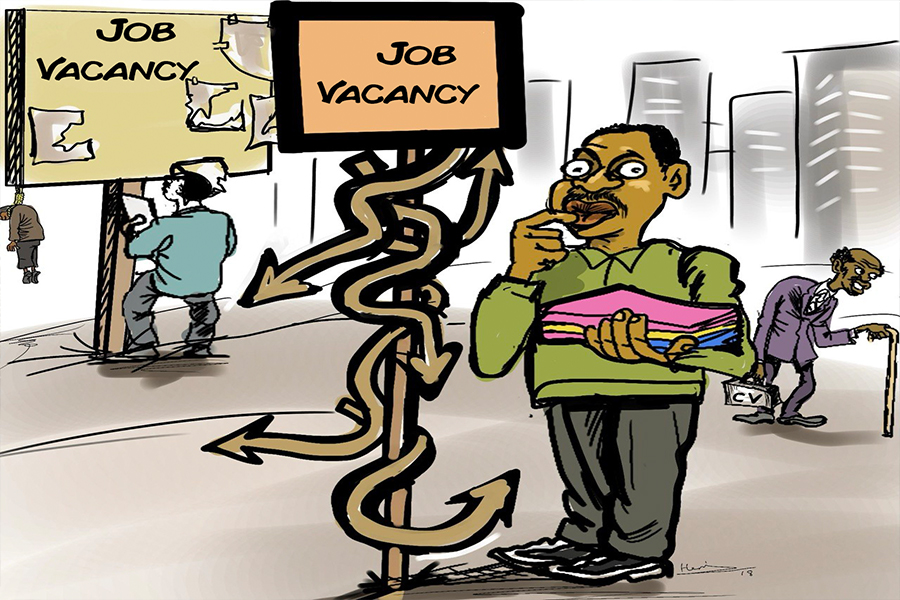
Pressed in Parliament on jobs and household incomes, Prime Minister Abiy Ahmed (PhD)...





 Loading your updates...