
In-Picture | Jul 25,2026



Aug 27 , 2022
By Berket Yemiru Nega
As a member of the Diaspora, I can speak here with first-hand knowledge: any investment requiring frequent trips outside of Addis Abeba is off the table for most of the Diaspora community. Farming is not even in the conversation when people discuss doing business in Ethiopia. Real estate and the import of commodities and raw materials are the main activities discussed as an investment.
Why? Well, these investments are relatively risk-averse and highly liquid. At the same time, such investments have low or sometimes an adverse impact on the overall economy and our compatriots who are most in need. As Diaspora, if we are successful and invest in our homeland, we should not engage in low-impact investment; we should try to have as much impact as possible to make the road to success more accessible for the next generation.
The Diaspora have an opportunity to combine our knowledge and social and financial capital to change the foundation of Ethiopia's economy. In 2019, the country imported about 18 billion dollars worth of goods and exported about three billion dollars - Ethiopia is a net importer. Considering the arable land, water resource and favourable climate, there is no reason why we cannot become a net exporter.
When spending 100 million Br on building a 10-storey apartment building with three apartments a floor, one creates housing for 30 people and jobs for the surrounding community during the construction phase. Of course, there is also steady income for the investor for the life of the apartment. But suppose the person invests 100 million Br into regenerative farming, after a growing phase of three to four years. In that case, the investor can potentially secure a source of foreign currency from exports for the next half a century, depending on how the farm is designed. Permanent jobs are also being created for the rural farming communities, which likely did not have many job opportunities previously. The investor is also benefiting the climate positively while educating the neighbouring farmers about modern farming techniques and market knowledge.
Considering the recent breakdown in global supply chains, Ethiopia needs to utilise its natural advantage in regard to agriculture. We have almost one million square kilometres of arable land, abundant water resources, and a young and motivated labour force. Ethiopia could be the bread and veggie basket for Africa and Europe.
Diaspora investors in Ethiopian agriculture ought to implement regenerative agricultural practices championing the smallholder farmer to become a larger and more important part of the value chain. The Ethiopian Diaspora community should be galvanised and inspired to revisit regenerative farming as a high-impact, high-reward investment by demonstrating and being a model farm developer.
Smallholder farmers mainly maintain sustenance farming, mostly on rain-fed farmland (farmland that is only irrigated when it rains, which is about five to six months of the year). Considering climate change and the increased frequency of irregular rain patterns, it will be a very ineffective use of farmland. I realised that if I can empower, train, and equip smallholder farmers with the necessary knowledge and know-how, we can change the lives of not only the farmers we work with but the next generation of farmers. We need the next generation of farms to not only feed the country but also produce surplus and begin to feed the ever-growing population worldwide.
After successfully developing a 13-hectare plot of land using agroforestry as the guiding agricultural strategy, I believe that my team is ready for the next phase of development. We are surrounded by about 200 smallholder farmers who have also planted avocado plants. In June 2022, we had our first export shipment to the Saudi Arabian market. I bought avocados from the surrounding farmers at almost 0.80 dollars a kilo and sold them for about 2.25 dollars. Considering packaging and transportation cost, there really is no profit to be made. But the profit is in the market knowledge and export know-how gained throughout the process.
To further the cooperation between the surrounding famers and myself, I have requested the local government to create a farmer’s union or cooperative. This will allow for a more formal relationship between the farmers and myself. It will allow me to share resources, knowledge, and experience with the cooperative versus each individual farmer, which is obviously more efficient. Forming a cooperative is also important for volume estimations, export markets focus on volume and consistency. If a supplier cannot consistently supply the buyer with high-volume, high-quality goods, they will be pushed out of the market. Cooperatives help to facilitate the sharing of knowledge and resources, volume, and quality management, and also community development.
I am a living example that the Diaspora can add value and that promising returns could be generated from the agriculture sector.
My new farm will be established as a nucleus-state integrated syntropic farm. We plan to mix animal husbandry and agroforestry to create an integrated farm that produces zero waste and has a diversified source of income. When developing the farmland, we will emphasise two main points: creating a world-class integrated syntropic farm using permaculture design that focuses on scalability and profitability, and creating a resource centre for communities in and around the area of the nucleus state farm. The centre will serve as a one-stop shop for the surrounding farmers. It will include seeds, seedling nursery, chemicals, tractor services, knowledge and technical information and a small pilot project for demonstration purposes.
The community resource centre will function as an “Agricultural Hub” for that community, a place where the rural farmer can come and learn, share experience, and purchase resources on a credit basis. It will also serve as the first point in the all-important cold chain for that community. We will establish a cold warehouse on its nucleus state farm that will provide space for storage, sorting, and grading of all produce harvested for both local and export markets.
Eventually, the rural farmers utilising the resource centre will become partner farmers in executing a coordinated out-growers scheme serving local and export markets. We will collaborate with farmers, aggregate the harvested produce and store it in the cold-house for further processing, later providing cold-truck transportation to local markets in Addis Abeba and facilitating cold-truck transportation for the export market.
Thus, the centre will provide a one-stop shop for the rural farmer for all their agricultural needs. It will serve both my farm and the partner farms without distinction to engrain itself and become part and parcel within the community.
Farming is mainly about patience, persistence, being consistent and not taking any shortcuts. It can be likened to building a large building. When digging the foundation of the building, one will do as such until reaching an incompressible layer of soil. Why? Because they want to make sure that once the building is complete, it can withstand both the dead and dynamic load it may face in its 40–60-year life span. Farming is similar. When planting a fruit tree with a life span of 30-40 years, the person should not supplement its growth with chemical fertiliser. Chemicals might seem like the quickest and easiest way to profitability, but they produce such long-term consequences as soil erosion, loss of biodiversity, input dependence, and eventually lifeless soil.
The influence of the Ethiopian Diaspora will enhance and benefit people's lives and not degrade them.
PUBLISHED ON
Aug 27,2022 [ VOL
23 , NO
1165]

In-Picture | Jul 25,2026

Radar | May 03,2026
Commentaries | Dec 16,2023

Life Matters | Sep 02,2023

Viewpoints | Jul 27,2024

Fortune News | May 09,2020

Radar | Aug 23,2025
Commentaries | Jun 24,2023
Fortune News | Aug 18,2024
Fortune News | Sep 27,2025

Photo Gallery | 193214 Views | May 06,2019

Photo Gallery | 183100 Views | Apr 26,2019

Photo Gallery | 179896 Views | Oct 06,2021

My Opinion | 145344 Views | Aug 14,2021





Dec 22 , 2024 . By TIZITA SHEWAFERAW
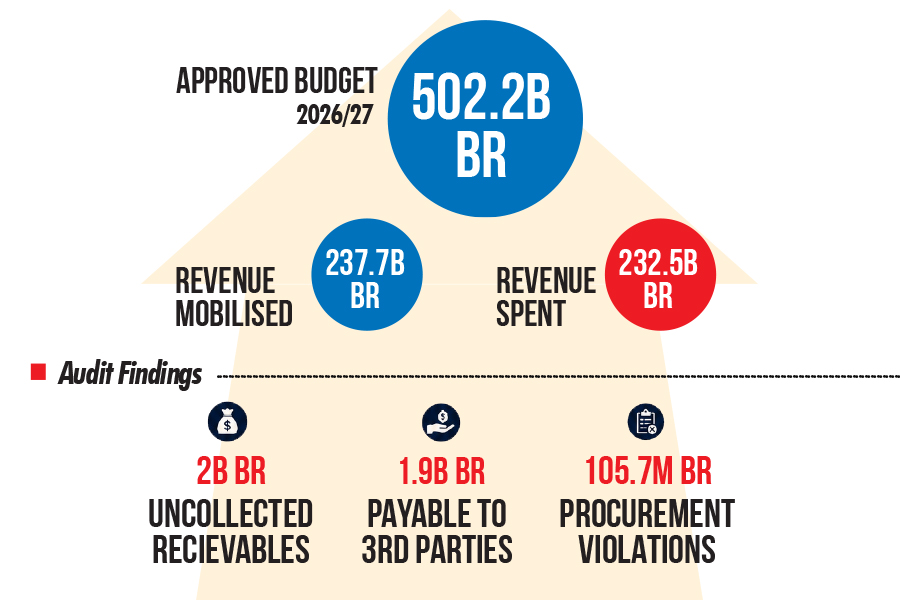
Charged with transforming colossal state-owned enterprises into modern and competitiv...

Aug 18 , 2024 . By AKSAH ITALO
Although predictable Yonas Zerihun's job in the ride-hailing service is not immune to...

Jul 28 , 2024 . By TIZITA SHEWAFERAW
Unhabitual, perhaps too many, Samuel Gebreyohannes, 38, used to occasionally enjoy a couple of beers at breakfast. However, he recently swit...

Jul 13 , 2024 . By AKSAH ITALO
Investors who rely on tractors, trucks, and field vehicles for commuting, transporting commodities, and f...

Aug 14 , 2026
Aschalew Fetene, known as “Ardi” and admired for his poetic depth, has built a ti...

Aug 8 , 2026
The World Bank asks readers to picture a mother in rural Ethiopia who has never held...

Jul 31 , 2026
Weldu Yiheysh has not read the Pacific temperature charts. He does not need to. In Shibta District of Enderta Wereda, in...

Jul 25 , 2026
Ideally, citizens who have paid income tax all year should not have to reach for thei...
Aug 15 , 2026 . By NAHOM AYELE
Federal prosecutors have charged seven defendants over a set of foreign-trade deals t...
Aug 15 , 2026 . By BEZAWIT HULUAGER
Ethio-post is preparing to turn its thousands of branches into banking agents, allowi...
Kassahun Gofe (PhD), minister of Trade & Regional Integration (MoTRI), is prepari...
Aug 16 , 2026 . By NAHOM AYELE
Justices at the Federal Supreme Court widened the shield they are holding over lawyer...




 Loading your updates...