


Viewpoints | Aug 08,2026



Apr 25 , 2026
By Eden Sahle
What began as a brief personal update unfolded into a case of prolonged misread symptoms. Persistent exhaustion, irritability, and physical changes were present for nearly a year before medical evaluation occurred. Hypothyroidism was identified only after hospital testing, linking all symptoms to a single cause. The condition had quietly progressed while concerns were minimised within the household. Recovery began after treatment, yet the timeline raised concerns about delayed response.
I ran into an acquaintance recently. She shared news that should have been simple to celebrate. She said she was pregnant. I congratulated her right away, caught in the moment. She smiled, but only briefly.
Then her tone shifted. What followed was not just a happy announcement. It became a story about how close things came to a very different outcome.
Before the pregnancy, she had been struggling for a long time. She described a kind of exhaustion that never lifted. No matter how much she slept, she woke up drained. She was sleeping more than usual, yet it did not help. Her energy was gone. She felt irritable in a way that was new to her. She was gaining weight even though nothing in her routine had changed.
She sensed something was wrong. She told her husband and family that she needed to see a doctor. They reassured her she was fine. The advice leaned toward sleep habits needing adjustment. At times, it sounded like she was overthinking it. Her irritability slowly became something to correct rather than a signal to understand.
Nearly a year passed before her husband finally agreed to take her to a hospital. By then, she had grown used to carrying the discomfort in silence. When she was finally examined, the answer came quickly. She had hypothyroidism, a condition where the thyroid gland does not produce enough hormones. One condition explained everything she had been living through. The fatigue. The weight gain. The mood changes. Even the difficulty in becoming pregnant.
Once treatment began, things started to change. Medication replaced the missing hormone. Her energy returned. The long oversleeping stopped. Her mood steadied. The weight linked to fluid retention reduced. Slowly, she began to feel like herself again. Then she became pregnant.
As she spoke, she mentioned that her husband still carries a sense of shock and guilt. He reflects on how long it took to act. On the moments he did not listen when she said something was wrong. Her story has a good ending, yet that is not always the case.
I know families whose experiences still sit heavily in memory. In those situations, delayed care led to outcomes that cannot be reversed. What remains are unanswered questions. What if attention had come sooner? What if the warning signs were taken seriously? What if waiting had not stretched so long?
Doctors see this pattern more often than many realise. My physician friend once told me that one of the hardest parts of his work is not only disease complexity, but timing.
“Some of the people we lost didn’t have to die,” he said. “They came too late.”
A common thread runs through these experiences. Many people wait for visible signs before believing something is wrong. They respond to what can be clearly seen. Bleeding. Severe pain. Something unmistakable.
Many conditions do not begin that way. They start quietly. A shift in energy. A change in appetite. Mood changes. A persistent feeling that something is off. These signs are easy to dismiss because they do not look urgent.
Sometimes the dismissal happens within ourselves. Other times, it happens in families. Words like “you are fine” get spoken without full understanding. Reassurance without real attention can slow down the search for help that might change everything.
There is also a deeper layer to this. People tend to trust what they can see more than what they are told. If someone appears fine, the assumption follows that they are fine. Yet the person living inside that experience is carrying something invisible from the outside. Listening to that reality matters.
This does not mean every symptom signals something severe. It means persistent and unexplained changes deserve attention. It means seeking medical advice rather than relying on assumptions.
There are practical reasons people delay care. Some avoid hospitals altogether. Others fear the cost. Some fear what they might discover. Many simply dislike the environment, where stress and illness feel close at hand.
That hesitation is understandable. Still, it can carry consequences. Hospitals are where answers begin. They are where symptoms are properly assessed, where tests clarify what is happening, and where treatment can start early, when it is often more effective.
Waiting can shift a manageable condition into something more serious. The challenge is not to panic at every change, but not to ignore patterns either. When something repeatedly feels wrong, it deserves attention.
There is also a social dimension. In many homes, decisions about seeking care are not made alone. A partner or family member often shapes the response. When someone says they feel unwell, the reaction they receive influences what happens next. If they are taken seriously, they are more likely to seek help. If they are dismissed, delay becomes more likely.
The acquaintance I met that day reminded me how thin the line can be between a stable outcome and a tragic one. Her brief smile carried both relief and memory. Relief that she received care in time. Memory of how long the path to that care took.
The lesson is simple. When something feels off, it should not be brushed aside. It should be noticed. It should be taken seriously, even when the signs are not obvious. Seeking help early can feel unnecessary in the moment, but waiting can cost far more. In the end, the decision to act or delay shapes everything that follows.
PUBLISHED ON
Apr 25,2026 [ VOL
27 , NO
1356]
Viewpoints | Aug 08,2026

Obituary | Mar 02,2024

Agenda | Apr 25,2026

Radar | Jul 25,2026

View From Arada | Feb 03,2024

Fortune News | Jul 17,2022

Life Matters | Apr 25,2026
Sunday with Eden | Jul 07,2024

Sponsored Contents | Oct 25,2024

Radar | May 10,2026

Photo Gallery | 193373 Views | May 06,2019

Photo Gallery | 183258 Views | Apr 26,2019

Photo Gallery | 180066 Views | Oct 06,2021

My Opinion | 145498 Views | Aug 14,2021







Dec 22 , 2024 . By TIZITA SHEWAFERAW
Charged with transforming colossal state-owned enterprises into modern and competitiv...

Aug 18 , 2024 . By AKSAH ITALO
Although predictable Yonas Zerihun's job in the ride-hailing service is not immune to...

Jul 28 , 2024 . By TIZITA SHEWAFERAW
Unhabitual, perhaps too many, Samuel Gebreyohannes, 38, used to occasionally enjoy a couple of beers at breakfast. However, he recently swit...

Jul 13 , 2024 . By AKSAH ITALO
Investors who rely on tractors, trucks, and field vehicles for commuting, transporting commodities, and f...

Aug 14 , 2026
Aschalew Fetene, known as “Ardi” and admired for his poetic depth, has built a ti...

Aug 8 , 2026
The World Bank asks readers to picture a mother in rural Ethiopia who has never held...

Jul 31 , 2026
Weldu Yiheysh has not read the Pacific temperature charts. He does not need to. In Shibta District of Enderta Wereda, in...
Jul 25 , 2026
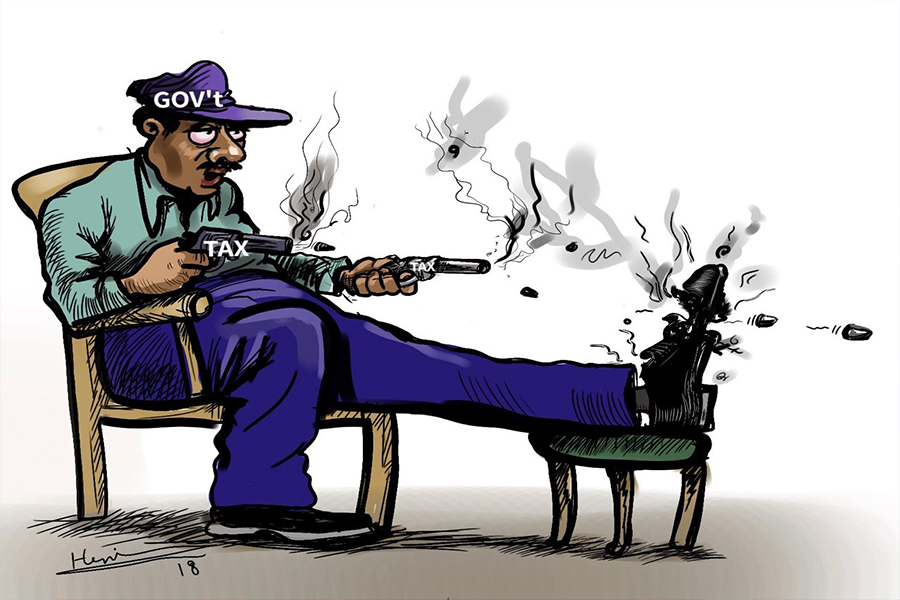
Ideally, citizens who have paid income tax all year should not have to reach for thei...
Aug 15 , 2026 . By NAHOM AYELE
Federal prosecutors have charged seven defendants over a set of foreign-trade deals t...
Aug 15 , 2026 . By BEZAWIT HULUAGER
Ethio-post is preparing to turn its thousands of branches into banking agents, allowi...
Aug 18 , 2026 . By BEZAWIT HULUAGER
Kassahun Gofe (PhD), minister of Trade & Regional Integration (MoTRI), is prepari...

Aug 16 , 2026 . By NAHOM AYELE
Justices at the Federal Supreme Court widened the shield they are holding over lawyer...






 Loading your updates...