
Radar | Nov 20,2023



Feb 8 , 2026
By BEZAWIT HULUAGER ( FORTUNE STAFF WRITER )
Healthcare entrepreneurs are creating a financing structure to help patients manage insurance payments. Premiums would be financed through microfinance loans and repaid gradually. The approach responds to gaps in insurance coverage and affordability. Supporters say it strengthens the medical ecosystem. Critics caution against pricing control and reduced market diversity.
A new model in the healthcare and financial sectors is taking shape as Aspire Microfinance and Family Health Insurance await approval from the National Bank of Ethiopia (NBE).
Backed by healthcare professionals, these institutions have proposed a model in which microfinance loans directly fund health and life insurance premiums. If approved, the companies pledged to introduce a hybrid model that ties microfinance lending directly to health and life insurance, and then anchors both to a digitally integrated hospital network.
It is an ambitious attempt to lower out-of-pocket health spending by turning insurance premiums into financed products.
Aspire Microfinance comes to the regulator with 75 million Br in paid-up capital and 300 million Br in subscribed capital, backed by 33 founding shareholders. Family Health Insurance, its partner institution, posted 110 million Br in paid-up capital and 400 million Br in subscribed capital, with 96 shareholders.
The numbers are modest by banking standards, but material for an industry where entry barriers, especially for insurance, remain high and regulatory review is intense.
The architect of this approach is Girma Ababi (MD), a physician and anatomical pathologist who chairs Family Health Insurance board. His professional journey, from lecturing at Dilla and Hawassa universities to building a private healthcare establishment, tells the hybrid logic behind the project.
Girma is also the founder and chief executive officer (CEO) of Liyana Healthcare Solutions Plc, a firm that manages more than 23 healthcare institutions, owns ten outright, and operates others through joint ventures. Liyana is now preparing to register as a service provider with the Ethiopian Capital Market Authority (ECMA), signalling longer-term ambitions that stretch beyond health delivery into finance and capital markets.
The model has a simple but unusual proposition. Patients will be able to take microfinance loans from Aspire to pay health or life insurance premiums issued by Family Health Insurance, repaying those premiums in instalments rather than upfront.
In the domestic market, this is largely uncharted territory. Unlike in some other jurisdictions, insurance premiums do not accumulate savings or dividends for policyholders. Insurance remains a risk-transfer product, and for many households, the upfront cost alone is prohibitive.
Girma argued that embedding finance within the health sector is the “missing element” in building a functioning medical ecosystem. Microfinance, he contended, is less costly and less encumbered than banking, especially at a time when banks face capital pressures, tighter supervision, and growing asset-quality concerns.
“Aspire is not meant to replace banks but to bypass them, channelling smaller, purpose-specific loans directly into healthcare consumption,” said Girma.
The insurance arm is designed to mirror this modularity.
Family Health Insurance plans to offer segmented products (dental and eye-only coverage is a frequently cited example), allowing households to insure specific risks rather than buy comprehensive packages they cannot afford. The logic is incremental coverage first, depth later.
“If someone wants to insure only their dental and eyes , they've that option,” he said.
For experts such as Azalech Yirgu, a veteran insurance professional with more than four decades of experience at United Insurance and the Ethiopian Insurance Corporation, whether this segmentation improves affordability without undermining risk pooling remains an open question.
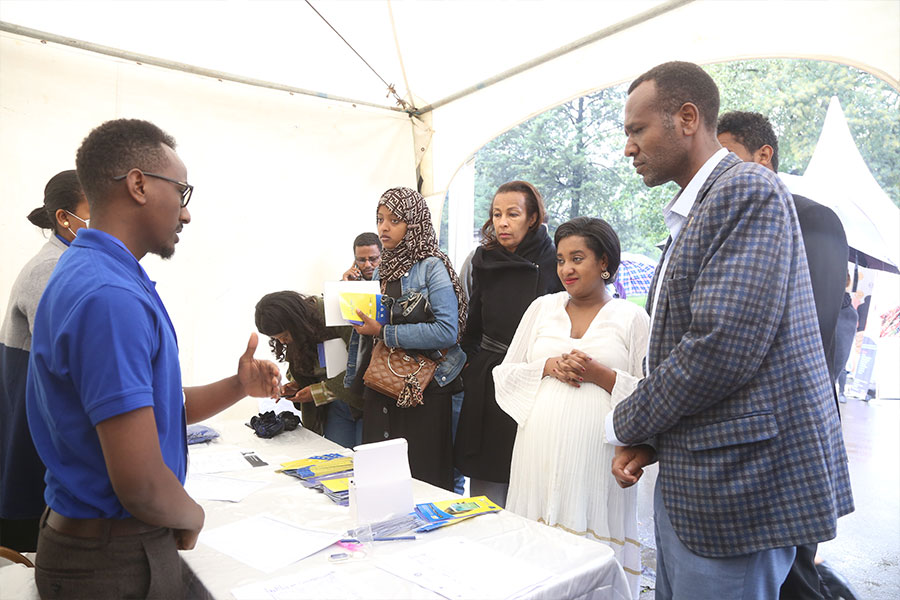
Family Medical Network (FMN) backbone is the connective tissue of the system. Around 50 hospitals are being integrated into a platform that standardises billing, negotiates mass tenders for inputs, and enforces uniform pricing across the network.
Participation is compulsory for selected hospitals. Among them is Alatyon General Hospital in Hawassa. It is a seven-floor, 75-bed facility established a decade ago and led by Yidnekachew Woldemeskel (MD). Serving up to 250 patients daily, Alatyon draws clients from southern Ethiopia, Kenya, and Somaliland.
According to him, digital integration allows hospitals to focus on treatment while the platform manages pricing, claims, and payment flows.
“For hospital operators, the appeal is operational clarity,” said Yidnekachew. “The system is a way to separate clinical care from financial administration.”
Girma has gone further, promising a price discount of 20pc to 30pc at Yanet General Hospital.
Out-of-pocket spending remains one of the most stubborn features of the health system. Management Sciences for Health estimates that such spending accounts for roughly 31pc of total health expenditure, a level widely associated with unbearable household costs.
Public schemes exist but remain partial as community-based health insurance covers more than 2.5 million people and collected about 480 million Br last year, while the Addis Abeba City Administration alone subsidised the program with 1.3 billion Br. Social health insurance is expanding digitally, with around 475,000 beneficiaries registered, including family members, yet only about 65pc of healthcare centres are contracted.
UNICEF reported that government and donor financing are central to the health sector, but gains are undermined by currency depreciation and by the sector's share being below continental targets. The Ministry of Finance recently secured a 30 million dollar loan from the Korea Import-Export Investment Bank for the next phase of medical equipment distribution.
Private initiatives that promise pre-payment and risk sharing attract attention. They also invite scepticism.
Azalech questioned whether harmonised pricing across a large private network can remain competitive and socially responsive.
“Medical insurance is fundamentally compensatory, with policyholders still bearing part of the cost,” she said. “Life insurance carries broader social obligations that extend beyond product innovation.”
Regulators will be required to assess not only capital adequacy and governance but also systemic effects. Experts warn that tying credit to insurance could expand access, but it could also expose low-income households to new forms of indebtedness.
“Financial support for patients and hospitals has been the missing element in building a truly comprehensive medical ecosystem," he said.
Girma acknowledged the risks but remains confident that integration and transparency will offset them. Reference prices, digital audit trails, and standardised service protocols are meant to discipline providers and financiers. For proponents, this is not monopolisation but coordination in a fragmented market.
PUBLISHED ON
Feb 08,2026 [ VOL
26 , NO
1345]
Radar | Nov 20,2023
Radar | Feb 17,2024
Radar | May 18,2024

Advertorials | Dec 01,2024
Commentaries | Sep 03,2022
Radar | Jul 03,2022
Fortune News | Jul 07,2026

Fortune News | Jul 12,2026

Commentaries | May 09,2026

Radar | Jun 30,2024

Dec 22 , 2024 . By TIZITA SHEWAFERAW
Charged with transforming colossal state-owned enterprises into modern and competitiv...

Aug 18 , 2024 . By AKSAH ITALO
Although predictable Yonas Zerihun's job in the ride-hailing service is not immune to...

Jul 28 , 2024 . By TIZITA SHEWAFERAW
Unhabitual, perhaps too many, Samuel Gebreyohannes, 38, used to occasionally enjoy a couple of beers at breakfast. However, he recently swit...

Jul 13 , 2024 . By AKSAH ITALO
Investors who rely on tractors, trucks, and field vehicles for commuting, transporting commodities, and f...

Aug 14 , 2026
Aschalew Fetene, known as “Ardi” and admired for his poetic depth, has built a ti...

Aug 8 , 2026
The World Bank asks readers to picture a mother in rural Ethiopia who has never held...

Jul 31 , 2026
Weldu Yiheysh has not read the Pacific temperature charts. He does not need to. In Shibta District of Enderta Wereda, in...

Jul 25 , 2026
Ideally, citizens who have paid income tax all year should not have to reach for thei...








 Loading your updates...