
Exclusive Interviews | Apr 15,2023



Sep 30 , 2023
By Gordon Brown
After India's G20 Summit and the UN General Assembly this month, world leaders will attend the International Monetary Fund (IMF) and World Bank meetings in Marrakesh, Morocco, before heading to Dubai's UN Climate Change Conference (COP28). But there is little optimism that these summits will deliver meaningful progress in tackling our most significant challenges, not because of any lack of resolve, but because the global rulebook we have been following since the end of World War II is no longer fit for purpose.
The world's growing fragmentation was confirmed at the G20 Summit. Though the meeting signalled India's arrival as a major power, Prime Minister Narendra Modi's moment of triumph was fleeting. The Summit did little to prevent the 2020s from almost certainly becoming a low-growth decade.
Despite the African Union's (AU) admission as a full member of the G20, the Global South received scant relief for its crushing debts. And though G20 members are responsible for 75pc of global carbon emissions, the Summit failed to address the scale of the climate financing gap. Based on the findings of the G20's Capital Adequacy Review, the Biden Administration has committed to securing an additional 25 billion dollars for the World Bank. But that figure falls far short of the 260 billion dollars annual fillip that former US Treasury Secretary Lawrence H. Summers recommended in the Singh-Summers report to the G20 this year.
Instead, the Summit concludes a year in which China and the West have erected new "iron curtains" in technology, trade, investment, and data – foreshadowing a future of "one world, two systems." With this new protectionism came a downgrading of the G20.
Whereas former US President Barack Obama recognised the G20 as the premier forum for global economic cooperation, current US National Security Adviser Jake Sullivan sees the G7 (Europe, America, and Japan) as the "steering committee of the free world." The G20's relegation is a by-product of the shift from a unipolar to a multipolar world, from a hyper-globalised economy to one that might be called "globalisation lite," and from neoliberalism toward neo-mercantilism.
For the last three decades, economics has determined political decision-making. Now politics – and nationalist politics at that – is driving policymaking. Zero-sum politics is triumphing over "win-win" economics.
In 1999, when I attended the first G20 (then composed only of finance ministers), American hegemony peaked, and the US Federal Reserve and US Treasury were happy to be called "the committee to save the world."
When the global economy unravelled in 2008, the United Kingdom (UK) and others called on G20 member-state heads of government to come together for the first time. At the London G20 in 2009, we were keen that China join with the West in buttressing the global economy with one trillion dollars of support. We could already see the world heading in a more multipolar direction.
The London Summit also commissioned India's then-Prime Minister, Manmohan Singh, to oversee a review of the prevailing international architecture. Then, at the Pittsburgh Summit in the fall of 2009, the G20 agreed on a global compact for growth, to be spearheaded by the IMF, which would publish annual assessments to identify both the risks facing the global economy and the opportunities for coordinated action.
But as the West retreated into austerity policies and embraced new forms of protectionism, these initiatives fizzled out. Under Donald Trump, the United States broke from its tradition of (usually) acting multilaterally, and pursued unilateralism even as a multipolar world was coming into play. However, climate change, the COVID-19 pandemic, and the energy and food crisis of 2022 confirm that the issues we face today are genuinely global problems that need global solutions.
Progress cannot be achieved by bilateral and regional interventions alone; it requires globally coordinated action. In elevating the G7 at the expense of the G20, we need to ask what happens the next time there is a global financial crisis and we cannot find a way to bring all the major players together.
What chance will we have of progress in reducing global emissions and preventing "free riders" in a world of "everyone for himself"? What chance do we have of dealing with global inequality if countries see the world only in terms of "us versus them," and where there are no forums to find common ground?
True, US President Joe Biden acknowledges the need for global cooperation and is the most internationalist of recent US presidents. But while his own G20 agenda was not wrong-headed, it was half-hearted, preferring bilateral alliances to globally coordinated action. Equally, China presents itself as a champion of the global rules-based order and promises to uphold the UN Charter; yet its top leader, Xi Jinping, did not even attend the G20 or this month's UN assembly.
These rare moments where preparation meets opportunity are when we must act together. US President John F. Kennedy's nuclear test ban treaty, Ronald Reagan and Mikhail Gorbachev's nuclear arms reductions, and the historic 1987 agreement to address the ozone layer depletion all showed that strong leaders could ensure radical changes in direction. Today's leaders must not wait for a catastrophe before being forced into action.
PUBLISHED ON
Sep 30,2023 [ VOL
24 , NO
1222]
Exclusive Interviews | Apr 15,2023

My Opinion | Jan 03,2026

Viewpoints | Jun 04,2022
Commentaries | Sep 23,2023

Exclusive Interviews | May 17,2025

Commentaries | Jun 18,2022
Radar | Nov 29,2025
Commentaries | Dec 06,2025
Viewpoints | Mar 09,2019
My Opinion | Mar 01,2024

Photo Gallery | 193091 Views | May 06,2019

Photo Gallery | 182980 Views | Apr 26,2019

Photo Gallery | 179764 Views | Oct 06,2021
My Opinion | 145229 Views | Aug 14,2021








Dec 22 , 2024 . By TIZITA SHEWAFERAW
Charged with transforming colossal state-owned enterprises into modern and competitiv...

Aug 18 , 2024 . By AKSAH ITALO
Although predictable Yonas Zerihun's job in the ride-hailing service is not immune to...

Jul 28 , 2024 . By TIZITA SHEWAFERAW
Unhabitual, perhaps too many, Samuel Gebreyohannes, 38, used to occasionally enjoy a couple of beers at breakfast. However, he recently swit...

Jul 13 , 2024 . By AKSAH ITALO
Investors who rely on tractors, trucks, and field vehicles for commuting, transporting commodities, and f...

Aug 8 , 2026
The World Bank asks readers to picture a mother in rural Ethiopia who has never held...

Jul 31 , 2026
Weldu Yiheysh has not read the Pacific temperature charts. He does not need to. In Shibta District of Enderta Wereda, in...
Jul 25 , 2026
Ideally, citizens who have paid income tax all year should not have to reach for thei...
Jul 18 , 2026
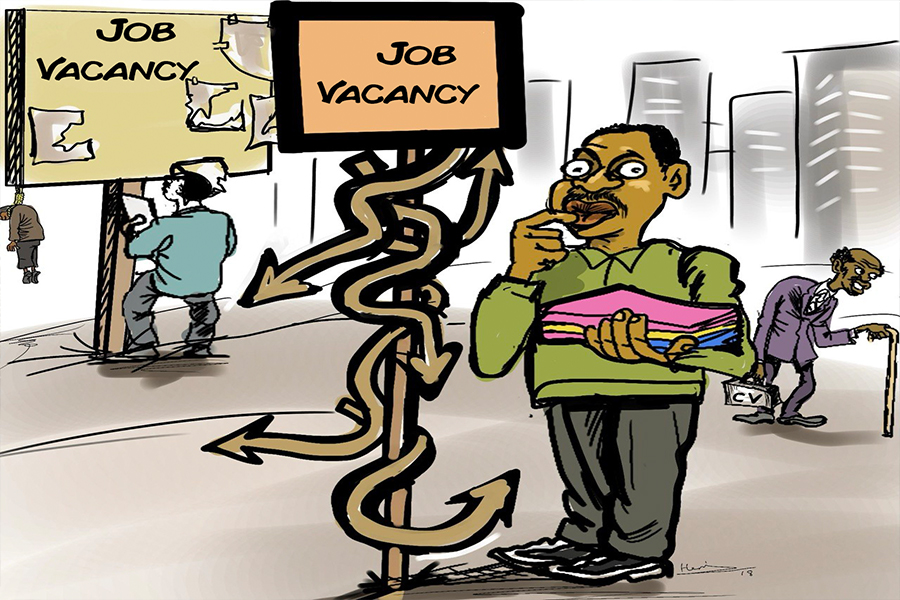
Pressed in Parliament on jobs and household incomes, Prime Minister Abiy Ahmed (PhD)...
Aug 9 , 2026 . By NAHOM AYELE
Anbesa Bank has elected an entirely new board of directors, nine months after the Boa...
Ethiopia Hotel, one of the country's oldest hospitality establishments and a landmark...
Aug 9 , 2026 . By FITSUM TADESSE
The excise-tax reform on alcohol and tobacco has done much of what it was made to do...
Aug 9 , 2026 . By BEZAWIT HULUAGER and ABDUREUF JUHAR
Three inter-city transport companies have spent 450 million Br on new vehicles to mee...






 Loading your updates...