
Fortune News | Mar 11,2026



Jan 31 , 2026.
Shiferaw Teklemariam (PhD), czar of the federal relief operations, is wrestling with a problem that is growing faster than the country’s patience, its fiscal space and, increasingly, its foreign friends.
After decades of relying on outsiders to underwrite disaster response, his government wants to raise its own money for a Risk & Disaster Management Fund. The scheme is deceptively simple. Shave a few cents from everyday transactions, such as telecom bundles, mobile-money transfers, fuel sales and even shareholders’ dividends, then pool the proceeds to pay for droughts, floods and conflicts. The levies would be “tiny”, he would insist, but applied everywhere and all the time.
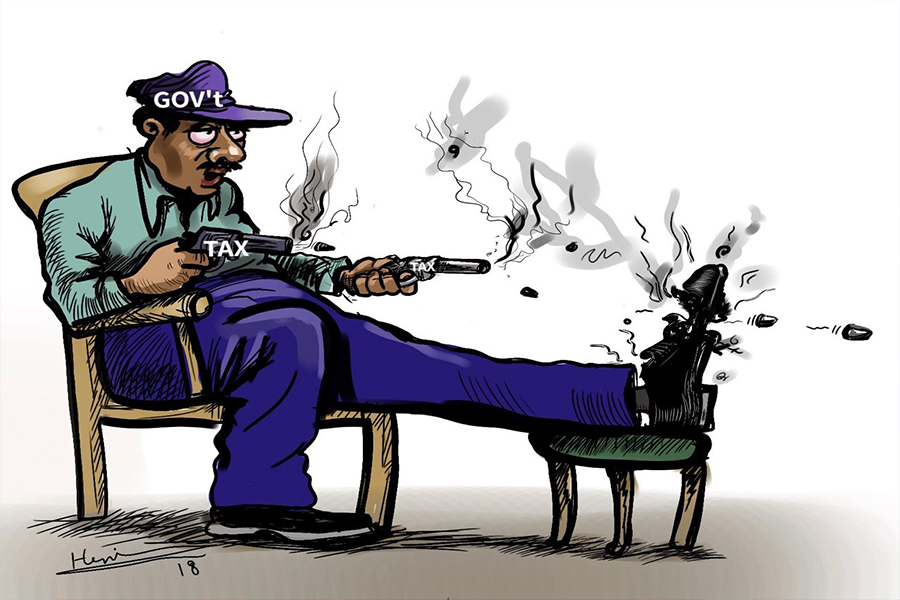
Such surcharges look harmless on a receipt, yet they accumulate quickly. Households already struggling to overcome a dense web of income taxes, service charges, and indirect levies will feel poorer the moment the new fees take effect. Businesses will not escape. Banks facing higher interest rates are likely to raise lending rates, and businesses that borrow will pass those costs on to their customers, fueling inflation that is already painfully high.
The timing could scarcely be worse.
Washington is trimming USAID, part of its effort to rein in spending, and has abandoned the World Health Organisation (WHO), among several other multilateral agencies. Other donors are distracted by wars in Ukraine, Gaza, Sudan and the Sahel, not to mention a parade of climate-fuelled disasters. The comforting myth in humanitarian circles, that if needs are large enough and the story bleak enough, money will follow, no longer holds.
In 2023, Shiferaw's federal agency, the Disaster Risk Managment Commission, appealed to the international community for nearly four billion dollars to help more than 20 million Ethiopians. The following year, the Commission sought 3.23 billion dollars for about 15 million. The sums, once measured in millions, are now counted in billions, yet the coffers arrive emptier each season.
Worse, Ethiopia’s aid pipeline is narrow. A handful of donors supply much of the cash in good years. When one of them shifts priorities because of domestic politics, budget rows, or a scandal over allegations of aid diversion, the shock travels quickly from a congressional committee room in Washington or a parliamentarians' squabble in Brussels to a ration line in Ethiopia. Recent high-level pledging events made the point that even when diplomats and donors declare success, large funding gaps remain and warehouses remain thin, exposing the widening gulf between promises and reality.
Undoubtedly, the strain will intensify over the coming years.
Ideally, the ambition to domestically finance emergency humanitarian responses can have a strong moral logic. The country is hit repeatedly by droughts that return before herders can rebuild their flocks, floods that follow failed rains, epidemics that fester in displacement camps and internal conflicts that turn climate stress into bloodshed. These are not discrete emergencies but an architecture of vulnerability, each shock perched on the last and raising the floor for the next.
A national fund - “Ethiopia Aid” - would signal that solidarity is not a seasonal import like wheat or fuel but a civic covenant. Disasters will not be financed mainly by the mood swings of foreign capitals.
However, the nobility of the cause is not in question. The invoice is.
Ethiopia is often described as one of the world’s least-taxed economies. In macro ratios, the claim appears valid. Tax revenue has slid from 6.8pc of GDP in 2022/23 to 6.1pc in 2023/24, even as nominal receipts reached 716.2 billion Br. This combination, where more Birr is collected from a shrinking share of output, creates a seductive argument that there is room to tap the citizenry. Yet, people do not live inside ratios. They live inside markets, where the formal tax take is only part of the story.
The system leans heavily on indirect taxes collected at the till and baked into prices. These are easy to administer but regressive. Ministries, such as Berhanu Nega (Prof.) of Education, hungry for cash, have also embraced “fees and charges”. A stamp here, a certificate there, a compliance levy somewhere else, each defended as reasonable and each individually trivial, but all collectively transformative. That is how a country can post a low tax-to-GDP figure and still leave a populace feeling nickel-and-dimed every time it steps into the formal economy.
Another macroeconomic reality adds sting. Since the exchange-rate regime shifted in mid-2024, the Birr has fallen off a cliff. The Central Bank’s indicative rate recently was 154.85 Br to the dollar, compared with 57 Br in June 2024, a depreciation of 172pc in under two years. Import prices have soared, and every indirect tax on those imports bites harder. In such an environment, a fresh levy on fuel, airtime or digital payments is not merely annoying. It can get incendiary.
Policy mistakes are punished with unusual speed. Soon, the public calculates that the state is funding compassion by making daily life more expensive. People may tolerate that logic during an acute emergency. It is unlikely they will accept it as a permanent fixture, especially when the emergency never ends.
Contributions, moreover, should come from those best able to pay. Parliament should debate them openly. Convenience taxes masked as service fees may be administratively simple, but they corrode legitimacy. Policymakers should stop confusing a low tax-to-GDP ratio with spare capacity. The figure is a warning that the formal system fails to capture where value is created and stored, not an invitation to milk consumers.
Trust is already fragile. Allegations of aid diversion and the ugly logistics of operating in insecure regions have made foreign donors wary. Domestic contributors will be as suspicious. If the new fund is perceived as a pot of money with weak oversight, it will become a magnet for political patronage and cynicism. Structure, therefore, should do the heavy lifting. The money should be ring-fenced, the books audited and published, the triggers for release transparent and automatic. Governance needs walls to prevent conflicts of interest and a rigid separation between humanitarian purpose and political patronage.
Credibility, in this scheme, is a financing instrument as transparency lowers the “trust premium” that citizens demand.
Ethiopia’s own traditions offer clues. Communal schemes such as Idir and Equb thrive because they are socially legible and morally reciprocal. Their members contribute today because they can imagine receiving help tomorrow. A state-run mechanism needs to meet an even higher standard. If Ethiopians suspect that “solidarity” is a slogan disguising fiscal desperation, compliance will collapse, and the country will lose both donor confidence and domestic goodwill.
Shiferaw should therefore design a fund that taxes pain where it is least painful. The mechanism should sit within a layered risk-financing architecture that rewards anticipatory action and limits the size of appeals. Releasing money early, before livelihoods crumble, is cheaper than paying for emergency rations after collapse.
Above all, "Ethiopia Aid" resist the temptation to multiply fees. The federal government already has what officials call a quasi-fiscal ecosystem, a tangle of charges that is hard to track and easy to expand. If “Ethiopia Aid” becomes the excuse for every agency to add a new toll, the noble idea will rot. The instinct to help neighbours in distress is indigenous. That moral reservoir should be tapped, not poisoned.
The choice is clear. Shiferaw and his government can build a humane buffer that strengthens resilience and restores agency, or they can assemble a new extraction machine that deepens hardship and discredits the intention it was meant to dignify. The cause is noble. The bill must be fair for many.
PUBLISHED ON
Jan 31,2026 [ VOL
26 , NO
1344]
Fortune News | Mar 11,2026
Radar | Jul 17,2022
Advertorials | Jun 02,2025
Exclusive Interviews | Apr 10,2026

Fortune News | Jul 07,2024
Verbatim | Apr 13,2024

Featured | Feb 21,2026
Commentaries | Jun 01,2019
Editorial | Mar 11,2023
My Opinion | Apr 10,2026

Photo Gallery | 193375 Views | May 06,2019

Photo Gallery | 183260 Views | Apr 26,2019

Photo Gallery | 180068 Views | Oct 06,2021

My Opinion | 145500 Views | Aug 14,2021












Dec 22 , 2024 . By TIZITA SHEWAFERAW
Charged with transforming colossal state-owned enterprises into modern and competitiv...
Aug 18 , 2024 . By AKSAH ITALO
Although predictable Yonas Zerihun's job in the ride-hailing service is not immune to...

Jul 28 , 2024 . By TIZITA SHEWAFERAW
Unhabitual, perhaps too many, Samuel Gebreyohannes, 38, used to occasionally enjoy a couple of beers at breakfast. However, he recently swit...
Jul 13 , 2024 . By AKSAH ITALO
Investors who rely on tractors, trucks, and field vehicles for commuting, transporting commodities, and f...
Aug 15 , 2026 . By NAHOM AYELE
Federal prosecutors have charged seven defendants over a set of foreign-trade deals t...
Aug 15 , 2026 . By BEZAWIT HULUAGER
Ethio-post is preparing to turn its thousands of branches into banking agents, allowi...
Aug 18 , 2026 . By BEZAWIT HULUAGER
Kassahun Gofe (PhD), minister of Trade & Regional Integration (MoTRI), is prepari...
Aug 16 , 2026 . By NAHOM AYELE
Justices at the Federal Supreme Court widened the shield they are holding over lawyer...








 Loading your updates...