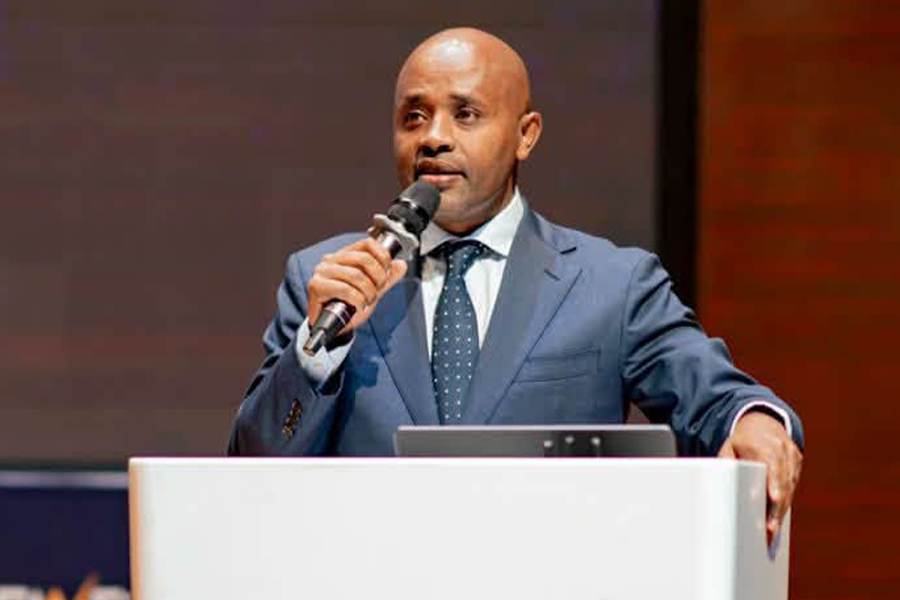



The Harambe Hotel, a mid-20th-century landmark on Ras Desta Damtew St., is undergoing extensive renovations to house the second branch of St. Urael Internal Medicine Speciality Clinic, a known health institution in diabetology and internal medicine.
The Hotel had several tenants, with the last group to operate the property running into bankruptcy and falling behind on rent and taxes. When they eventually vacated the building in 2022, the Federal Housing Corporation (FHC) put it up for lease. A bidder, Mesay Ashenafi, initially won the lease bid but changed his mind, opting not to proceed with his plans to renovate and reopen the Hotel. That left the door open for the Clinic to take over the property for its second branch.
St. Urael Clinic was founded in 2007 by three partners, Genanaw Berihun, Tekleab Mekibib (MD), and Senait Mekibib. The original branch stood near the Rwandan Embassy on Rwanda St., and quickly developed a reputation for speciality care. Over time, the ownership structure shifted to two brothers, Tewodros Gizaw (MD) and Behailu Gizaw. Eventually, Tewodros became the Clinic’s sole owner and the driving force behind its latest expansion.
He has ambitious plans for the new site, broadening the Clinic’s range of services by offering inpatient and intensive care units, as well as surgical procedures.
“We've already invested nearly 120 million Br to renovate the building,” Tewodros disclosed to Fortune. “It needed major work to turn it from a hotel into a medical facility.”
Tewodros believes that once the expanded services are up and running, the Clinic will recoup its investment, citing the site’s central location and accessibility for patients and medical staff. The planned overhaul will bring the total investment to nearly 300 million Br by the time renovations are complete.
The transformation marks the end of an era for a site that played a crucial role during the formative years of African unity.
In the early 1960s, as Africa stood at a historic crossroads, the continent was awash with optimism, political uncertainty, and a yearning for unity. Newly independent states were wrestling with border disputes and ideological rifts, with leaders split between two camps, the Casablanca and the Monrovia groups, each holding strong views about the speed and structure of a united Africa. Doubts lingered whether these rival factions could ever sit together and find common ground.
Emperor Hailesellasie succeeded in bringing the continent’s leaders together to Addis Abeba. The diplomatic breakthrough set the stage for the first African Heads of State Summit, which gave birth to the Organisation of African Unity (OAU). But behind the fanfare, Addis Abeba’s preparations were hurried and makeshift. The city simply did not have the hotel capacity to receive such a prominent and distinguished assembly of guests.
Officials scrambled to find enough beds for the visiting delegations, and every resource was pressed into service. Ministry offices, guesthouses, and even private homes were drafted into service. The city’s mainstays at the time, Taitu, Ethiopia, and the Ghion Imperial hotels, shouldered much of the pressure. Even so, the shortage of rooms was a persistent headache for organisers.
Built by Tesfaye Kejela, a prominent businessman during the Imperial time, the Harambe Hotel opened its doors in time for the Summit. Intended initially as a gas station and cinema, the building became a symbol of civic utility when, at the urging of Ras Hotel’s management and city officials, Tesfaye allowed its unfinished structure to be repurposed for diplomatic hospitality, with an investment of almost one million Birr, a sum that would have turned heads in those days.
According to historian and journalist Berhanu Semu, who documented the commercial evolution of Addis Abeba in his book "From Entoto Thursday Market to Mercato", Tesfaye intended to establish a business that his children could one day manage.
As the country transitioned into a new political era, the military regime nationalised the property. A business that Tesfaye had hoped would secure his family’s future became another state asset, swept up in the Derg’s broader nationalisation campaign in the late 1970s. The Harambe Hotel building became part of the Corporation’s portfolio since.
The Hotel continued to operate under successive tenants for many years, serving as a venue for numerous historical events. However, Berhanu believes the building is worthy of preservation as a piece of living history.
His is not a lone voice of compunction as not everyone is pleased to see the building’s new identity.
Bisrat Haile, who has lived in the neighbourhood for years, prefers the building remain a hotel, not only for sentimental reasons but also because he believes the location is part of the city’s heritage.
“Demolitions are everywhere,” he said, “but if it’s going to change, I’d rather see it as a clinic than lose it altogether.”
The issue of heritage preservation is a growing concern in Addis Abeba. At a public forum marking the 75th anniversary of Addis Abeba University, Fasil Giorgis, a former chair of Conservation & Architectural Heritage at the University, voiced his frustration about the city’s track record.
“I feel a sense of failure when I see the destruction of historic sites and heritage buildings,” he said.
Fasil argued that much of the damage could have been avoided if more people were informed about the value of preservation. He warned that the city’s rapid pace of construction is taking a heavy toll. Many historical sites are being demolished, paving the way for new projects to be launched "without adequate research or expert input."
"The loss is more than just bricks and mortar," Fasil said. "When such sites disappear, so does a piece of the city’s identity and collective memory. Protecting important buildings is crucial because they're symbols of our history.”
PUBLISHED ON
Dec 06,2025 [ VOL
26 , NO
1336]

Radar | Jul 17,2022

Fortune News | Oct 15,2022
Sponsored Contents | Jul 24,2022
Advertorials | Jul 14,2025
Sunday with Eden | Jul 17,2022

Verbatim | Aug 10,2024

Viewpoints | Aug 30,2025
Fortune News | Jul 04,2026
Radar | Jun 22,2024

Exclusive Interviews | Apr 10,2026

Dec 22 , 2024 . By TIZITA SHEWAFERAW
Charged with transforming colossal state-owned enterprises into modern and competitiv...

Aug 18 , 2024 . By AKSAH ITALO
Although predictable Yonas Zerihun's job in the ride-hailing service is not immune to...

Jul 28 , 2024 . By TIZITA SHEWAFERAW
Unhabitual, perhaps too many, Samuel Gebreyohannes, 38, used to occasionally enjoy a couple of beers at breakfast. However, he recently swit...

Jul 13 , 2024 . By AKSAH ITALO
Investors who rely on tractors, trucks, and field vehicles for commuting, transporting commodities, and f...

Aug 14 , 2026
Aschalew Fetene, known as “Ardi” and admired for his poetic depth, has built a ti...

Aug 8 , 2026
The World Bank asks readers to picture a mother in rural Ethiopia who has never held...

Jul 31 , 2026
Weldu Yiheysh has not read the Pacific temperature charts. He does not need to. In Shibta District of Enderta Wereda, in...

Jul 25 , 2026
Ideally, citizens who have paid income tax all year should not have to reach for thei...









 Loading your updates...