
Verbatim | May 27,2023



Feb 7 , 2026
By Margrethe Vestager
The world order’s troubles predate the Trump presidency. The UN has struggled to function effectively, and the WTO has lost momentum. Middle powers such as India, Brazil, and South Africa have openly questioned the legitimacy of international systems anchored in Western priorities. As institutions lose their legitimacy, countries increasingly pursue unilateral interests, often leading to trade disputes and unresolved conflicts.
When people ask me how I am doing, I generally reply: "I'm fine, but the world is a mess." Still, as a Dane, the past few weeks have been particularly difficult, and incomparably worse for the people of Greenland.
With his assertion that might-makes-right, his threats to Danish sovereignty, his undermining of the United Nations (UN) through a Board of Peace, and his commercialisation of humanitarian aid, President Donald Trump has made his worldview plain, and it is deeply troubling.
But the uncomfortable truth is that the world order was already broken before Trump's first presidency. He did not create the dysfunction. He simply poured gasoline on the fire and accelerated the decline. The UN had long failed to function effectively, and the World Trade Organisation (WTO) had ground nearly to a halt. Major regional powers such as India, Brazil, and South Africa were openly questioning the legitimacy of an international system that remained wedded to a Western perspective and too often failed to reflect their perspectives or accommodate their interests.
The real danger now is that Trump-incited chaos will be used as an excuse for paralysis; that we will be so busy defending the old order that we fail to build a better one. It is all too tempting to circle the wagons, to defend existing institutions as a matter of principle or out of a sense of duty. But this defensive approach misses the essential point. The alternative to a dysfunctional order is not the same order functioning better. It is a better order, or no order at all.
When international institutions lack legitimacy, countries pursue their interests unilaterally. When the WTO cannot resolve disputes, governments eventually resort to tariff wars. When the UN Security Council is paralysed, conflicts metastasise, and the costs fall most heavily on smaller countries and the global commons. We have seen this time and again when it comes to tackling climate change, pandemics, cybersecurity, and other collective challenges.
Trump's might-makes-right approach only works because our institutional constraints have already failed. Now that he is gleefully destroying what remains of the old order, a strategy for reform and renewal is not a luxury that we can afford to defer. The erosion of institutional legitimacy creates the very conditions that allow leaders like Trump to thrive.
For proof that reforming global institutions is no longer an option, look no further than the challenges posed by AI. These technologies, with their extraordinary potential benefits and equally extraordinary risks, cannot be governed by any single country, no matter how powerful it is. Effective governance requires exactly what we are missing: legitimate and effective global cooperation.
That means we have an opportunity. Unlike reforming institutions burdened by decades of accumulated dysfunction and resentment, we can build governance frameworks for AI from the ground up, and what we build can properly reflect today's multipolar reality, rather than yesterday's Western dominance.
The Hiroshima AI Process, launched under Japan's G7 presidency in 2023, offers a model that we can build on. It brought together major economies to establish voluntary guidelines for AI development and deployment. But, of course, voluntary guidelines among a limited group of countries are not enough. What we really need is a global framework that includes the Global South, that strikes an optimal balance between innovation and safety, and that has functioning enforcement mechanisms.
This is not about creating a new bureaucracy. It is about establishing clear principles on safety, transparency, legal liability, and the rights of affected populations. That is how all countries can be confident that AI will develop in ways that serve humanity, rather than narrow national or private interests.
The comparison to nuclear weapons is instructive, even if it is imperfect. AI will not be contained by non-proliferation treaties, because the technology is simply too distributed for that. Instead, we need something closer to the frameworks governing aviation safety or pandemic surveillance. These function through technical cooperation grounded in shared self-interest, with mechanisms for rapid information sharing and coordinated responses to emerging risks.
We need frameworks that are inclusive, practical, and genuinely empowering. Establishing effective AI governance could demonstrate what reformed multilateralism looks like and restore confidence that international cooperation delivers real value. And it could establish a template for tackling other challenges that do not stop at national borders.
The world is indeed a mess. But defending institutions that have lost their effectiveness and legitimacy is not the answer. We can and should build something better, starting with AI. The alternative is not preserving the status quo. It is watching it collapse entirely.
PUBLISHED ON
Feb 07,2026 [ VOL
26 , NO
1345]

Verbatim | May 27,2023
Featured | Sep 08,2024
Radar | May 08,2021
Radar | Feb 19,2022
Fortune News | May 09,2026
Fineline | Jan 04,2020
Life Matters | Dec 14,2024
Viewpoints | Aug 03,2024
Radar | Jul 04,2026
Commentaries | Apr 02,2022

Photo Gallery | 193373 Views | May 06,2019

Photo Gallery | 183258 Views | Apr 26,2019

Photo Gallery | 180064 Views | Oct 06,2021

My Opinion | 145496 Views | Aug 14,2021







Dec 22 , 2024 . By TIZITA SHEWAFERAW
Charged with transforming colossal state-owned enterprises into modern and competitiv...
Aug 18 , 2024 . By AKSAH ITALO
Although predictable Yonas Zerihun's job in the ride-hailing service is not immune to...

Jul 28 , 2024 . By TIZITA SHEWAFERAW
Unhabitual, perhaps too many, Samuel Gebreyohannes, 38, used to occasionally enjoy a couple of beers at breakfast. However, he recently swit...
Jul 13 , 2024 . By AKSAH ITALO
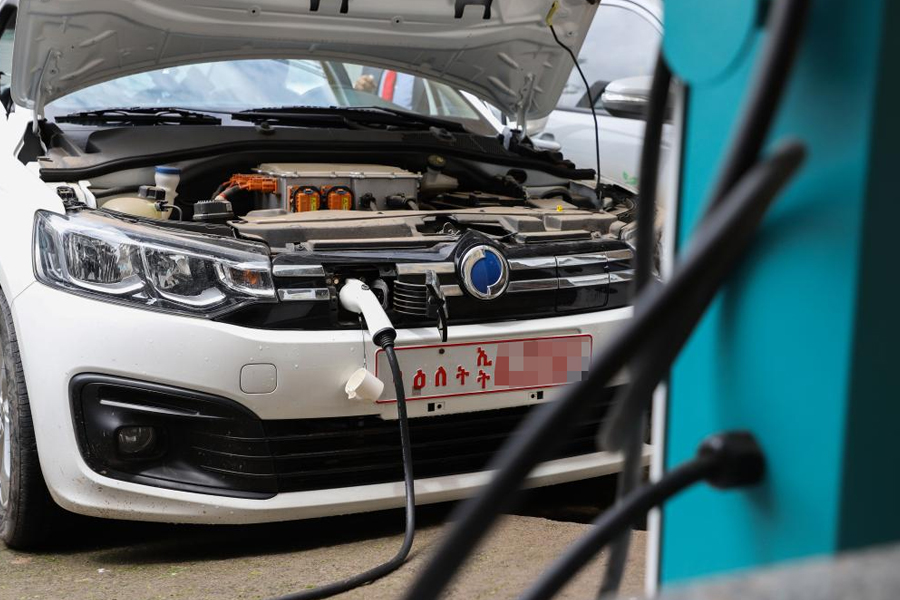
Investors who rely on tractors, trucks, and field vehicles for commuting, transporting commodities, and f...

Aug 14 , 2026
Aschalew Fetene, known as “Ardi” and admired for his poetic depth, has built a ti...

Aug 8 , 2026
The World Bank asks readers to picture a mother in rural Ethiopia who has never held...

Jul 31 , 2026
Weldu Yiheysh has not read the Pacific temperature charts. He does not need to. In Shibta District of Enderta Wereda, in...
Jul 25 , 2026
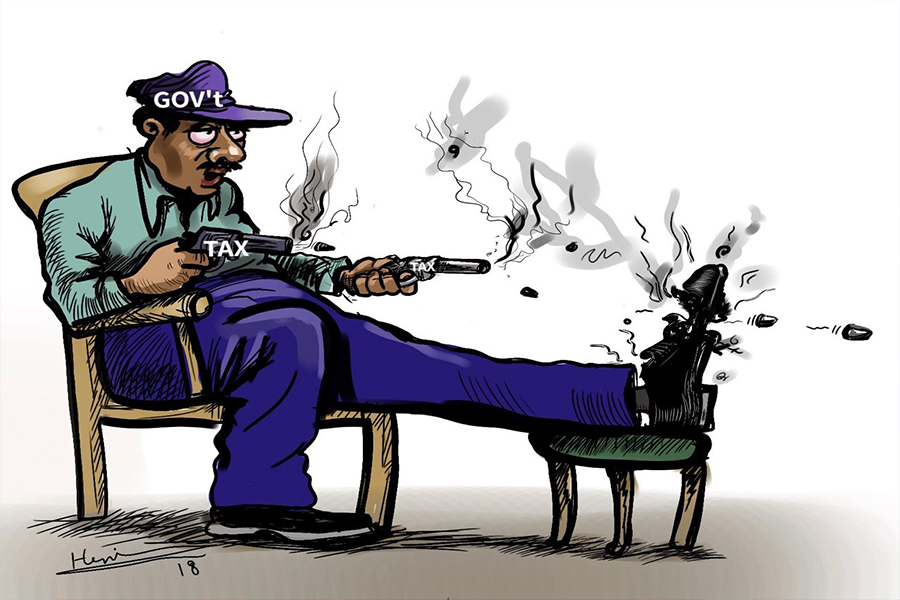
Ideally, citizens who have paid income tax all year should not have to reach for thei...
Aug 15 , 2026 . By NAHOM AYELE
Federal prosecutors have charged seven defendants over a set of foreign-trade deals t...
Aug 15 , 2026 . By BEZAWIT HULUAGER
Ethio-post is preparing to turn its thousands of branches into banking agents, allowi...
Aug 18 , 2026 . By BEZAWIT HULUAGER
Kassahun Gofe (PhD), minister of Trade & Regional Integration (MoTRI), is prepari...

Aug 16 , 2026 . By NAHOM AYELE
Justices at the Federal Supreme Court widened the shield they are holding over lawyer...





 Loading your updates...