
Viewpoints | Feb 28,2026



Apr 18 , 2026
By Kidist Yidnekachew
The demand to be seen, understood, and categorised has intensified in the digital age. Social psychology highlights the burden of impression management and the exhaustion of correcting perceptions. With limited emotional resources, individuals are choosing selective truth over constant clarification. This shift challenges the assumption that identity must always be publicly asserted. Instead, authenticity is becoming a private exercise.
In the grand tapestry of human history, principles have often been painted in high contrast. We honour the martyrs of freedom movements and the pioneers of civil rights, individuals whose convictions were so absolute that they were willing to trade their lives for a cause. Their clarity was their strength. In the modern era, that clarity has become a rare luxury. For many, the contemporary world does not offer a singular, “real” cause to die for. Instead, we navigate a grey zone (enter the world of conspiracies or hidden truths), where the most sacred principles are often the most private ones: family, children, and the quiet right to exist without being categorised.
There is a distinct psychological shift in how we perceive collective causes. Historically, social movements provided a sense of “optimal distinctiveness,” a psychological theory suggesting that humans strive to balance the need to belong with the need to feel unique. When the cause is clear (e.g., the right to exist), the “middle ground” feels like moral cowardice.
In a digital age saturated with performative activism and shifting social goalposts, the “middle ground” has transformed. It is no longer a sign of indecision but a response to cognitive overload. When every issue is framed as a binary battle, choosing the centre becomes an act of self-preservation. It reflects the recognition that, while some causes are undoubtedly worthy, the modern landscape is often cluttered with “simulated” causes that lack the moral weight of the past. For the modern individual, the only cause that may justify ultimate sacrifice is not a political ideology but the tangible, breathing reality of one’s own family.
Living between two sides or belonging to none comes with a specific mental tax known as psychological disequilibrium. Humans are biologically hardwired to categorise. From an evolutionary perspective, the ability to quickly identify “friend or foe” or “member of my tribe” was essential for survival. When you refuse easy categorisation, you disrupt the social scripts of those around you.
This creates a constant state of brain fatigue. There is a subtle, persistent pressure to prove yourself, to pick a team, or to clarify your stance to ease others’ confusion. Social psychology refers to this as impression management. Usually, we work to ensure others see us as we see ourselves. Yet there is a peculiar freedom in “silent correction”, the choice to stop managing those impressions altogether.
Consider the phenomenon of perceived identity. Imagine a person from one African nation who, due to physical features, is consistently mistaken for an Ethiopian. In every interaction, a greeting on the street, a casual exchange in a shop, an observer projects an entire cultural and linguistic background onto them.
The standard social contract suggests that the individual should correct the misconception: “Actually, I’m not from here.” But why?
If truth is a personal treasure, must it be spent on every stranger? Choosing not to correct an assumption is not the same as lying; it is a form of selective disclosure. Psychologically, we operate with a limited reserve of emotional labour. Correcting every misidentification is exhausting. By allowing others their assumptions, the individual reclaims that energy. They know their truth; the world operating on a false premise does not alter who they are.
This “middle-of-the-road” existence allows one to become a silent observer. There is an advantage in being perceived as “one of them.” It offers a unique vantage point, a way to see how groups behave when they believe they are among their own. It is a position of quiet power.
The need to be “known” is often confused with the need to be “understood.” We want our friends and family to know us deeply, yet the desire for the general public to “get us” can become a trap. When we demand universal accuracy in how we are seen, we hand over control of our identity.
By contrast, there is profound liberation in allowing the world to be wrong about you. It creates a private sanctuary. If people assume you belong to a certain group or hold a certain belief, and you feel no need to correct them, you have reached a rare level of autonomy. You are no longer performing for an audience; you are simply living.
In an era that insists we must “stand for something or fall for anything,” there is a quiet, radical dignity in standing in the middle. Valuing principles does not require a battlefield; at times, the greatest principle is the protection of one’s inner peace and the safety of one’s kin.
We do not owe the world a map of our soul. Whether it is our nationality, our politics, or our deepest convictions, we retain the right to remain unclassified. Truth does not lose value because it is unannounced. In the end, those who ask with care and stand close enough will see it. For everyone else, the assumption is theirs to carry. Living authentically is not about volume; it is about certainty in who you are when the room is silent.
PUBLISHED ON
Apr 18,2026 [ VOL
27 , NO
1355]

Viewpoints | Feb 28,2026

In-Picture | May 23,2026
Fortune News | Jun 22,2024

Fortune News | Sep 09,2024

Advertorials | Jul 25,2025

In-Picture | Mar 16,2024
Fortune News | Jun 21,2026

Radar | Jun 14,2026

Money Market Watch | Feb 21,2026
Fortune News | Mar 02,2024

Photo Gallery | 191735 Views | May 06,2019

Photo Gallery | 181491 Views | Apr 26,2019

Photo Gallery | 178201 Views | Oct 06,2021

My Opinion | 143748 Views | Aug 14,2021





Dec 22 , 2024 . By TIZITA SHEWAFERAW
Charged with transforming colossal state-owned enterprises into modern and competitiv...

Aug 18 , 2024 . By AKSAH ITALO
Although predictable Yonas Zerihun's job in the ride-hailing service is not immune to...

Jul 28 , 2024 . By TIZITA SHEWAFERAW
Unhabitual, perhaps too many, Samuel Gebreyohannes, 38, used to occasionally enjoy a couple of beers at breakfast. However, he recently swit...

Jul 13 , 2024 . By AKSAH ITALO
Investors who rely on tractors, trucks, and field vehicles for commuting, transporting commodities, and f...
Jul 18 , 2026
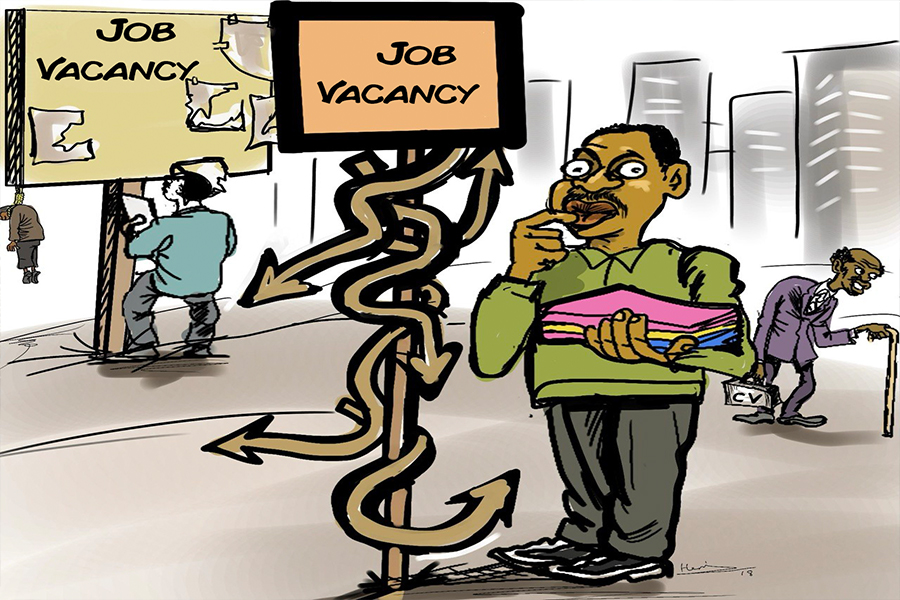
Pressed in Parliament on jobs and household incomes, Prime Minister Abiy Ahmed (PhD)...
Jul 11 , 2026
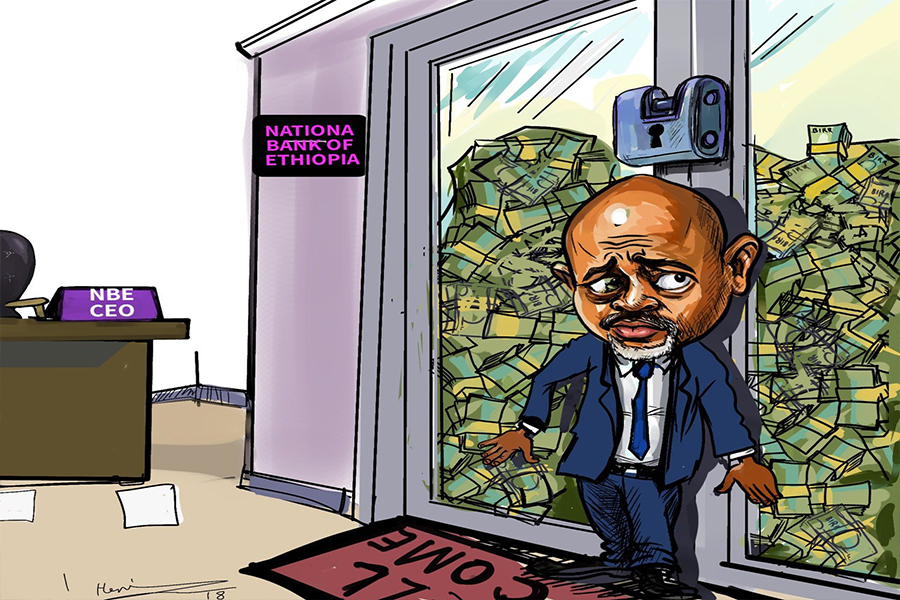
At a market stall, reform arrives without a communique. It comes as a higher transpor...
Jul 4 , 2026
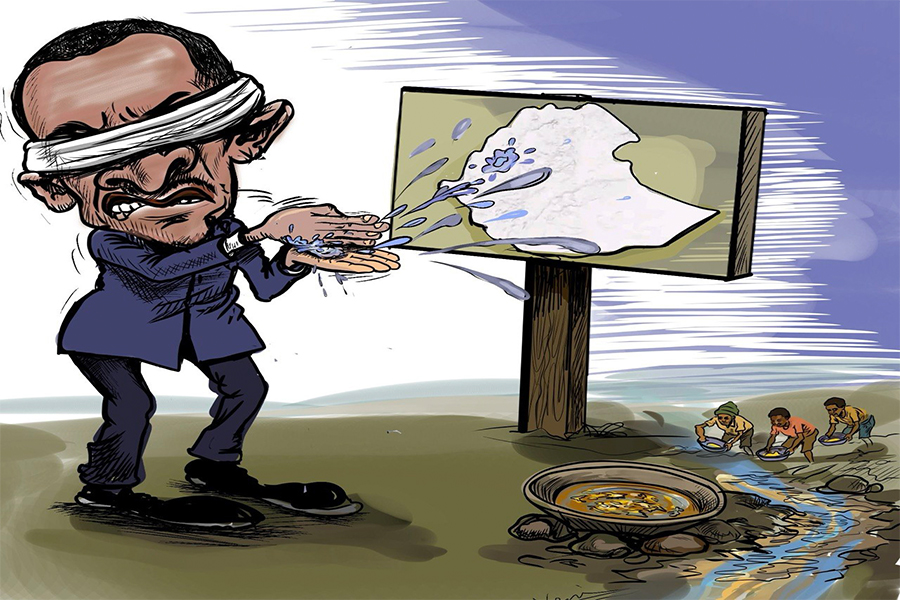
In the goldfields of the Benishangul-Gumuz Regional State, Ethiopia's balance-of-paym...
Jun 27 , 2026
The federal legislative house rushed through one of the country's most contentious ho...
Jul 19 , 2026 . By BEZAWIT HULUAGER
Bureaus, agencies and institutions under the Addis Abeba City Administration are sitt...

Jul 22 , 2026 . By NAHOM AYELE
Most airports under the Ethiopian Airlines Group (EAG) lack master plans, and some op...

Jul 19 , 2026 . By NAHOM AYELE
Judges at the Federal High Court have struck down an amendment that the Ministry of E...
Jul 19 , 2026 . By BEZAWIT HULUAGER
Addis Abeba is moving to force its money through the wires. A draft directive from th...




 Loading your updates...