


Nov 8 , 2025
By Bjorn Lomborg
As politicians jet into Belém, Brazil, for the 30th annual UN climate meeting, philanthropist Bill Gates has provided a straightforward insight. Climate summits like COP30 should prioritise what truly improves human lives, rather than simply chasing reductions in emissions or temperatures. His point is refreshingly overdue and, frankly, a common-sense observation.
I have long argued that policymakers should always ask what the smartest way is to do the most good with limited resources. For billions of people in the developing world, addressing immediate challenges such as poverty and disease takes precedence over pursuing distant temperature goals. In poor countries, parents are not kept awake by concern about achieving a 0.1°C temperature reduction over a century. They worry whether their children will survive a bout with malaria or get a decent education.
As Gates pointed out, "the biggest problems are poverty and disease, just as they always have been." Every year, more than 7.5 million people in poorer countries die from illnesses that could be prevented or managed very cheaply. Smart investments in health, nutrition and education could save over four million people every year, while also building growth and resilience for the future.
Gates' common-sense message is at the crest of a growing global shift in thinking.
For years, no departure from dogmatic climate conformism was tolerated. Making drastic emissions cuts at any cost was the paramount policy goal. This extremist message was repeated ad nauseam by the United Nations Secretary-General, numerous politicians and an army of hectoring celebrities. Anyone questioning the supremacy of the climate threat or expressing scepticism at the costly policies required was derided as a "climate denier."
Suddenly, pragmatism and nuanced thinking are back in fashion. Canadian Prime Minister Mark Carney, who warned a decade ago that potential climate catastrophe meant fossil fuel reserves could be "unburnable", is fast-tracking the construction of an LNG export terminal and promising to "transform our country into an energy superpower." In the U.S., Democratic Senator Chris Coons says that climate is "not a top three issue right now." Even the green-leaning British and German governments are discussing the need to incorporate some economic considerations into climate and energy policy.
It is time to move beyond the doomsday narratives that have dominated the climate discussion in recent years.
Climate change is a real problem, but it is not the end of the world. If it is not addressed, climate economics shows that it might shave two to three percent off global GDP by 2100. We will be 435pc richer instead of 450pc. Climate is one issue among many, not an apocalypse that eclipses everything else. And yet the same old activists are repeating their well-worn arguments.
First, the notion that climate spending is not crowding out efforts to tackle poverty. This idea is pushed by climate professor Michael Oppenheimer, who claims Gates sets up a "false dichotomy." But anyone living in the real world knows money cannot be spent twice. By their own admission, the world's multilateral development banks, international organisations funded largely by taxpayers to help the world's poorest countries, devoted an astonishing 137 billion dollars to climate financing in 2024. That is 137 million dollars spent on climate that will not be spent on preventing disease and hunger.
Globally, we have spent over 14 trillion dollars on climate policies. Last year alone, the cost exceeded two trillion dollars. Having been spent on climate policy, that money cannot be spent again on basic education and maternal healthcare.
Then there is the alarmist claim from climate professor Michael Mann that "there is no greater threat to developing nations than the climate crisis." This patronising argument suggests that climate campaigners in rich-country ivory towers understand things better than people living in the global South. In real life, Africans from 39 countries rank climate as their 31st most important problem out of 34, far behind education, jobs, health and roads.
The greatest challenges are pretty obvious for those who live in poverty, and disease and hunger claim lives daily. Yet, green campaigners tell us, in essence, that poor people need emissions cuts first and foremost, before more food, medicine or pathways out of poverty. Bill Gates now disagrees, urging us to focus on what helps most.
A climate summit focused on human welfare would recognise that, making people more resilient. Boosting prosperity is one of the best policy responses to climate change. As with any policy, we should approach the climate with a focus on what makes the biggest impact. That means ending the obsession with costly and inefficient Net Zero and doubling down on adaptation, as well as R&D to spark green-energy innovation.
In the city of Belém on the Amazon, the private jets of the world's climate elites gathered for yet another climate summit. There, more than anywhere else, it is well past time for common sense to get a hearing.
PUBLISHED ON
Nov 08,2025 [ VOL
26 , NO
1332]


Fortune News | Feb 28,2026
Fortune News | Oct 22,2022
Radar | Jan 31,2026

Radar | Jun 27,2020

Viewpoints | May 30,2026
Radar | May 03,2026
Election 2026 coverage | Apr 10,2026

Sunday with Eden | Apr 04,2026
Fortune News | Dec 27,2025
Fortune News | Jun 21,2026

Photo Gallery | 192064 Views | May 06,2019

Photo Gallery | 181827 Views | Apr 26,2019

Photo Gallery | 178560 Views | Oct 06,2021

My Opinion | 144086 Views | Aug 14,2021




Dec 22 , 2024 . By TIZITA SHEWAFERAW
Charged with transforming colossal state-owned enterprises into modern and competitiv...
Aug 18 , 2024 . By AKSAH ITALO
Although predictable Yonas Zerihun's job in the ride-hailing service is not immune to...

Jul 28 , 2024 . By TIZITA SHEWAFERAW
Unhabitual, perhaps too many, Samuel Gebreyohannes, 38, used to occasionally enjoy a couple of beers at breakfast. However, he recently swit...
Jul 13 , 2024 . By AKSAH ITALO
Investors who rely on tractors, trucks, and field vehicles for commuting, transporting commodities, and f...

Jul 25 , 2026
Ideally, citizens who have paid income tax all year should not have to reach for thei...
Jul 18 , 2026
Pressed in Parliament on jobs and household incomes, Prime Minister Abiy Ahmed (PhD)...
Jul 11 , 2026
At a market stall, reform arrives without a communique. It comes as a higher transpor...
Jul 4 , 2026
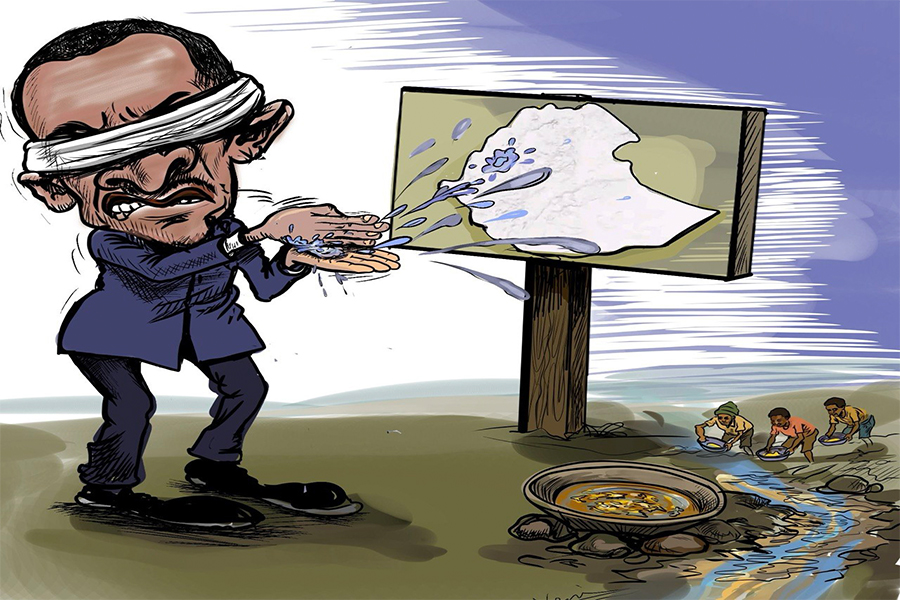
In the goldfields of the Benishangul-Gumuz Regional State, Ethiopia's balance-of-paym...
Jul 25 , 2026 . By BEZAWIT HULUAGER
Global Bank's Board of Directors have overhauled top management, after suspending sev...

Jul 25 , 2026 . By NAHOM AYELE
Judges at the Federal High Court have overturned the National Lottery Administration...
Jul 28 , 2026 . By NAHOM AYELE
A newly enacted regulation by the Council of Ministers lets eligible producers pledge...
Jul 25 , 2026 . By FITSUM TADESSE
A fuel tanker carrying tens of thousands of litres was confiscated after its driver a...







 Loading your updates...