

Radar | Jan 15,2022



Feb 18 , 2023
By Myriam Castaneda Solares
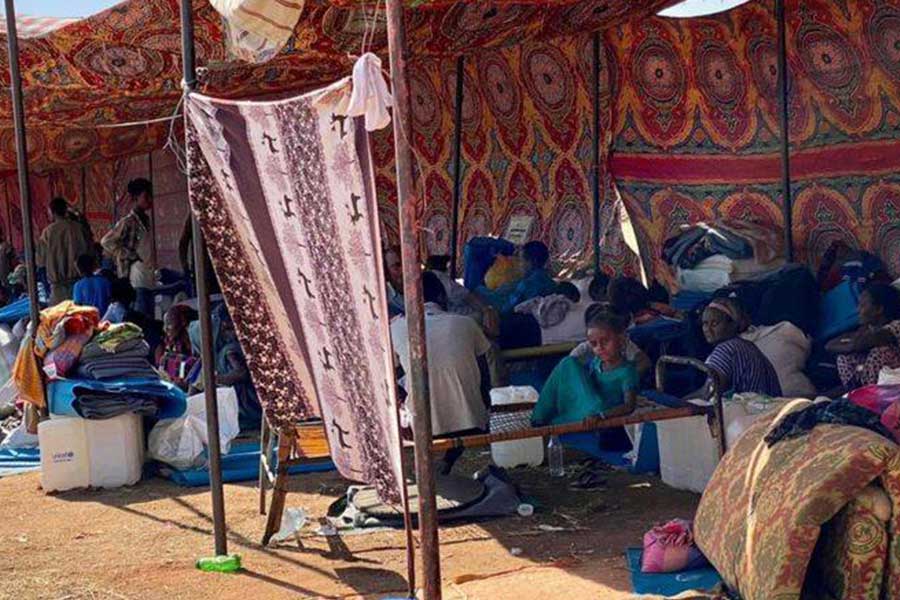
The world is in the midst of the worst food crisis in modern history. As a confluence of geopolitical, economic, and climate crises fuels global shortages, a staggering 326 million people in dozens of countries need humanitarian aid, with 222 million facing acute food insecurity and up to 50 million at risk of starving to death.
The poorest countries have been hit the hardest by the rise in global food prices caused by the war in Ukraine. And with the looming climate catastrophe threatening to compound the effects of conflict and supply-chain disruptions, the humanitarian sector must adopt a more proactive, anticipatory approach to the growing hunger crisis.
Until relatively recently, humanitarian organizations did not pay much attention to climate change. But the proliferation of weather-related humanitarian emergencies has caused the sector to recognize the threat that the climate crisis poses to low-income countries and the global food system.
While the deadly floods and heatwaves that have struck Europe over the last two years have shown that even countries considered to be relatively safe are not immune to extreme weather events, developing countries are much more vulnerable. In 2021, 94pc of internally displaced people became so as a result of climate-related hazards. Last year’s floods in Pakistan, which shocked the world, submerged one-third of the country, claimed more than 1,739 lives, affected 33 million people, and caused economic losses estimated at 16.3 billion dollars.
With climate change causing humanitarian crises worldwide, the number of people needing aid has increased by 40pc over the past year. In response to the growing need, funding for humanitarian causes has nearly doubled over the past decade, reaching 31.3 billion dollars in 2021. But while funding has increased, the challenge facing international agencies and NGOs today is to maximize the impact of these resources and empower local and national organizations.
As matters currently stand, two-thirds of all direct contributions to humanitarian causes go to United Nations agencies and prominent international organizations like the Red Cross and Red Crescent. While these large institutions play a crucial role, community-based initiatives often have a better grasp of local contexts. The world’s largest donors and NGOs seemed to acknowledge this when they launched the Grand Bargain Initiative in 2016, committing to providing 25pc of humanitarian funding to local organizations.
But seven years after the agreement was announced, the figure is still less than two percent.
So far, the sector’s modus operandi has been reactive. Whether it is Haiti, Ethiopia or Pakistan, the methods are the same: a crisis emerges, a humanitarian appeal is launched, funding is raised, and assistance is delivered many days (if not months) later. But by relying on climate science, we can anticipate risks and address humanitarian needs before they become emergencies.
Anticipatory action, defined as “acting ahead of predicted hazardous events to prevent or reduce acute humanitarian impacts before they fully unfold,” involves forecasting mechanisms and pre-agreed triggers and thresholds for releasing funds in advance. By responding to needs in this way, we can deliver aid more effectively and in a more dignified way. In 2019, for example, the Senegalese government and Start Network each purchased insurance policies against drought, allowing them to receive funding for humanitarian action and coordinate measures to protect at-risk communities.
But anticipatory action also has its limits. As a recent report by Start Network shows, not all crises can be forecasted or modelled. Even so, adopting this approach would allow humanitarian actors and organizations to be proactive, improve efficiency, and prevent life-threatening events from developing into large-scale disasters.
The global aid system needs rapid reform. While some progress has been made in recent years, much of it has been transactional rather than transformative. The problems we face are complicated and multidimensional, and we cannot disregard the political dimension of humanitarian action. Some may believe that necessity or desperation will force the sector to change for the better, but scaling up anticipatory and locally-led action represents a far more promising path.
The ongoing climate crisis offers a unique opportunity for evidence-based humanitarian reform. There is no reason to wait until disaster strikes in our data-driven world. By anticipating risks and planning ahead, we can protect vulnerable communities and make the world a safer place.
PUBLISHED ON
Feb 18,2023 [ VOL
23 , NO
1190]

Radar | Jan 15,2022
Fortune News | Nov 21,2020
Radar | Mar 11,2024
Radar | Nov 20,2021
Commentaries | Jul 30,2022

Radar | Sep 01,2024
Radar | Mar 12,2022

Radar | Aug 24,2019
Commentaries | Jun 14,2025

Editorial | Dec 06,2025

Photo Gallery | 193358 Views | May 06,2019

Photo Gallery | 183242 Views | Apr 26,2019

Photo Gallery | 180049 Views | Oct 06,2021

My Opinion | 145478 Views | Aug 14,2021











Dec 22 , 2024 . By TIZITA SHEWAFERAW
Charged with transforming colossal state-owned enterprises into modern and competitiv...

Aug 18 , 2024 . By AKSAH ITALO
Although predictable Yonas Zerihun's job in the ride-hailing service is not immune to...

Jul 28 , 2024 . By TIZITA SHEWAFERAW
Unhabitual, perhaps too many, Samuel Gebreyohannes, 38, used to occasionally enjoy a couple of beers at breakfast. However, he recently swit...

Jul 13 , 2024 . By AKSAH ITALO
Investors who rely on tractors, trucks, and field vehicles for commuting, transporting commodities, and f...

Aug 14 , 2026
Aschalew Fetene, known as “Ardi” and admired for his poetic depth, has built a ti...

Aug 8 , 2026
The World Bank asks readers to picture a mother in rural Ethiopia who has never held...

Jul 31 , 2026
Weldu Yiheysh has not read the Pacific temperature charts. He does not need to. In Shibta District of Enderta Wereda, in...

Jul 25 , 2026
Ideally, citizens who have paid income tax all year should not have to reach for thei...
Aug 15 , 2026 . By NAHOM AYELE
Federal prosecutors have charged seven defendants over a set of foreign-trade deals t...
Aug 15 , 2026 . By BEZAWIT HULUAGER
Ethio-post is preparing to turn its thousands of branches into banking agents, allowi...
Aug 18 , 2026 . By BEZAWIT HULUAGER
Kassahun Gofe (PhD), minister of Trade & Regional Integration (MoTRI), is prepari...

Aug 16 , 2026 . By NAHOM AYELE
Justices at the Federal Supreme Court widened the shield they are holding over lawyer...






 Loading your updates...