


Life Matters | Feb 21,2026



Aug 28 , 2021
By Eden Sahle
Recently, I began taking a course on behavioural science with about 10 people in my class. It took only a few minutes to introduce ourselves to one another and to our young and energetic instructor.
Not long after the lecture started, our instructor jumped right into the grim situation of Ethiopia. Some of the specific and chilling things he was telling us for an entire couple of hours were new to me, although I was aware of the many crises the nation is undergoing. From family to society, he explained how hostile and dysfunctional we are.
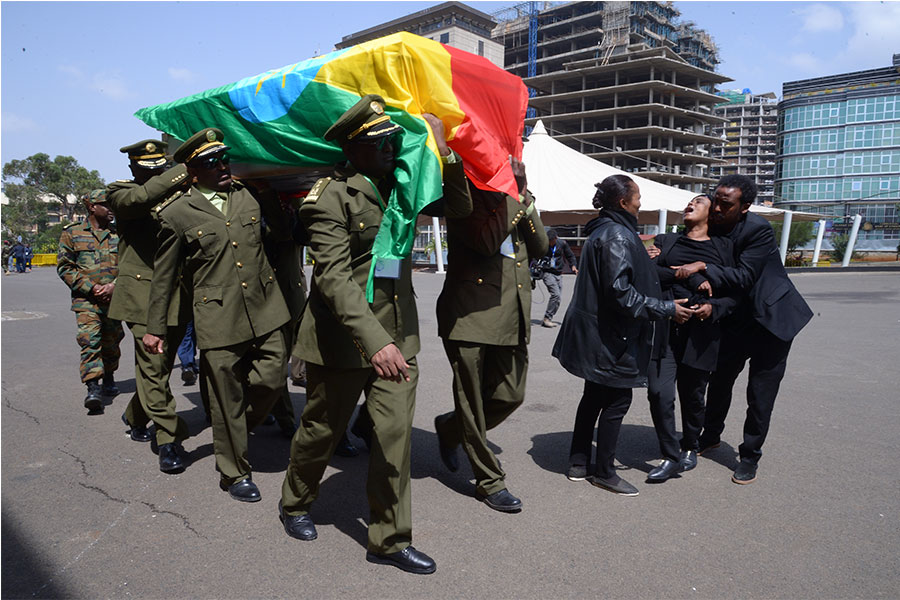
We listened to his stories in shock and sadness. It is surprising that all of us are not bathed in tears given the plight of our country and its people, according to him. For most of us, individual suffering and death are tragedies while we tend to have a comparatively less sympathetic response to many people’s loss of life. The deaths of many are often taken just as statistics where the fact that these people are individuals is forgotten. They are someone's father, mother, sister, brother, spouse, sibling, child, or friend.
This is because it is much harder to comprehend a mass tragedy than a single death. But in both situations, precious human life is being lost. Beneath the surface of the numbers, there are always individuals.
The tendency to fail to relate to the loss of many lives at such regular intervals and scale in Ethiopia has triggered our emotional numbing and complacent behaviour to the endless tragedies we wake up to every morning. The more we are exposed to large numbers of losses of life, the more desensitised we become.
It is not just desensitisation. The public, exposed to war and the persistent COVID-19 pandemic, is experiencing a fall in mental, emotional and physical health. Severe losses and disruptions in lives are leading to high rates of depression and anxiety. These impacts may be prolonged by exposure to further hardships and violence in daily lives. The heavy impact of this is making society lose its meaning. They may also have to change their moral structure to care for others and adapt to the new reality.
No one seems to know when peace and order will be restored. Confusion has erupted as people settle for their own understanding and analysis of the ongoing crisis. We are fast losing people who comfort and tell us there is light at the end of the tunnel, that somehow a better day would come for the nation and its people. Words may not conceal realities, bring the diseased back, or even meaningfully alleviate the pain grieving families feel, but it gives hope that can keep people going.
It is about time that we rise to help and comfort at least one person, to care for another individual who is part of society. We should not be resigned to the persistence of tragedies and ignore the individuals that make up mass catastrophes.
“If I look at the mass, I will never act,” as Mother Teresa once famously said. “If I look at the one, I will.”
Whether we like it or not, our welfare is highly dependent on that of others. If caring for others is such a fundamental aspect of humanity, we should ask ourselves why we do not practice it often. For the most part, developing compassion for others allows us to ease their burden, and reaching out to one person for support is reaching out to many.
The joy that comes with choosing to care for others' loss and tragedy is immeasurable. As we all have people we hold close to us, the people we only consider as statistics are someone's beloved. Even if they live at the far periphery of our concentric circles of concern, we have responsibilities to people. If not out of compassion, at least from the view that our welfare eventually depends on it as well.
PUBLISHED ON
Aug 28,2021 [ VOL
22 , NO
1113]
Life Matters | Feb 21,2026

Fortune News | Nov 21,2018
Fortune News | Jun 29,2019
Commentaries | Feb 08,2020

Sunday with Eden | Feb 23,2019

Viewpoints | Dec 25,2021
Verbatim | Oct 27,2024
View From Arada | Aug 28,2021
Sunday with Eden | Sep 10,2022
Featured | Jul 10,2020

Photo Gallery | 193638 Views | May 06,2019

Photo Gallery | 183533 Views | Apr 26,2019

Photo Gallery | 180359 Views | Oct 06,2021

My Opinion | 145784 Views | Aug 14,2021










Dec 22 , 2024 . By TIZITA SHEWAFERAW
Charged with transforming colossal state-owned enterprises into modern and competitiv...

Aug 18 , 2024 . By AKSAH ITALO
Although predictable Yonas Zerihun's job in the ride-hailing service is not immune to...

Jul 28 , 2024 . By TIZITA SHEWAFERAW
Unhabitual, perhaps too many, Samuel Gebreyohannes, 38, used to occasionally enjoy a couple of beers at breakfast. However, he recently swit...

Jul 13 , 2024 . By AKSAH ITALO
Investors who rely on tractors, trucks, and field vehicles for commuting, transporting commodities, and f...

Aug 22 , 2026
A record is a strange thing to worry about. Federal trade officials have booked the b...

Aug 14 , 2026
Aschalew Fetene, known as “Ardi” and admired for his poetic depth, has built a ti...

Aug 8 , 2026
The World Bank asks readers to picture a mother in rural Ethiopia who has never held...

Jul 31 , 2026
Weldu Yiheysh has not read the Pacific temperature charts. He does not need to. In Shibta District of Enderta Wereda, in...
Aug 22 , 2026 . By BEZAWIT HULUAGER
The forthcoming strategy for interest-free finance will place Sharia-compliant financ...
Aug 22 , 2026 . By NAHOM AYELE
Wegagen Capital Investment Bank (WCIB) has completed its first full year in profit an...
Judges at the Federal High Court, sitting on a limited basis to hear only urgent matt...
Aug 22 , 2026 . By BEZAWIT HULUAGER
Federal authorities are about to find out whether they can make a single payment wind...






 Loading your updates...