

My Opinion | Dec 20,2025



Jun 27 , 2026
By Carl Benedikt Frey
In Kurt Vonnegut’s 1952 novel, "Player Piano", machines have automated most industry, leaving only a few engineers and managers to oversee things. Everyone else is fed and housed by the state, with nothing to do.
Was Vonnegut prescient?
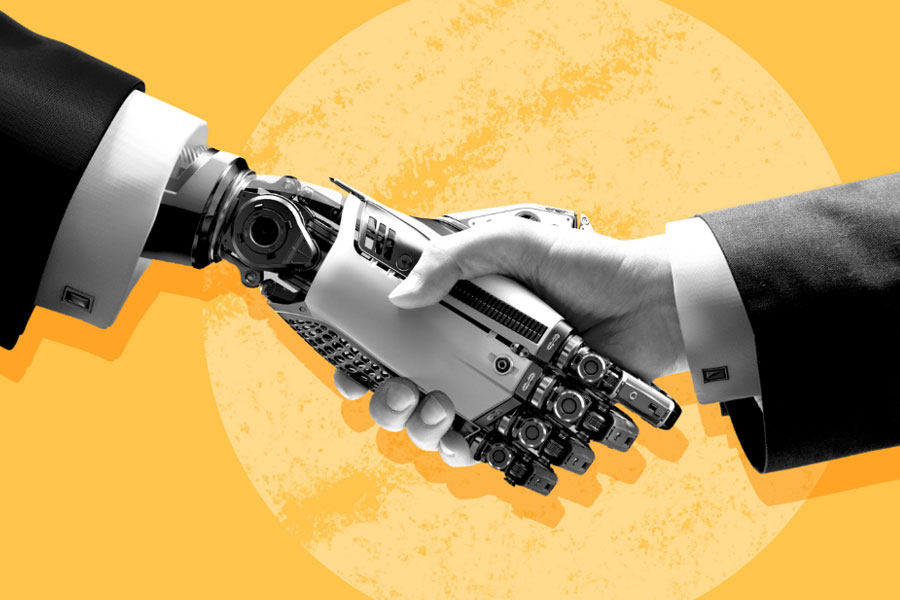
Whether AI will render a large share of the workforce redundant is, of course, unknowable. But we do already know that AI poses challenges in two critical dimensions of human flourishing: happiness and meaning.
In terms of happiness, automating much of our work should, on average, make us richer, which should, in turn, lead to higher life satisfaction. Research finds that doubling income lifts how we rate our life by a similar amount, whether rich or poor. The challenge that AI poses here is about redistribution.
Meaning is different. As Betsey Stevenson of the University of Michigan shows in her analysis of the cross-country evidence, reported meaning and purpose do not track income growth the same way. Work supplies more than money. Joblessness harms mental health even when incomes are fully replaced. Alongside a paycheck, work offers structure and a sense of belonging, status, and contribution. These attributes cannot easily be redistributed.
AI threatens meaning in at least three ways. To undermine our sense of purpose, AI does not have to be better than us, only functionally adequate and cheaper. It is one thing to be surpassed by something truly extraordinary. It is another thing to be made irrelevant by something merely good enough.
Moreover, AI-powered entertainment and companionship could capture enough of people’s time and social appetite to displace the more challenging activities that generate meaning. By offering a frictionless sense of connection, AI could crowd out the effort - the obligations, reciprocity, selflessness, and inconveniences - that real relationships require. AI companionship asks nothing of us. It is consumption dressed up as connection.
Digital life has already reshaped human connection, and not always for the better. Across the OECD, face-to-face interaction has declined and heavy social media use tracks lower well-being among the young. None of this is AI’s doing (yet), but it does suggest that an easier digital connection does not reliably deepen the human variety. Convenience tends to win out, even when people know that the alternative is better for them.
Lastly, meaning is rarely produced from a state of comfort. It comes from effort in the service of a chosen goal, be it raising a child or mastering a craft. What people value, in retrospect, is not ease but having struggled toward something that mattered. If AI removes friction at scale, it may remove one of the raw materials from which meaning is made. This may explain why richer societies report more comfort without more purpose.
True, not all work will disappear even if AI exceeds human capabilities. Humans did not stop playing chess when computers surpassed them. People still run, cook, make music, build furniture, and pay a premium for live performances. Meaning comes from competition, mastery, and self-expression within human-scaled constraints, not from generating optimal outputs. The value of human effort can grow even as human performance declines.
But this principle has limits. It works where activities are social, embodied, and have a tradition of amateur practice, but not where meaning has come entirely from professional prestige or economic necessity. Chess was always a game, even if some made it a job. The same cannot be said for back-office accounting. Moreover, even where meaning may survive, it will live in the process rather than the result. Before the 2025 Open Championship, Scottie Scheffler said that winning a golf trophy is gratifying but fleeting (“awesome for two minutes”).
The daily work of mastery is what confers a more enduring sense of meaning.
A common, reassuring refrain from AI boosters is that the meaning problem will solve itself. If AI gives us more time, we will become more rooted in family, place, and community, the way people were before industrialisation bundled meaning into paid employment. Perhaps that will be true for some people. But preindustrial rootedness was sustained by conditions, such as low mobility, kinship obligations, religion, and local necessity, that were often constraining and sometimes oppressive.
We should not wish them back, nor would they reappear automatically with mass leisure.
Material abundance alone does not recreate the structures from which meaning was once drawn. Consider Sweden. It combines a robust welfare state and very high life satisfaction with an unusually large share of single-person households and evidence that younger adults have less meaning in their lives than older ones.
Of course, some meaning will emerge organically. But the question is whether it will be felt broadly enough to replace what work once supplied. There is little reason to assume so. Higher incomes can reduce stress, but they do not necessarily produce a role that others depend on, a community that notices our absence, or a challenge worth struggling with. Those require functioning traditions of participation and institutions that sustain it.
The institutions that once provided sources of meaning, including unions, professions, churches, schools, and civic associations, were built over time, through a mix of local initiative and public support. The same will be true of what comes next. We can think of it as meaning infrastructure. The institutions through which people find roles, recognition, and a sense of being.
What makes such institutions durable is not goodwill but a simple principle. Prestige should follow performance. Show up reliably, and earn a voice. Master a craft and earn recognition. Mentor others and earn status. Take responsibility for a shared task and earn authority.
Far from ending the competition for status, abundance would merely redirect it. This new competition would then need to be civilised, for example, by expanding what counts as a contribution worthy of honour. How this happens will differ from place to place. Societies with strong families, dense civil institutions, and high social trust will find it easier. Those without will have to build from less. But the challenge would be the same everywhere, and no amount of abundance would solve it.
PUBLISHED ON
Jun 27,2026 [ VOL
27 , NO
1365]


Commentaries | Jun 10,2023
Verbatim | Oct 20,2024
Commentaries | Apr 04,2020
My Opinion | Jul 29,2023

Photo Gallery | 193881 Views | May 06,2019

Photo Gallery | 183776 Views | Apr 26,2019

Photo Gallery | 180676 Views | Oct 06,2021
My Opinion | 146022 Views | Aug 14,2021








Dec 22 , 2024 . By TIZITA SHEWAFERAW
Charged with transforming colossal state-owned enterprises into modern and competitiv...

Aug 18 , 2024 . By AKSAH ITALO
Although predictable Yonas Zerihun's job in the ride-hailing service is not immune to...

Jul 28 , 2024 . By TIZITA SHEWAFERAW
Unhabitual, perhaps too many, Samuel Gebreyohannes, 38, used to occasionally enjoy a couple of beers at breakfast. However, he recently swit...

Jul 13 , 2024 . By AKSAH ITALO
Investors who rely on tractors, trucks, and field vehicles for commuting, transporting commodities, and f...
Aug 28 , 2026
Every year, the Ministry of Education (MoE) sets a national examination. Every year,...
Aug 22 , 2026
A record is a strange thing to worry about. Federal trade officials have booked the b...

Aug 14 , 2026
Aschalew Fetene, known as “Ardi” and admired for his poetic depth, has built a ti...

Aug 8 , 2026
The World Bank asks readers to picture a mother in rural Ethiopia who has never held...
Aug 29 , 2026 . By BEZAWIT HULUAGER
The federal government is increasingly relying on Treasury bills (T-bills) to repay T...
Aug 29 , 2026 . By NAHOM AYELE
Judges on a Federal High Court bench have ordered D'Afrique, one of Addis Abeba's old...
Sep 1 , 2026 . By BEZAWIT HULUAGER
The Ministry of Revenues wants to know not just who a taxpayer is but almost everythi...
Aug 29 , 2026 . By BEZAWIT HULUAGER
Electricity supplied from Ethiopia has helped halve Djibouti's power production costs...







 Loading your updates...