

Radar | Oct 31,2022



Jul 22 , 2023
By Solomon Debebe
The sweeping optimism and ardent hopes that permeated Ethiopia four years ago have dwindled into disillusionment, with promises made to the country's youth remaining unfulfilled. While leaders once vowed to bolster the country's prosperity and deliver a hopeful future, the reality remains one of stark contrast.
Four years ago, several Ethiopians were abuzz with the anticipation of change. The youth yearned for an overhaul of policies that would elevate their living conditions, invigorate their hopes, and economically empower them.
The common belief was that any attempt to advocate for this much-needed policy shift was not only noble but also worthwhile, even if met with fierce criticism or pushback from those at the helm of the state at the time.
This anticipation reached a fever pitch when Ethiopia's incumbent Prime Minister took office; his speeches resounded with promises of nationwide growth, development, and progress. He was welcomed with enthusiasm and high expectations from Gondar to Mekelle and Hawassa to Jimma. His assurances also captivated international audiences when he travelled to the United States, Germany, and Dubai, among other locations.
However, the civil war and the worldwide havoc wreaked by COVID-19 began to reshape the trajectory of his promises. The distribution of coveted properties in Addis Abeba and prime green areas in numerous villages skewed towards the privileged few.
These actions hinted at an abdication of the principles of fairness and justice, as his administration seemed to prioritise favouritism over youth development, a course that has been widely criticised as being premature and myopic.
Ethiopia's youth, a segment of society known for their discipline and piety, continue languishing in limbo. Their patience with the Prime Minister's ambitious promises has now stretched over. Instead of formulating and implementing detailed policy frameworks that might uplift them, the administration seems more focused on mobilising them to battle the pervasive conflicts threatening the country's stability.
The failure to deliver on earlier promises has led to an alarming sense of despair among the youth.
In a poignant testament to this, some youths were seen volunteering to participate in the Russia-Ukraine war instead of pursuing their studies in Ethiopia's universities. This seemingly inexplicable choice starkly highlights the sense of hopelessness that has engulfed a generation that was once teeming with dreams and aspirations.
The administration's belated response to conflict-related crises, coupled with its sluggishness in addressing the country's strategic priorities, has exacerbated the situation. While the Prime Minister's tree-planting initiatives might symbolise growth and renewal, they are hardly the panacea for the monumental challenges that Ethiopia currently faces.
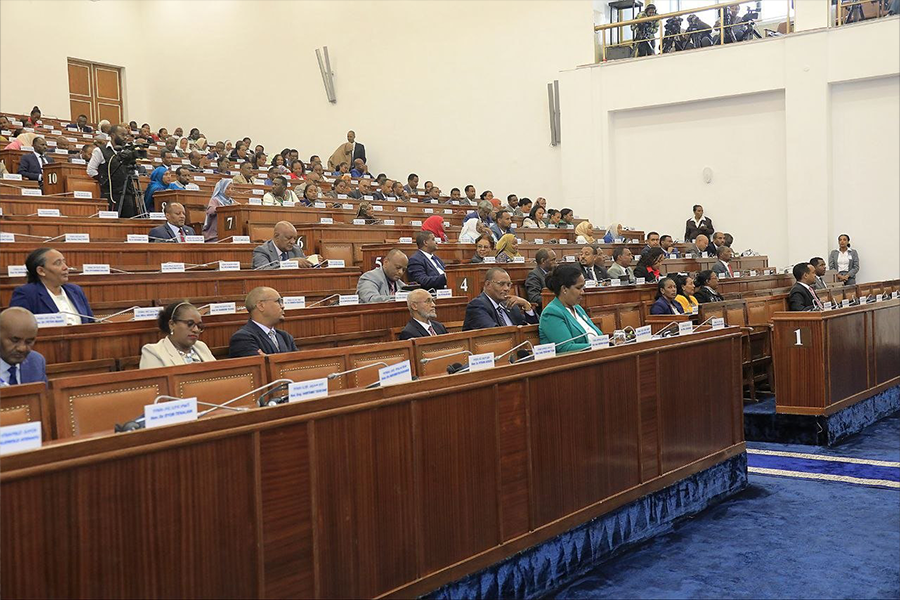
Recently, the grim reality of the employment landscape for the youth was underscored during a parliamentary discussion. A Finance Minister's declaration that the public service would have no new job opportunities for fresh graduates sent shockwaves.
Contrasting Ethiopia's seemingly stagnant situation with the proactive measures being undertaken by other countries brings the problem into sharper zoom.
Post-COVID-19 China, despite grappling with its youth unemployment crisis, has outlined ambitious plans prioritising youth employment. Similarly, Eastern Cape Premier in South Africa, Oscar Mabuyane, has urged departments to favour young job seekers and bolster their representation in public sector roles.
Governments are acknowledging the importance of equipping the younger generation to meet the challenges of the 21st Century. An exemplar of this is former U.S. President Barack Obama, who signed laws to foster innovation and creativity in the public sector.
Such strategic decisions aim to draw fresh talent into roles that will shape the future of a nation.
Ethiopia's leaders have to reconsider the current path. Policymakers should proactively create adequately funded internships that provide a platform for youthful engagement and contribution to national development.
It is crucial to design national-level policy options that promote productive livelihoods for the youth, thus helping transform the country before it is too late. In the end, it is the youth who are its future.
Acknowledging their importance today is key to ensuring a prosperous Ethiopia tomorrow. Ignoring their potential could result in a national loss, for a country that fails to invest in its youth is one that gambles with its future.
PUBLISHED ON
Jul 22,2023 [ VOL
24 , NO
1212]

Radar | Oct 31,2022

Featured | Apr 22,2022

Editorial | Dec 30,2023

Viewpoints | Feb 13,2024
Viewpoints | Jan 16,2021

My Opinion | Jul 18,2021
Radar | Oct 27,2024
Commentaries | Apr 30,2022
Fortune News | Jul 19,2025
Radar | Jun 11,2024

Photo Gallery | 193633 Views | May 06,2019

Photo Gallery | 183531 Views | Apr 26,2019

Photo Gallery | 180354 Views | Oct 06,2021

My Opinion | 145782 Views | Aug 14,2021










Dec 22 , 2024 . By TIZITA SHEWAFERAW
Charged with transforming colossal state-owned enterprises into modern and competitiv...

Aug 18 , 2024 . By AKSAH ITALO
Although predictable Yonas Zerihun's job in the ride-hailing service is not immune to...

Jul 28 , 2024 . By TIZITA SHEWAFERAW
Unhabitual, perhaps too many, Samuel Gebreyohannes, 38, used to occasionally enjoy a couple of beers at breakfast. However, he recently swit...

Jul 13 , 2024 . By AKSAH ITALO
Investors who rely on tractors, trucks, and field vehicles for commuting, transporting commodities, and f...

Aug 22 , 2026
A record is a strange thing to worry about. Federal trade officials have booked the b...

Aug 14 , 2026
Aschalew Fetene, known as “Ardi” and admired for his poetic depth, has built a ti...

Aug 8 , 2026
The World Bank asks readers to picture a mother in rural Ethiopia who has never held...

Jul 31 , 2026
Weldu Yiheysh has not read the Pacific temperature charts. He does not need to. In Shibta District of Enderta Wereda, in...
Aug 22 , 2026 . By BEZAWIT HULUAGER
The forthcoming strategy for interest-free finance will place Sharia-compliant financ...
Aug 22 , 2026 . By NAHOM AYELE
Wegagen Capital Investment Bank (WCIB) has completed its first full year in profit an...
Judges at the Federal High Court, sitting on a limited basis to hear only urgent matt...
Aug 22 , 2026 . By BEZAWIT HULUAGER
Federal authorities are about to find out whether they can make a single payment wind...





 Loading your updates...