

Life Matters | Dec 31,2022



Apr 5 , 2026
By BEZAWIT HULUAGER ( FORTUNE STAFF WRITER )
In a sweeping directive, the National Bank of Ethiopia (NBE) has raised the eligibility bar for insurance firms, requiring CEOs to possess 12 years of experience. Regulators are enforcing a governance upgrade that seems to align the industry with banking standards, yet executives bemoaned a "sharp narrowing" of the leadership pipeline. The rule forces a 10,000 Br penalty for missed approval deadlines, turning a quest for stability into a compliance race.
Regulators have thrust the insurance industry into a defining moment, issuing a sweeping directive that raises the eligibility bar for board directors, chief executive officers and senior executive officers. It is one of the strongest recent pushes for long-term corporate governance in a sector that has long sought regulatory independence.
The regulation aligns insurance with governance and compliance standards already seen in banking, and it arrives as the industry’s economic role weakens. Recent financial reports show the industry's contribution to GDP fell by 0.1 percentage point to 1.5pc in 2025. Market concentration remains below one percent, far below the global average of six percent, exposing how little financial protection exists for individuals and businesses against risk.
The directive imposes a tougher standard for leadership, raising the minimum experience requirement for a chief executive officer from 10 years to 12 years. Candidates are required to demonstrate that they have served at the senior executive director level for at least five years. Senior executive officers now need a minimum of four years of experience and formal regulatory approval. That approval process is capped at six months, and failure to meet the deadline carries a penalty of 10,000 Br.
What regulators at the National Bank of Ethiopia (NBE) frame as a governance upgrade, many in the industry see as a sharp narrowing of an already shallow succession pipeline.
Industry insiders warn that the succession pool is alarmingly depleted because education, training, and skills have not kept pace with the industry’s needs. Executives fear the new thresholds will leave insurance firms with fewer internal options, making it difficult for many rising professionals to be promoted from within.
An insurance executive, speaking on condition of anonymity, cautioned that the rules will decrease the talent pool and leave firms with only one possible successor each. He argued that young professionals are being pushed away from advancement, "diminishing the morale of work."
"The directive is not grounded in research but reflects the regulators’ perspective while overlooking fields such as ICT and marketing within management structures," he told Fortune. "This doesn't go with the liberalisation policy of the government. It's walking backwards."
Officials from the National Bank were not responsive to queries from Fortune, while leaders of the Ethiopian Insurance Association were not available for comment.
The directive also reaches into the boardroom, requiring directors to be at least 30 years old. Independent directors, long familiar in banking, are now required in insurance, and they may be non-Ethiopians if they meet the qualifications. Existing boards are exempt until their next selection cycle, but some firms are already encountering contention.
The National Bank has also shortened the life of temporary leadership. An acting CEO or senior executive officer can now serve for only six months, except for the CEO position, which has a nine-month cap before a permanent appointment can be made. Yet this, too, has sharpened debate over what kind of leadership the industry should value.
"The regulator favours operational experience over broader leadership skills, even as insurers increasingly depend on capacities beyond traditional insurance functions," said the Chief Executive’s Officer, who asked not to be named.
The industry comprises 19 companies, with four non-life insurers, 14 firms operating in life and non-life segments, and one reinsurer. A fully fledged Sharia-compliant insurance company is expected to make its debut in an industry whose gross written premiums reached 41.4 billion in the 2024/25 financial year, a near-50pc leap from the previous two years. The acceleration has been driven by a cocktail of aggressive asset revaluations and a nascent shift in corporate risk appetite.
General Insurance, anchored largely by motor and fire policies, dominated the market, accounting for 38.7 billion Br of total premiums. Life Insurance remained small by comparison at 2.7 billion Br, but it is the sliver of the market that analysts watch most closely.
The industry is consolidating around a familiar hierarchy, with the state-owned Ethiopian Insurance Corporation (EIC) casting a long shadow over the market. Controlling nearly 45pc of total business, EIC remains the insurer of choice for the country’s large infrastructure ventures and state-affiliated enterprises, its dominance underwritten by the heft of the industry's largest balance sheet.
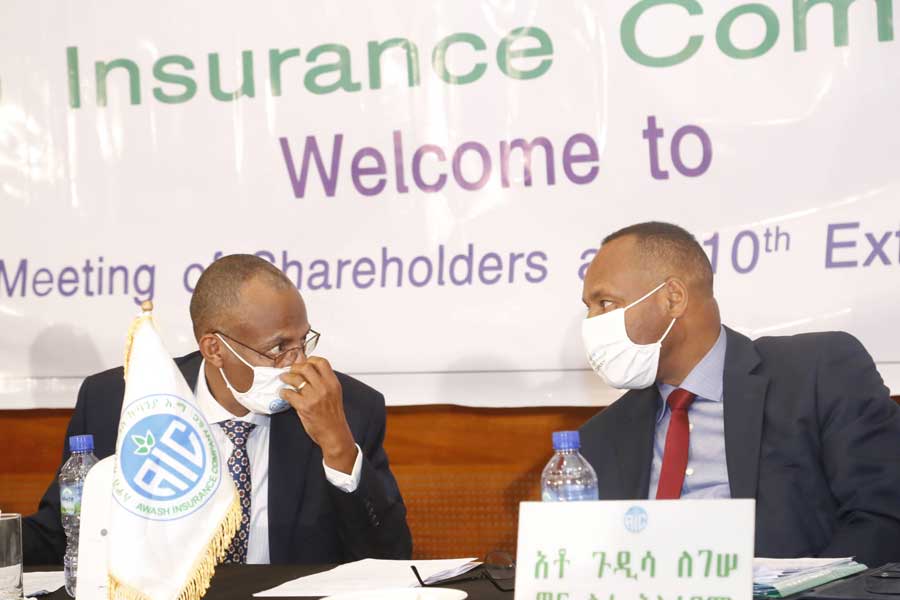
Awash Insurance is leading the charge among the private insurance firms. With a paid-up capital exceeding 2.6 billion Br and total assets above 11.1 billion Br, it has positioned itself as the "gold standard" for private underwriting. Close behind, United Insurance and Nyala Insurance are locked in a contest for the next rung of the ladder, each leaning on deep corporate relationships while branching into "Takaful" to reach constituencies long overlooked by conventional products.
The scale of the market’s transition is visible not only in premiums but also in its broader institutional shape. Total industry capital, which was 16.3 billion in 2022/23, expanded to 22.4 billion Br. However, the industry's total capital measured against liabilities of 33.4 billion Br revealed a capital-to-asset ratio that keeps regulators awake at night.
Premiums are rising fast, balance sheets are expanding, and shareholder interest is increasing in a market with enormous room to grow. But the financial underpinnings remain fragile, especially outside the largest firms. The sole reinsurer, Ethio-Re, reported a stellar earnings per share (EPS) of 21.8pc, while top private firms such as Africa Insurance saw returns in the mid-20s.
For critics, that expansion only sharpens the contradiction. They attribute the industry’s slow growth to the overly stringent regulations that fail to account for market realities, and that a more flexible framework should have opened more pathways into senior management roles.
Others, like Assegid Gebremedhin, an insurance industry expert with decades of hands-on experience, see the directive as long-overdue discipline. He welcomed the stringent rules as a response to structural needs. He argued that expertise in marketing, finance, risk and compliance is essential if insurers are to survive beyond the short-term bottom line.
"A CEO must combine knowledge, aptitude and experience, with financial acumen indispensable," said Assegid.
But he also cautioned that the directive could narrow the pool of eligible executives for senior positions too sharply. To avoid widespread discouragement, he urged that existing senior executives be judged on merit "so they can advance without being frustrated" by the new requirements.
At the board level, he argued for even higher standards to ensure that directors properly oversee executives and drive firms toward long-term sustainability rather than short-term gains.
PUBLISHED ON
Apr 05,2026 [ VOL
27 , NO
1353]
Life Matters | Dec 31,2022

Commentaries | Feb 21,2026
Sunday with Eden | Jun 20,2026
Fortune News | Dec 07,2019

Radar | Jul 19,2026
Fortune News | Nov 07,2020

Featured | Apr 10,2026

Election 2026 coverage | Mar 28,2026

Fortune News | Feb 11,2023
Commentaries | Aug 01,2020
Dec 22 , 2024 . By TIZITA SHEWAFERAW
Charged with transforming colossal state-owned enterprises into modern and competitiv...

Aug 18 , 2024 . By AKSAH ITALO
Although predictable Yonas Zerihun's job in the ride-hailing service is not immune to...

Jul 28 , 2024 . By TIZITA SHEWAFERAW
Unhabitual, perhaps too many, Samuel Gebreyohannes, 38, used to occasionally enjoy a couple of beers at breakfast. However, he recently swit...

Jul 13 , 2024 . By AKSAH ITALO
Investors who rely on tractors, trucks, and field vehicles for commuting, transporting commodities, and f...

Aug 14 , 2026
Aschalew Fetene, known as “Ardi” and admired for his poetic depth, has built a ti...

Aug 8 , 2026
The World Bank asks readers to picture a mother in rural Ethiopia who has never held...

Jul 31 , 2026
Weldu Yiheysh has not read the Pacific temperature charts. He does not need to. In Shibta District of Enderta Wereda, in...
Jul 25 , 2026
Ideally, citizens who have paid income tax all year should not have to reach for thei...









 Loading your updates...