
Editorial | Sep 01,2024



For as long as her daughter had been in school, the summer break belonged to the family. Every year, the mother, who lives in Addis Abeba's Lemi Kura District and asked for anonymity for her and her daughter's identities for fear of reprisal, packed the holiday with visits to extended relatives.
This year, for the first time, the ritual collapsed. Her daughter, now in Grade 12 at a private school, was told to report for summer tutorials, and the condition left no room to argue.
“The School gave us no choice," the mother said. "They made it mandatory that if my daughter didn’t attend the summer programme, she would not be allowed to register for the upcoming semester.”
The lessons carried extra fees for the weekend sessions, and her unease has grown with the bill. The mother’s frustration is a small window onto a large intervention.
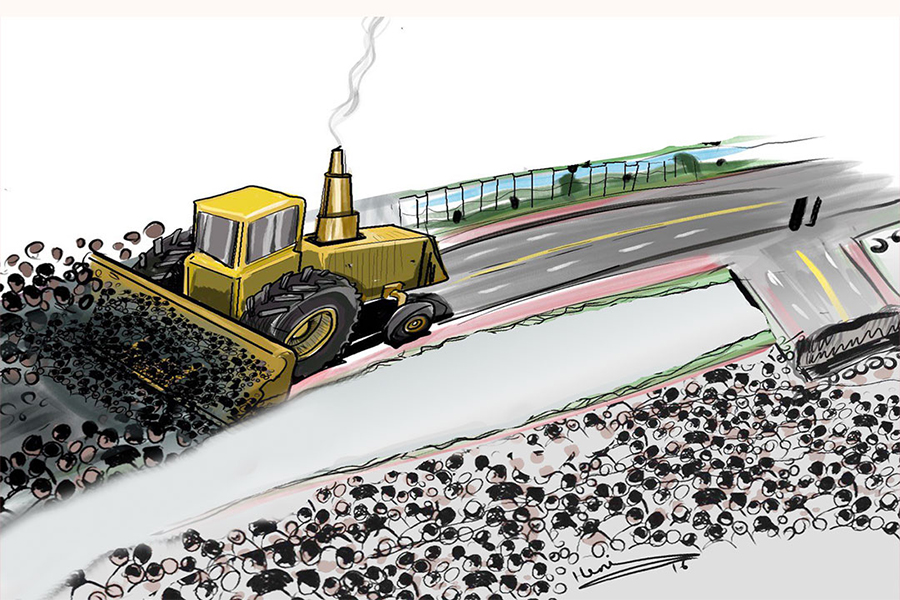
The Addis Abeba City Administration Education Bureau has launched a summer tutorial programme across designated cluster centres, deploying 1,800 selected teachers to support more than 51,520 Grade 11 and 12 students preparing for the Ethiopian University Entrance Examination. According to Abebe Chernet, the Bureau’s communication director, the programme offers a condensed curriculum designed to sharpen readiness and improve educational quality before the Grade 12 national examinations.
The numbers behind the drive explain its urgency.
The Bureau’s officials traced poor outcomes to curriculum-alignment gaps, weak instruction, distraction due to social media and poor communications between parents and schools. They proposed structured study forums and closer parental engagement.
A document produced by the Bureau, dubbed “Excellence Strategy”, responds to years of weak results for high school graduates. Its authors aspire to double the share of students scoring 50pc and above to 60pc.
The strategy puts its faith in three pillars.
The first gathers the top 30 Grade 11 and 12 students from neighbouring public and private schools into specialised cluster centres, supported by monthly parent contributions of 500 Br.
The second offers school-based tutorials for average performers. The last builds an advisor-advisee system, pairing strong teachers with groups of Grade 12 students at a ratio of one teacher to four to seven students. Selected Grade 12 students are made to mentor Grade 11 peers in smaller groups.
Public education is justified on the premise that “every child” should gain the knowledge to participate in society, regardless of family means. It is anchored in the Constitution, which requires the state to expand access to and commit resources to public services, including education.
A law passed last year on “general education” defines public education as a state-financed and -run system serving the public’s interest.
The push lands against a national picture the Ministry of Education's figures lay bare. Secondary gross enrolment across Grades 9 to 12 was 30.4pc, and net enrolment 22.9pc.
Addis Abeba was the only region to top a 100pc gross rate, with a net rate near 80pc. Yet, nationally, barely half of pupils complete Grade 8 and the survival rate to Grade 7 sits near a quarter. Those sitting the Grade 12 examination are already the narrow survivors of a leaking pipeline.
That the capital, the clear front-runner, still cannot lift its pass rate past 31pc is what gives the strategy its edge.
With the capital's Grade 12 pass rate stuck near 31pc, the Bureau's effort is seen as an attempt to reverse a persistent slide, yet it also raised a harder question about how targeted help can lift results without eroding equal access to quality learning.
The cluster model carries a social dividend alongside the academic one, mixing public and private students who rarely meet. A private school director, who asked not to be named, sees promise in that.
“Private school students often remain within their own social bubbles throughout their primary and secondary education," the Director said. "Learning alongside peers from diverse public-school backgrounds gives them a vital head start in social integration, making the transition to university life far less daunting."
However, specialists such as Melkam Zewdu (PhD), assistant professor of educational psychology at Bahir Dar University, are more cautious about what selective programmes do over time.
Grouping high performers with experienced teachers can speed learning, sharpen problem-solving and lift results. But Melkam warned that pouring extra resources into the advanced students risks leaving struggling learners without support.
“Too much drilling for the examination can pull learning toward memorisation and away from thinking,” she told Fortune.
Melkam was uneasy, too, about compulsory attendance during the holidays, arguing that intensive summer programmes driven by outside pressure can sap the motivation they mean to build and add to stress.
“Enrichment works best,” she said, “when it’s voluntary, when selection remains transparent and when it aims at broad intellectual growth rather than examination preparation alone.”
However, other experts, such as Girma Lemma (PhD), an associate professor at Addis Abeba University, place motivation at the centre. For him, policy formulation or impositions from parents, schools, or educational bureaus will not bring about the desired outcome.
"It isn’t simply a question of attending or not attending classes during break time,” he told Fortune. “It’s about creating interest in what students are learning. Talent combined with determination will help them join universities."
Girma named examination anxiety as an additional drag, noting that pressure from teachers, tests, peers, and social expectations can make the examination hall feel overwhelming.
Schools’ leaders on the public side see opportunity where parents in some private schools see imposition.
Bekele Bogale, chairperson of the Parent-Teacher-Student Association at Beshale Public Secondary School, a cluster centre in Wereda 8 of Lemi Kura, one of the city's 11 districts, called the programme “a needed intervention.”
His School organised meetings where its administrators presented the tracking data of Grade 11 and 12 national exam performances dating back to 2022.
“Before launching, our priority was building consensus with parents," he said. “Seeing these figures firsthand gave parents a clear perspective to recognise and support the value of this effort."
The School has folded Grade 6 and Grade 8 students into its summer classes for regional examinations, and the Association plans a review meeting after the first month.
According to Dita Beshada, vice director of teaching and learning at Beshale, the support predates the summer.
"Our academic support started during the regular term in November 2025 through early-morning, after-school, and weekend tutorial sessions," he told Fortune.
Under the structure, the top 30 attend cluster centres, and the rest take school-based tutorials, both following the same module. The curriculum condensed essential content from Grades 9 through 11, focusing specifically on national examination competencies.
Experienced teachers deliver the lessons and receive transport allowances, and where money is tight, the School steps in.
“If a family is struggling financially, the student can request support from the School,” Dita said. “The School covers the fee.”
Students who finish receive certificates for the coming year. Those with legitimate reasons to stay away are excused. However, the unresolved argument is one of priorities.
The strategy’s authors expect the same top 30 to mentor weaker students during the year. But specialists worry that extra duty on high achievers could crowd out their own progress.
Girma argued that active, student-centred teaching can ease that load, and that accelerated models work best when they build motivation, engagement and confidence rather than chase scores alone.
Experts fear that selective grouping carries a subtler risk, too, that advanced students feel set apart while those left out read the sorting as a verdict on their ability, deepening divisions inside schools.
Whether scarce resources should back students already thriving or those struggling to reach basic competency is the question the “Excellence Strategy” cannot avoid.
They acknowledge that focus on teacher quality, structured support and school-community collaboration is a serious response to a decline. But they also cautioned that the strategy’s measure will be whether it lifts achievement while keeping the promise that quality education stays within reach of all students.
PUBLISHED ON
Jul 25,2026 [ VOL
27 , NO
1369]
Editorial | Sep 01,2024
Fortune News | Jul 06,2025
Fortune News | Jun 13,2025
Commentaries | Apr 10,2026

View From Arada | Oct 11,2025

Commentaries | Jun 27,2026
Radar | Dec 20,2025

Fortune News | Jul 13,2024
In-Picture | Aug 04,2024
Radar | Sep 29,2024

Dec 22 , 2024 . By TIZITA SHEWAFERAW
Charged with transforming colossal state-owned enterprises into modern and competitiv...

Aug 18 , 2024 . By AKSAH ITALO
Although predictable Yonas Zerihun's job in the ride-hailing service is not immune to...

Jul 28 , 2024 . By TIZITA SHEWAFERAW
Unhabitual, perhaps too many, Samuel Gebreyohannes, 38, used to occasionally enjoy a couple of beers at breakfast. However, he recently swit...
Jul 13 , 2024 . By AKSAH ITALO
Investors who rely on tractors, trucks, and field vehicles for commuting, transporting commodities, and f...

Aug 8 , 2026
The World Bank asks readers to picture a mother in rural Ethiopia who has never held...

Jul 31 , 2026
Weldu Yiheysh has not read the Pacific temperature charts. He does not need to. In Shibta District of Enderta Wereda, in...

Jul 25 , 2026
Ideally, citizens who have paid income tax all year should not have to reach for thei...
Jul 18 , 2026
Pressed in Parliament on jobs and household incomes, Prime Minister Abiy Ahmed (PhD)...









 Loading your updates...