

Fortune News | Sep 07,2025



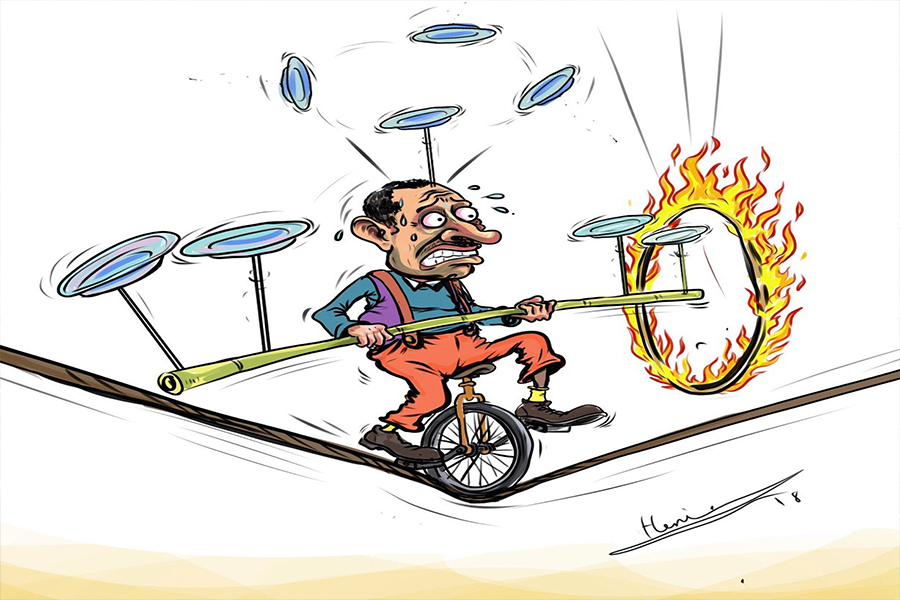
Finance Minister Ahmed Shide entered the last quarter of the fiscal year with a budget under pressure and a financing plan stretched by delayed foreign support.
The Minister’s nine-month report showed the federal government borrowing faster from the domestic market than planned, while promised inflows from development partners arrived late and fell short of expectations.
On Monday, May 4, 2026, Parliament proceeded with the third-quarter report, during which Ahmed delivered his fiscal account in the absence of the private media, outlining a budget whose financing assumptions have become harder to sustain.
The federal budget of 1.93 trillion Br, the largest fiscal envelope approved by the government, carries a projected deficit of 277.5 billion Br, to be financed mainly through market-based domestic instruments. At the start of the fiscal year, officials planned to raise 208.1 billion Br from the domestic market to cover the shortfall. By the end of the nine months, they had mobilised 232.4 billion Br. Against the target, execution reached 111.7pc, showing that borrowing had already passed the level expected for the third quarter.
Ahmed attributed the overshoot to external financing that had not arrived on schedule.
“It’s because the budget assistance is delayed,” he told federal lawmakers.
The Finance Minister also acknowledged that the plan rested on uncertain assumptions.
“We're planning stretching,” he told Parliament.
The phrase captured the fragile base of external financing projections at a time when the federal government’s expenditure commitments are fixed and politically sensitive. According to the Minister, his Administration expects inflows in the coming months and has temporarily stopped additional borrowing from the market.
The external financing figures explain why the government turned inward. It had planned to secure four billion dollars in loans and grants from development partners for the year. By the third quarter, disbursements reached a little over two billion dollars, 65pc of what was thought to come. It represents half of what was planned for the fiscal year, with the World Bank accounting for 45.4pc of the amount received and disbursing 914.2 million dollars.
The shortfall has become a key driver of the widening fiscal gap.
The federal government's deficit-financing model has been changing in recent years. In earlier periods, it relied heavily on direct borrowing from the Central Bank, an instrument macroeconomists often describe as “money printing.” That helped finance spending but put upward pressure on inflation. Government bonds then carried interest rates as low as two percent, while pension funds and resources from the National Bank of Ethiopia (NBE) were drawn into financing operations.
A policy turnaround, under pressure from the IMF, moved policymakers away from Central Bank financing and toward domestic market instruments. They stopped issuing bonds to the Central Bank and ended the practice of forcing commercial banks to absorb Treasury bonds (T-bills). The latter monetary instrument became the main channel, a change that Ahmed and other senior officials of the Ministry have described as a step toward fiscal discipline.
However, the shift has carried a price. T-bills now carry interest rates between 16pc and 18pc, sharply increasing the cost of domestic borrowing. The transition is widely seen as useful for macroeconomic stabilisation, but is unfolding while debt-service obligations rise and liquidity tightens across the financial system.
According to the Finance Ministry’s report, total public debt, combining external and domestic obligations, reached 51.8 billion dollars as of March 31, 2026. External debt stood at 33.5 billion dollars, 22.1 billion dollars of which is owed by the federal government, while the balance is attributable to sovereign obligations, including those of the Central Bank.
Although external debt remains dominant, domestic borrowing is gaining speed, especially through T-bills.
Domestic debt is also concentrated at the federal level. Of the 18.3 billion dollars, 95.6pc is held by the federal government, while 800 million dollars is classified under government sovereign funds. Around 3.22 billion dollars has been raised through T-bills, with the balance linked to long-maturity and T-bond debt instruments. This shifts the burden of debt service, as in the previous fiscal year, interest payments accounted for 97.53 billion Br of the total domestic debt service of 100.6 billion Br. Principal repayment was only three billion Birr.
The pace has accelerated this year. In the first two quarters, domestic interest payments climbed to 126.5 billion Br, up from 36 billion Br in the same period last year, an increase of nearly 250pc. Despite the rise, the federal government continued to expand T-bill issuance over the nine months, deepening an interest-heavy fiscal pattern.
Abdulmenan Mohammed (PhD), a London-based financial analyst, called the path "unsustainable."
“We can’t sustain like this,” he told Fortune. “We should manage our deficit better.”
Abdulmenan sees that Ahmed and his fiscal wonks have two choices. Either they reduce expenditure or raise revenue. Federal officials have focused heavily on revenue mobilisation in recent years, but Abdulmenan argued that the effort has often been poorly managed and, in some cases, accompanied by misuse under the banner of “revenue generation.” That has weakened the federal government's ability to close the deficit.
The Ministry of Revenue, under Aynalem Negussie, has reported a sharp rise in tax collections for the current fiscal year, putting the federal government ahead of its revenue plan and prompting authorities to raise their annual target. As of early May 2026, the Ministry disclosed it had collected 1.1 trillion Br during the first nine months of the fiscal year, a performance it described as a 68pc increase from the same period a year earlier. The pace of collection has led the federal government to revise its annual revenue target upward, from 1.2 trillion Br to 1.5 trillion Br.
"The harder task now lies in spending control," said Abdulmenan.
He urged the government to cut waste, inefficiency, and "unnecessary projects", and to fight corruption.
"Without course correction, interest payments alone could become the largest component of government expenditure," he warned.
Abdulmenan also cautioned that heavy government absorption of T-bills is distorting credit allocation. Commercial banks are increasingly encouraged to lend to the government rather than the private sector, risking a crowding out of productive investment and reducing credit access for businesses.
“This side also should get a solution,” he said. "If the deficit path is not corrected, it could ultimately lead to an economic disaster.”
Spending pressure has also come from transfers to federal institutions and regional states. Ahmed told Parliament that these expenditures exceeded the plan mainly due to the salary adjustment introduced last August, which required additional funding to cover the increased wage bill. The federal government has implemented a 160 billion Br salary increase for public workers, lifting the annual wage bill to a record 560 billion Br. Under the revised scale, the minimum monthly salary for civil servants increased from 4,760 Br to 6,000 Br, while the highest increased from 21,492 Br to 39,000 Br.
According to federal officials, the raise was meant to ease cost-of-living pressure on 2.4 million civil servants, offering workers relief. For the Treasury, it added another claim on a budget already leaning on domestic debt. The nine-month report left a clear picture of a fiscal program built on delayed aid, rising domestic debt and the cost of keeping government spending moving through the fiscal year-end.
The debt classification needs clearer wording: “sovereign obligations, including the central bank,” “government sovereign funds,” and “T-bound debt instruments” should be verified against the Ministry’s original table. The claim that the government temporarily stopped additional market borrowing should be reconciled with the statement that T-bill issuance continued during the nine months. The six-month domestic interest-payment figure should be clearly marked as a separate period from the nine-month budget execution report.
PUBLISHED ON
May 09,2026 [ VOL
27 , NO
1358]
Fortune News | Sep 07,2025

Viewpoints | Jul 12,2025

Life Matters | Nov 29,2025
Radar | May 27,2023

My Opinion | Apr 28,2024

Dec 22 , 2024 . By TIZITA SHEWAFERAW
Charged with transforming colossal state-owned enterprises into modern and competitiv...

Aug 18 , 2024 . By AKSAH ITALO
Although predictable Yonas Zerihun's job in the ride-hailing service is not immune to...

Jul 28 , 2024 . By TIZITA SHEWAFERAW
Unhabitual, perhaps too many, Samuel Gebreyohannes, 38, used to occasionally enjoy a couple of beers at breakfast. However, he recently swit...

Jul 13 , 2024 . By AKSAH ITALO
Investors who rely on tractors, trucks, and field vehicles for commuting, transporting commodities, and f...
Jul 11 , 2026
At a market stall, reform arrives without a communique. It comes as a higher transpor...
Jul 4 , 2026
In the goldfields of the Benishangul-Gumuz Regional State, Ethiopia's balance-of-paym...
Jun 27 , 2026
The federal legislative house rushed through one of the country's most contentious ho...
When Parliament takes up the appropriation bill, federal legislators will receive a d...










 Loading your updates...