
Radar | May 09,2020



May 2 , 2026.
By the time Ethiopia’s National Dialogue Commission (ENDC) reached the end of its first three-year mandate, the country had gathered everything a dialogue needs, except for the one thing it cannot do without. Trust.
There were commissioners, facilitators, procedures, regional consultations, agenda papers and the language of reconciliation. There were also militarised conflicts in Amhara and Oromia regional states, a traumatised Tigray Regional State, a cowed media, a Parliament held by the ruling Prosperity Party (PP), and a state whose monopoly on legitimate violence is contested.
This contradiction haunts the process led by Mesfin Araya, a professor of psychiatry and chief commissioner. Mesfin and 10 other commissioners run what was meant to be a peacebuilding instrument in a political order that has not accepted peacebuilding’s terms. They seek consensus before securing legitimacy. They ask citizens to speak, but not always the armed actors whose guns shape politics. They promise healing while tied to institutions many see as partisan.
Scepticism has always been abundant since the Commission entered into existence. It was established by Parliament in 2021 and began work in February 2022 with its mandate. It designed a three-stage process, from district consultations to regional forums and a national conference. It claims to have reached around 100,000 people, though earlier ambitions pointed to 1.5 million. It is reported that 12,294 participants from 679 of 769 weredas were nominated for regional conferences. In Addis Abeba, more than 2,000 delegates attended the first regional-phase event, which ended in June 2024.
However, scale is not legitimacy. A process can be large and still exclusionary, participatory and managed. It can collect grievances without empowering those who hold them. The test is whether those able to block peace accept the forum. By that measure, the dialogue remains weak.
The Commission has been sorting what its chief called “tonnes of agenda items”. Ironically, Ethiopia does not lack grievances. It lacks institutions seen as legitimate, impartial, and credible enough to rank, negotiate, and implement power-sharing among competing groups. The issues raised in Addis Abeba, from federalism to the flag, land claims and the capital’s status, are combustible. But touching a question does not resolve it. In Ethiopia, flags, regions, boundaries and land are tied to memory, violence and resources.
The defenders of dialogue are right about one thing. Ethiopians need settlements as they cannot shoot their way out of every constitutional dispute, grievance, centre-periphery tension or elite rupture.
Millions depend on humanitarian aid. Inflation, though below earlier peaks, remains punishing. The federal government has pursued grand projects in Addis Abeba and a few towns, while insecurity has made travel outside the capital frightening. Kidnapping has become an economic activity in the shadow of disorder.
The IMF facility, World Bank budget support and debt restructuring may bring relief, after the Birr was floated and monetary policy tightened. But macroeconomic reform cannot replace a political settlement. Investors may read exchange-rate reform as a signal, but armed groups read exclusion as provocation.
National dialogue is meant for moments when ordinary institutions cannot carry national fractures. It is a recent phenomenon in human history, born of Poland’s 1989 Round Table, which helped engineer an exit from communism. Benin’s 1990 sovereign national conference became a model for Africa. South Africa’s CODESA helped dismantle apartheid. The most touted Tunisia’s 2013 National Dialogue Quartet became a modern case because civil society convened rivals, set election dates, oversaw a resignation, and helped deliver a constitution.
All these cases demonstrated that dialogue can only work when actors in violent conflict believe the alternative is worse, when conveners are trusted, mandates are clear, armed actors are not wished away, and implementation is tied to an enforceable bargain. Unfortunately, Ethiopia has borrowed the vocabulary without reproducing the conditions.
The first weakness is the mandate, although, legally, the Commission's mandate appears clear. Politically, though, it is too ambitious and little owned. It is expected to build “national consensus” and "trust" between adversaries, citizens and the state. This is nearly impossible without an elite-level bargain. The Commission can collect views from farmers, teachers, traders, women, youth and displaced people. It cannot define the rules between the Prosperity Party, the Tigray People’s Liberation Front (TPLF), the Oromo Liberation Army (OLA), Fano factions, opposition parties and power brokers.
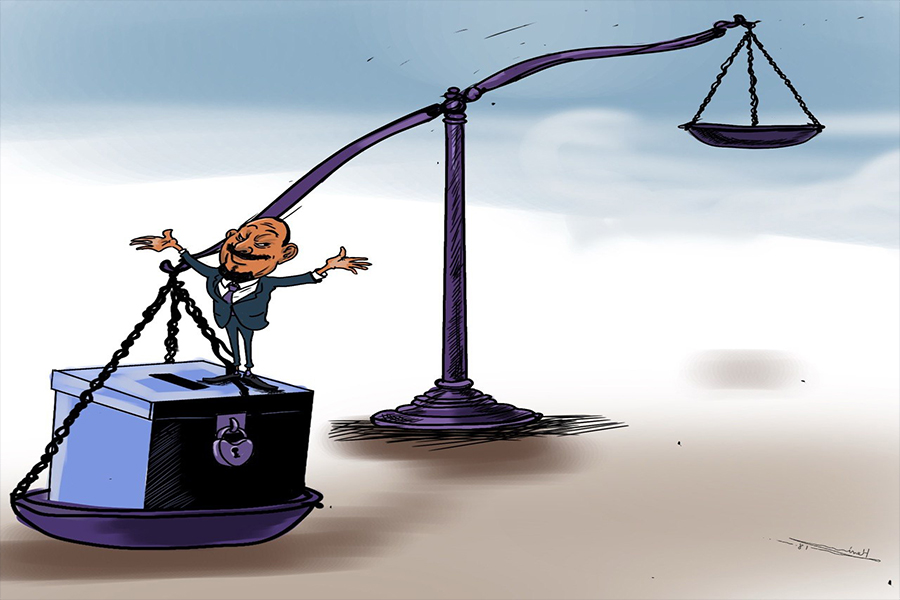
The second weakness is neutrality. The Commission is described as independent, and its members have standing. But its birth through a Parliament dominated by the ruling party marked it from the beginning. The Prosperity Party holds more than 96pc of parliamentary seats and claims around 14 million members. Where party, state and administration overlap, official consultation risks managed representation. The opposition fears the dialogue may serve to launder decisions already shaped by those in power rather than facilitating true power-sharing.
The third weakness is inclusiveness. The process has social reach but narrow penetration. Opposition forces have boycotted it or questioned its legitimacy. The Oromo Federalist Congress (OFC) and Oromo Liberation Front (OLF) are not meaningfully inside. The TPLF’s role is complicated by the civil war and its aftermath. Armed actors such as the OLA and Fano remain outside the architecture. The Commission has invited armed groups directly or through proxies. But an invitation is not inclusion without political guarantees.
The fourth weakness is the political environment. Dialogue cannot flourish where fear sets limits. The media space has narrowed, while human rights groups report arbitrary arrests, extrajudicial killings and repression in Amhara and Oromia regional states as well as Addis Abeba. The UN High Commissioner for Human Rights attributed 70pc of documented human rights violations in 2023 to government forces. Drone strikes and counterinsurgency activities have deepened civilian anger. Consultation under coercion records what people dare say, not what they believe.
The fifth weakness is implementation. The Commission may recommend reforms on federalism, the parliamentary system, constitutional interpretation, land, symbols, transitional justice and state-society relations.
But who will implement them? Parliament dominated by the Prosperity Party? The executive whose conduct sits at the centre of many grievances?
Without prior agreement among decisive actors, recommendations risk joining Ethiopia’s archive of unimplemented settlements.
This is why the expiry of the first term mattered.
After three years and extensions, has the process changed the political equation? Has it brought actors nearer to settlement, reduced violence, opened political space, increased trust, or reassured sceptics that it is not the incumbent’s project?
So far, the answer is inadequate. The process may have mapped grievances and given some communities a rare forum to speak. These cannot be dismissed as meaningless. It may ease local tensions where the stakes are less existential. But on central questions, it has not shown it can move from consultation to settlement.
The danger is not only failure, but instrumentalisation. Authoritarian systems often learn reform’s language without surrendering control. Elections are held, but competition is managed. Parliaments sit, but power lies elsewhere. Dialogues are convened, but the agenda is contained. Inclusion becomes performance, and not power-sharing. The Dialogue Commission may give the incumbent a certificate of consultation while leaving its hegemonic position intact.
The tragedy is that dialogue has never been more necessary for Ethiopia, which is too large, diverse and strategic for coercive improvisation. Its federal system cannot survive if every territorial dispute becomes militarised. Its state cannot regain legitimacy if citizens experience it more as a force to fear than an institution to trust.
PUBLISHED ON
May 02,2026 [ VOL
27 , NO
1357]
Radar | May 09,2020
Fortune News | Mar 11,2023
Radar | Jul 20,2025

Election 2026 coverage | Jan 17,2026
Radar | Jan 27,2024
Editorial | Jun 06,2026
Agenda | Oct 12,2025
In-Picture | Sep 14,2024
Fortune News | Aug 18,2024

Agenda | Feb 21,2026

Photo Gallery | 190993 Views | May 06,2019

Photo Gallery | 180777 Views | Apr 26,2019

Photo Gallery | 177450 Views | Oct 06,2021

My Opinion | 143087 Views | Aug 14,2021





Dec 22 , 2024 . By TIZITA SHEWAFERAW
Charged with transforming colossal state-owned enterprises into modern and competitiv...

Aug 18 , 2024 . By AKSAH ITALO
Although predictable Yonas Zerihun's job in the ride-hailing service is not immune to...

Jul 28 , 2024 . By TIZITA SHEWAFERAW
Unhabitual, perhaps too many, Samuel Gebreyohannes, 38, used to occasionally enjoy a couple of beers at breakfast. However, he recently swit...

Jul 13 , 2024 . By AKSAH ITALO
Investors who rely on tractors, trucks, and field vehicles for commuting, transporting commodities, and f...
Jul 7 , 2026
The health sector remains underprovided despite rising public spending, Prime Ministe...
Jul 7 , 2026
Prime Minister Abiy Ahmed (PhD) delivered one of his bluntest rebukes yet to the coun...
Jul 7 , 2026
Prime Minister Abiy answered his critics with a mix of gratitude and edge, thanking l...
Jul 7 , 2026
A ruling-party lawmaker, Mohammed Ahmed, called the Chamber to its feet for Prime Min...








 Loading your updates...