
Editorial | Jul 27,2024



Apr 18 , 2026
By Mohammad N. Khalifa
In a connected global economy, resilience depends less on access to resources than on the structure of production and the ability to earn foreign exchange. The disruption around the Strait of Hormuz makes this visible. A narrow maritime passage has exposed how much of the world economy depends on a handful of critical nodes. When one of those nodes comes under pressure, the consequences extend beyond prices to production, investment, and growth, writes Mohammed N. Khalifa, a finance expert.
When tensions rise around the Strait of Hormuz, following the war Israel and the United States openned against Iran, the reaction is familiar. People look at shipping routes, the risk of a supply disruption, and the oil prices.
Indeed, a fifth of global oil trade moves through this narrow corridor, and a substantial share of liquefied natural gas.
But that framing is too narrow. A disruption is not just a shock to one commodity. It unsettles a linked system of industrial inputs, transport networks, and financial expectations. Once energy supply tightens, the effects do not remain confined to the energy sector. They move outward into agriculture, mining, and manufacturing.
There are signs that this process has begun. Disruptions to LNG flows have stirred concern over electricity supply in economies that depend on imported energy. Shipping costs and insurance premiums have climbed. Delivery times have stretched. Fertiliser markets are showing signs of stress, and higher input costs are likely to work their way into agricultural cycles in the months ahead.
What looks like a problem for tankers and traders can quickly become a problem for factories, farms, and households. The importance of Hormuz is not only the volume of oil that passes through it. It is the role that energy and the products tied to it play in holding the economy together.
Hydrocarbons are fuel and feedstock. They also sit at the base of petrochemicals, fertiliser production, and industrial activity. Sulfur, produced during oil and gas refining, is turned into sulfuric acid, the world’s most widely used industrial chemical. That chemical is essential to fertiliser production and metal extraction.
The damage does not stop with the supply. As John Maynard Keynes observed, economic life is shaped as much by expectations as by material conditions. When uncertainty rises, firms tend to delay investment and hold more cash. In that way, a supply shock can turn into a broader slowdown in demand, making the effect larger than the disruption might suggest.
For advanced economies, the central worry should be the continuity of industrial production. For developing economies, the stakes are sharper. Many African countries are net importers of refined fuel, fertilisers, and industrial inputs. They face not only higher prices but also greater supply volatility and tougher financing conditions.
Ethiopia is no exception to this, nor is its economy, however lacking full integration in the global economy, immune from the shock the war has caused.
Admittedly, the country is moving toward a more market-based foreign-exchange regime meant to improve efficiency and competitiveness. This also leaves the economy more exposed to external shocks. The present turmoil in energy markets shows what that can mean as fuel costs have been rising.
The result is fiscal pressure through subsidies, making conservation measures urgent.
Ethiopia has also been relying on spot market procurement of petroleum products at elevated prices to keep supply flowing. It may be necessary for now, but it has also raised demand for foreign exchange, widened the import bill, and added pressure on the external balance.
Fertiliser imports face a similar problem. Higher input costs, along with the risk of supply disruption, could weigh on agricultural output. That would carry consequences for food prices and inflation. Industrial sectors face pressure as input costs swing and supply chains grow less predictable.
These pressures feed on one another. Higher import costs push inflation upward. Inflation then erodes real incomes and weakens domestic demand, while tighter global financial conditions raise borrowing costs and narrow access to outside capital.
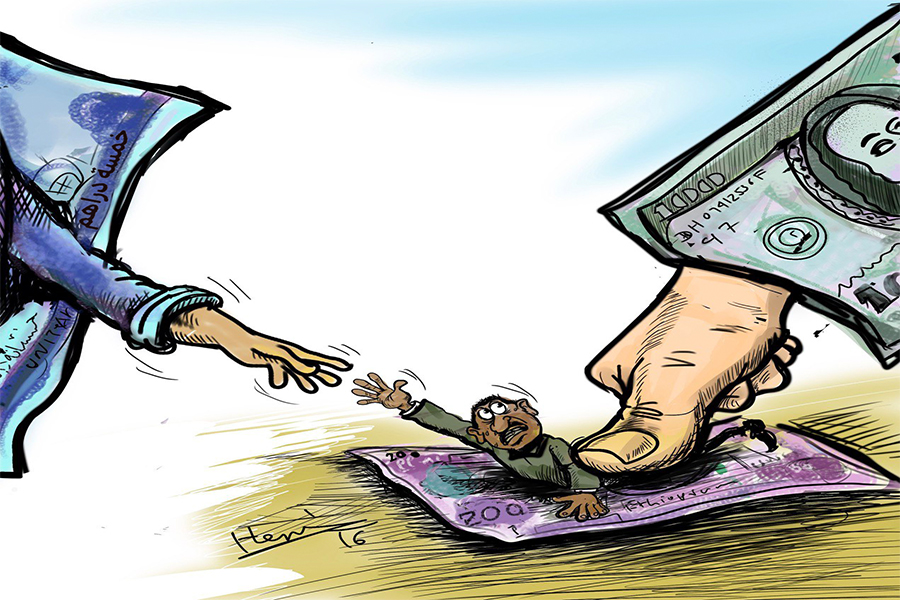
The deeper problem is not energy dependence alone, inasmuch as it is the meeting point between external shocks and foreign-exchange constraints. When world prices climb, the issue is not simply whether a country can find the goods it needs. It is whether it can pay for them. In economies with narrow foreign-exchange buffers, the question becomes urgent quickly, carrying apparent policy implications.
Governments need to secure essential imports, manage energy consumption, and ensure steady domestic markets. But the longer-term task should be to reduce structural vulnerability by diversifying export earnings, strengthening domestic value addition, and improving energy efficiency.
Cutting dependence on imported fuels through renewable energy, electrification, and efficiency gains is not only environmentally sensible. It is also a form of economic self-defence as every unit of domestic energy replaces a measure of imported vulnerability. Every gain in efficiency saves scarce foreign exchange and supports macroeconomic stability.
The good thing is that there are signs of movement in that direction. Investments in renewable energy, fertiliser production, and industrial capacity are beginning to emerge.
However, signing memoranda of understanding should not be mistaken for execution. Whether these investments materialise will depend on peace and stability, and on continued gains in transparency, regulatory clarity, and ease of doing business. They will not solve the present shock. But they present optimism, pointing toward a more resilient economic structure, one less exposed to distant chokepoints.
For policymakers, the challenge is twofold. They should manage the immediate risk while also confronting the structural weaknesses that make such shocks so damaging. That requires a change in perspective to recognise that these are unfoldings beyond temporary disturbances but warnings about deeper vulnerability.
The Strait of Hormuz will probably not be the last chokepoint to test the global economy. But it is a powerful reminder of how concentrated dependence shapes outcomes far from where danger begins. Its importance lies not only in the energy it carries, but in the system it sustains and the fragility it reveals.
If Hormuz exposes the weakness of the present, it also presses countries to build an economic model less reliant on single points of failure, with resilience built in and concentration risk no longer an afterthought.
However, the broader lesson could be universal, for the global economy, though highly integrated, remains uneven in its resilience.
Nassim N. Taleb has often warned that systems optimised for sheer efficiency are frequently the most fragile under stress. The global economy, while highly integrated, remains structurally vulnerable to the very chokepoints it relies on. There is a fundamental trade-off between optimisation and durability. When efficiency is the only goal, the system lacks the slack necessary to absorb shocks. As Iranian leaders treat geopolitical risk as a priced asset, the fragility of global supply chains becomes a strategic liability for the West. Policymakers should reconsider the design of global trade, moving away from fragile efficiency toward systems that can withstand the deliberate use of uncertainty.
To deepen its engagement with the global economy on terms defined by strategy rather than circumstance, Ethiopia has to aim for goals beyond sheer growth, but to endure and build an economic system that sustains momentum through disruption, adjusts with confidence, and compounds strength over time.
PUBLISHED ON
Apr 18,2026 [ VOL
27 , NO
1355]

Editorial | Jul 27,2024
Commentaries | Aug 08,2020

Life Matters | Jul 20,2024
Life Matters | Dec 31,2022

Radar | Jul 20,2025

News Analysis | Mar 21,2026

Commentaries | Sep 08,2024
Commentaries | Jan 16,2021
Radar | Feb 08,2026

Photo Gallery | 190987 Views | May 06,2019

Photo Gallery | 180770 Views | Apr 26,2019

Photo Gallery | 177441 Views | Oct 06,2021

My Opinion | 143083 Views | Aug 14,2021





Dec 22 , 2024 . By TIZITA SHEWAFERAW
Charged with transforming colossal state-owned enterprises into modern and competitiv...

Aug 18 , 2024 . By AKSAH ITALO
Although predictable Yonas Zerihun's job in the ride-hailing service is not immune to...

Jul 28 , 2024 . By TIZITA SHEWAFERAW
Unhabitual, perhaps too many, Samuel Gebreyohannes, 38, used to occasionally enjoy a couple of beers at breakfast. However, he recently swit...

Jul 13 , 2024 . By AKSAH ITALO
Investors who rely on tractors, trucks, and field vehicles for commuting, transporting commodities, and f...
Jul 4 , 2026
In the goldfields of the Benishangul-Gumuz Regional State, Ethiopia's balance-of-paym...
Jun 27 , 2026
The federal legislative house rushed through one of the country's most contentious ho...
When Parliament takes up the appropriation bill, federal legislators will receive a d...
Jun 13 , 2026
The recent policy decision to fully open freight forwarding to foreign capital may be...
Jul 7 , 2026
The health sector remains underprovided despite rising public spending, Prime Ministe...
Jul 7 , 2026
Prime Minister Abiy Ahmed (PhD) delivered one of his bluntest rebukes yet to the coun...

Jul 7 , 2026
Prime Minister Abiy answered his critics with a mix of gratitude and edge, thanking l...

Jul 7 , 2026
A ruling-party lawmaker, Mohammed Ahmed, called the Chamber to its feet for Prime Min...






 Loading your updates...