
Obituary | Mar 02,2024



Mar 28 , 2026.
The most alarming economic losses are often the hardest to see. A bridge destroyed by war is visible, not a factory closed down by foreign-exchange shortages. The machinery not imported, the warehouse not built, the workshop not expanded, the processing line not installed, and the fleet not financed remain outside of public discourse.
A construction site gone may be visible, but the slow erosion of private capital accumulation is harder to spot. This is a quieter form of collapse that may prove to be one of the costliest setbacks Ethiopia has suffered in a generation.
The real damage lies there, accumulating quietly year after year. It shows that private capital accumulation, measured through private gross fixed capital formation, expanded through the 2000s and mid-2010s, peaking at 24.51pc of GDP in 2017. Two years later, the share was still 21.4pc. Then the break came. By 2021, private investment had fallen to about 12.5pc of GDP. In 2024, it had recovered only partly, to 14.85pc.
This, beyond a normal cyclical dip, is a structural retreat in wealth formation.
Ironically, nominal figures offer a false comfort. On paper, private fixed investment appears to have grown from about eight billion Birr in 2000/01 to around 1.745 trillion Br almost a quarter of a century later. Total investment at current market prices also climbed, from 948.9 billion Br in 2018/19 to 2.409 trillion Br after five years. But inflation has done much of the lifting. In real terms, private capital accumulation grew until 2017, then contracted sharply in 2020 and 2021, and has recovered only partly since.
The nominal rise masks an erosion in the economy’s real capacity to build productive assets.
That matters because capital accumulation is the skeleton of growth. Countries become richer by building the assets (such as machines, industrial sheds, irrigation systems, logistics depots, hotels, gold chains, processing plants and digital infrastructure) that make future production possible. When private capital accumulation slows, an economy is weakening its ability to grow tomorrow.
Political leaders and policymakers once seemed to grasp this. The past quarter of a century can be seen in five phases, and the most striking was the decade-long ascent that began in 2004. Public infrastructure spending and rapid GDP growth helped pull private investment upward. Roads, power plants and industrial parks raised expected returns. Debt relief created fiscal room, while private investors followed the state into a widening field of opportunity.
The erosion began before the full force of the recent crises. By 2018 and 2019, the debt-fuelled public investment boom was already fading. The Birr (the Brewed Buck) was overvalued. Access to foreign currency had become a severe constraint for firms that depended on imported machinery or inputs. Some firms waited from six months to two years for foreign exchange, after first depositing the full Birr equivalent in their accounts.
On the factory floor, the absurdity was plain, and remains so. Capital tied up, imported equipment delayed, and expansion plans frozen, while overheads still running. This is how investment dies in practice, not in one dramatic event, but in a long administrative suffocation.
Then came the triple shock. The global pandemic, COVID-19, disrupted supply chains and confidence. The civil war in Tigray Regional State damaged the investment climate more severely than any event since the war with Eritrea in the late 1990s. It caused an estimated loss of over 28 billion dollars.
Macroeconomic deterioration delivered a third blow. Inflation remained stuck around 30pc for years, foreign-exchange shortages deepened, external support weakened, and the country defaulted on its one-billion-dollar Eurobond in December 2023. By 2021, private investment’s share of GDP had fallen by nearly nine percentage points from its 2019 level. It was a collapse in the rate at which the private sector was adding to the country's productive stock.
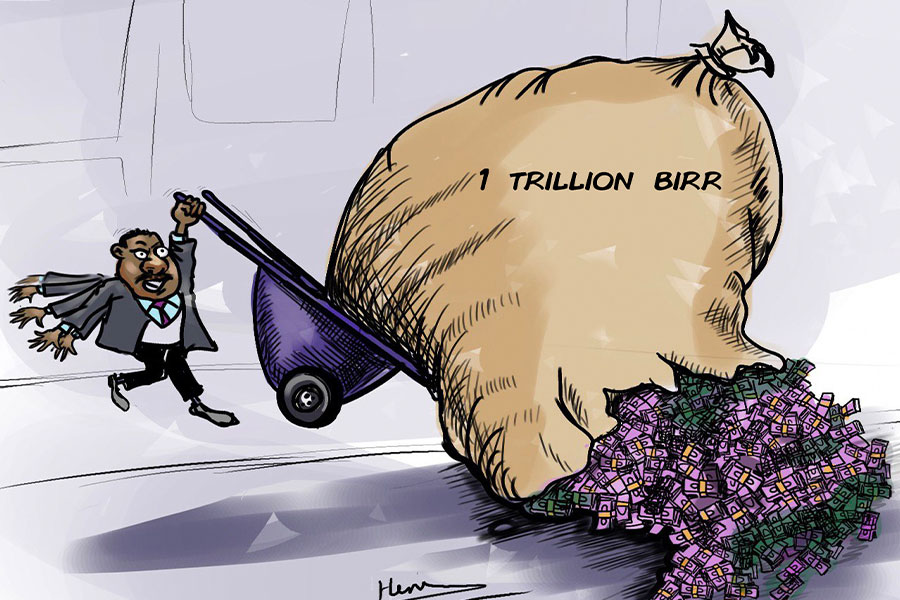
The share of private investment in the economy in 2024 was still about 10 percentage points below its peak in 2017, even though the economy's nominal GDP is now roughly five times larger. The estimate is evident, with annual private capital accumulation about 700 billion Br to 900 billion Br less than it would have been had the pre-crisis investment ratio been sustained. That is about five billion to 6.5 billion dollars a year, more than the country’s annual foreign direct investment (FDI) inflows.
What is evolving is a strange phenomenon in which the country has people with money but not enough productive capital. According to the Africa Wealth Report by Henley & Partners, by 2015, Ethiopia had 2,700 millionaires, more than double the 2007 figure, yet much of that wealth, while sitting in banking rather than being channelled into industrial production or infrastructure, remains unchanged a decade later.
Nonetheless, a country can produce millionaires without producing enough machinery, and it can generate wealth without compounding productive capacity.
Borrowing from Vladimir Lenin’s famous adage, "what needs to be done?" should be the "burning question" of the moment.
Foremost, it is an understatement to say Ethiopia needs peace, stability and consensus, goals that could be achieved through a negotiated political settlement carried out in good faith. It needs a governance reality that prioritises policy predictability over slogans. Private capital is cowardly by nature. It flees noise, uncertainty and arbitrary interruption. As long as wars and conflicts persist and the political compact remains unsettled, investors will keep shortening their time horizons, favouring commodity trading, arbitrage, and quick-turnover activities over factories and assets.
Indeed, policies and reforms targeting macroeconomic stabilisation should continue, but they have to be credible in the eyes of the public and investment-compatible. The mounting cost of living, high inflation, exchange-rate distortions, and foreign-exchange rationing have together been toxic to capital formation. The July 2024 liberalisation of the foreign-exchange regime, which reduced the parallel-market premium albeit with high cost, was an important step.
But liberalisation alone is not enough. Investors need a system through which capital goods can be financed and imported on a predictable timetable. A manufacturer would tolerate a weaker currency sooner than an unknowable one. What kills investment is uncertainty.
Policymakers also need to confront the deepest structural brake that is access to finance. An economy cannot preach industrialisation while asking entrepreneurs to post over 100pc collateral for loans. Nor can it mobilise large-scale domestic capital while keeping debt markets narrow and heavily regulated. The economy needs long-term finance at scale, including leasing, a broader corporate debt market, credible collateral enforcement, better credit information and financial institutions willing to lend against viable projects rather than existing assets.
Public investment should crowd in private capital, not retreat into fiscal exhaustion or crowd it out through distortion. The strongest driver over the long arc was the crowding-in effect of roads, power and industrial parks. The state needs to do the few things private investors cannot do alone. That is to mean, with no ambiguity, reliable electricity, trade logistics, industrial land, customs efficiency and the legal infrastructure of commerce.
Policy should reward reinvestment rather than speculative accumulation. Tax incentives, accelerated depreciation for capital equipment, export-linked investment privileges, and clearer treatment of retained earnings can help move wealthy domestic investors away from passive rent-seeking and toward productive asset formation. Policymakers should also resist the comfort of nominal growth. Construction values can rise while real investment ratios fall. Banks can report larger balance sheets while productive lending stagnates. Fiscal revenues can swell in Birr terms while the capital base decays. These are all unfolding now.
The private capital base was not eroded in a single blow, and a single reform will not rebuild it. But the country cannot afford complacency. When private investment falls from nearly a quarter of GDP to the middle teens, and stays there while the economy grows larger, the missing capital becomes a national economic wound. The question is whether it can restore the conditions under which private capital will once again dare to stay, build and compound.
That is what growth really is, not the temporary thrill of money changing hands. It is the patient accumulation of assets that makes tomorrow more productive than today. Ethiopia has already lost too much of that patience. It should not lose another decade.
PUBLISHED ON
Mar 28,2026 [ VOL
26 , NO
1352]
Obituary | Mar 02,2024
Radar | Jul 20,2025
Fortune News | Sep 03,2022

Life Matters | Apr 15,2023
Radar | Feb 17,2024

Agenda | Jan 10,2026
Editorial | Jun 21,2025
Featured | Nov 02,2019

Commentaries | Sep 08,2024

Radar | Dec 13,2025

Photo Gallery | 193371 Views | May 06,2019

Photo Gallery | 183256 Views | Apr 26,2019

Photo Gallery | 180064 Views | Oct 06,2021

My Opinion | 145496 Views | Aug 14,2021






Dec 22 , 2024 . By TIZITA SHEWAFERAW
Charged with transforming colossal state-owned enterprises into modern and competitiv...

Aug 18 , 2024 . By AKSAH ITALO
Although predictable Yonas Zerihun's job in the ride-hailing service is not immune to...

Jul 28 , 2024 . By TIZITA SHEWAFERAW
Unhabitual, perhaps too many, Samuel Gebreyohannes, 38, used to occasionally enjoy a couple of beers at breakfast. However, he recently swit...

Jul 13 , 2024 . By AKSAH ITALO
Investors who rely on tractors, trucks, and field vehicles for commuting, transporting commodities, and f...
Aug 15 , 2026 . By NAHOM AYELE
Federal prosecutors have charged seven defendants over a set of foreign-trade deals t...
Aug 15 , 2026 . By BEZAWIT HULUAGER
Ethio-post is preparing to turn its thousands of branches into banking agents, allowi...
Aug 18 , 2026 . By BEZAWIT HULUAGER
Kassahun Gofe (PhD), minister of Trade & Regional Integration (MoTRI), is prepari...
Aug 16 , 2026 . By NAHOM AYELE
Justices at the Federal Supreme Court widened the shield they are holding over lawyer...







 Loading your updates...