
Radar | Dec 15,2024



A six-storey building owned by the Ethiopian Shipping & Logistics Service Enterprise (ESLSE) on Gambia St., adjacent to Holy Saviour Catholic Church, will begin coming down this week.
The building, formerly owned by the Ethiopian Maritime & Transit Service Enterprise (EMTSE), houses the ESLSE, a state-enterprise incorporated after four other state-owned companies - Ethiopian Shipping Lines Share Company, Ethiopian Maritime & Transit Service Enterprise, Dry Port Enterprise, and Comet Transport Share Company - amalgamated in 2016. It operates in shipping, freight forwarding, land transport, dry port operations, and related services.
The building's planned demolition has become a flashpoint in a pattern that is harder to ignore. Buildings disappear, sometimes after public money has been spent to renovate them, and questions follow after the wrecking starts. The company's managment plans to move departments and functions to a new building behind the one slated for demolition, built on a 3,000Sqm plot for 400 million Br. Designed by ZIAS Consultants, managed by Derege Assefa (Eng.), MTSE's Multipurpose Building was completed in 2014.
On the 21st floor sits a revolving restaurant, while the lower levels are split between an apartment and an office attachment.
According to Iftu Anwar, communications division manager, much of the new building remains vacant and can accommodate employees who have been moved into it. The old building by the main road had undergone renovations costing close to 390 million Br, although company officials insist the figure is exaggerated. Two departments had been based there, while sources say another four departments were working there as well. ESLSE employs more than 3,000 people.
“There will be no damage even if the building is demolished,” Iftu told Fortune.
After the site is cleared, it is expected to be turned into parking and green space. The building dates back to the Derg era and was designed by Yusuf Negash. A replica of the former Ethiopian Investment Commission building on Africa Avenue (Bole Road) has likewise been demolished. Historic buildings have continued to disappear across the city. This trend has sharpened criticism that demolitions in the capital are too often carried out after considerable spending.
A similar case dates to the late 1960s, when a building that housed the Tourism Commission, designed by Henri Chomette, was demolished after its interior and elevators had been renovated.
For critics, these cases point less to urban renewal than to poor planning.
Among those questioning the decisions to demolish is Anteneh Tesfaye (PhD), an architect and planner at Addis Abeba University (AAU). He considers the renovation spending wasteful and argues that, because public money is involved, a feasibility study should have preceded the renovations and the demolitions.
“Aesthetical, ecological, and spatial values are the defence of the Shipping Lines,” he said.
He recalled a time when the city required developers to reserve around 20pc of land for greenery. According to Anteneh, if ESLSE is trying to meet that standard, it should view the site as part of the city’s green ecosystem.
"Such decisions are being made by the government and can seem confusing, though some appear to be pieces of a larger puzzle beyond politics and governance," he said. "The larger city imagined by the government can't yet be clearly shown or judged as right or wrong."
But Anteneh argued that a country dependent on imports should not waste public resources or allow such decisions to become a habit.
“The money might have even built 10 schools in a rural area,” he said, referring to the spending made to renovate the building that is now set for demolition.
Managed by Abdulber Shemsu (Eng.), ESLSE, known commercially as Ethiopian Shipping Lines, is a national cargo shipping company, first established in 1964, as a joint venture with the American company, Towers Perrin. A Dutch company was hired to manage the Line, in an arrangement comparable to the role Trans World Airlines played for Ethiopian Airlines. Operations began in 1966 with three ships, named The Queen of Sheba, Lion of Judah and Lalibela.
A few years ago, its iconic building on Ras Mekonnen Avenue (La Gare), which had served as its headquarters for over two decades, was demolished to make way for an apartment building. The company, whose board is chaired by Berhanu Tsegaye, state minister for Foreign Affairs, is a subsidiary of Ethiopian Investment Holdings, the country’s sovereign wealth fund.
PUBLISHED ON
Mar 21,2026 [ VOL
26 , NO
1351]
Radar | Dec 15,2024
Commentaries | Jun 21,2025
Radar | Mar 28,2026

View From Arada | Jun 27,2026

Money Market Watch | May 03,2026

Radar | Jan 19,2024

Viewpoints | Aug 03,2025
Fortune News | Apr 15,2023
Fortune News | Jan 10,2026

Fortune News | Aug 02,2025

Dec 22 , 2024 . By TIZITA SHEWAFERAW
Charged with transforming colossal state-owned enterprises into modern and competitiv...
Aug 18 , 2024 . By AKSAH ITALO
Although predictable Yonas Zerihun's job in the ride-hailing service is not immune to...
Jul 28 , 2024 . By TIZITA SHEWAFERAW
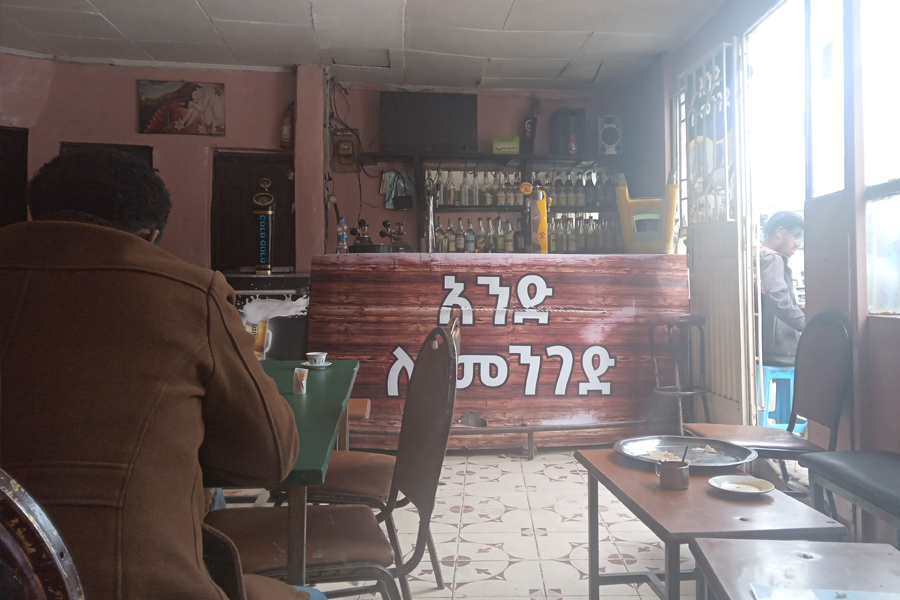
Unhabitual, perhaps too many, Samuel Gebreyohannes, 38, used to occasionally enjoy a couple of beers at breakfast. However, he recently swit...

Jul 13 , 2024 . By AKSAH ITALO
Investors who rely on tractors, trucks, and field vehicles for commuting, transporting commodities, and f...

Jul 4 , 2026
In the goldfields of the Benishangul-Gumuz Regional State, Ethiopia's balance-of-paym...

Jun 27 , 2026
The federal legislative house rushed through one of the country's most contentious ho...

When Parliament takes up the appropriation bill, federal legislators will receive a d...

Jun 13 , 2026
The recent policy decision to fully open freight forwarding to foreign capital may be...










 Loading your updates...