

Money Market Watch | Nov 16,2025



The backlash sparked by a TikTok clip featuring “Tigi Perspective”, a self-styled social critic known for her conservative takes on gender and family, has reignited long-buried cultural tensions.
The controversy followed her push to “bring back the endorsement” of the phrase “Ye se’t lij”, or “child of a woman,” to denote "uncouth", children raised without manners due to the absence of a father. To some, this was a defence of traditional values. To many others, it was a return to a shaming lexicon that has haunted generations.
However, the virality of this moment masks something deeper, not a mere cultural clash over evolving norms. It is a reckoning with how Ethiopians treat their most vulnerable caregivers, and how society persistently fails to ask the right question.
Where are the fathers?
In the Ethiopian context, “Ye se’t lij” has long been wielded as more than a descriptor. It is a moral branding. For decades, children raised in single-mother households, whether due to divorce, death, abandonment, or economic migration, have been marked by the term. The phrase insinuates a deficiency not only in the family structure but also in the child’s moral character and social worth.
Anthropological literature makes clear that such terms function less as identifiers and more as instruments of social control, tools to enforce patriarchal norms by stigmatising women who parent alone. This stigma spills over to the children, shaping their educational, social, and economic opportunities.
For me, this was not an academic theory but a lived experience. Growing up in Shola Market, on Kenenisa Avenue, near the British Embassy, surrounded by hard-working single mothers, the disconnect between societal scorn and maternal resilience was apparent.
Their labour was visible, and their exhaustion undeniable, yet judgment followed them more closely than praise.
I remember being eight years old, the first time we moved to Shola after my parents separated. My mother warned me about the phrase “Ye se’t lij.” At the time, I did not understand why it was considered shameful. I was proud to be one.
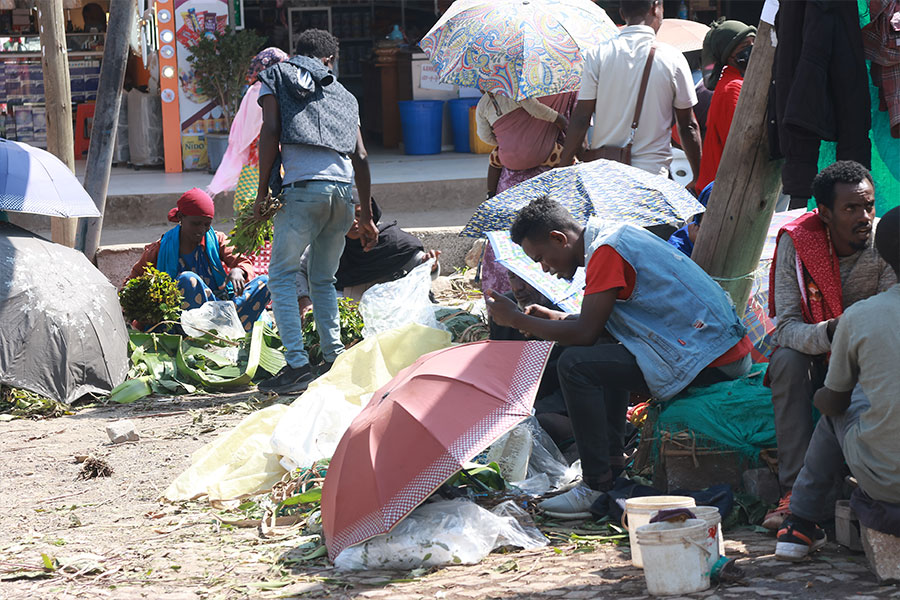
I saw a woman who had once been a housewife turn into a businesswoman almost overnight to put food on my plate. I watched her learn the rhythm of the market, negotiate prices, and stand on her feet without anyone’s permission. Around her were many women doing the same.
To me, that was admirable. I honestly still do not understand why society insists on calling that failure.
What the TikTok moment revealed is how quickly Ethiopian society collapses complex issues into simplistic morality plays. The backlash against “Tigi Perspective” was swift, but so too was the counter-backlash defending her as merely echoing a “truth” about broken families and absent discipline.
Both reactions miss the point.
The crisis facing single mothers is not a values crisis but a systems crisis. A moralistic lens blames family outcomes on individual failure rather than institutional neglect.
However, international research shows that the challenges children face in single-parent households are overwhelmingly shaped by economic precarity, not parental marital status.
According to joint studies by UNICEF and the American Institutes for Research, over half of Ethiopian caregivers cannot meet their children’s basic nutritional needs. These deficiencies derive from structural shortages, low wages, and inconsistent public services, not parental absence.
In 2024, the Federal Supreme Court issued a directive to standardise child maintenance calculations, a long-awaited attempt to bring order to a chaotic and inconsistently enforced system. While the directive signals progress on paper, its enforcement remains lacking.
Fathers are legally bound to support their children regardless of marital status. Yet in practice, legal redress is laborious, costly, and frequently ineffective. Court rulings in favour of mothers often go unenforced. With no system to track compliance or penalise defaulters, mothers are left to chase accountability across months or years.
Worse still, there is no central database tracking paternal compliance. Society tolerates male absence as unremarkable. Meanwhile, single mothers become the subject of blame, their struggles rebranded as personal or moral failings.
Comparative insights from countries such as Norway and Singapore show that outcomes improve when governments invest in systems. In Singapore, universal childcare, wage support, and structured schooling environments ensure that even children from single-parent households are not left behind. The difference is not one of moral fibre, but of institutional scaffolding.
In Ethiopia, where even intact two-parent households struggle against textbook shortages and inadequate infrastructure, single mothers operate without even that baseline. Heroic parental efforts are drowned in systemic neglect.
PUBLISHED ON
Jan 03,2026 [ VOL
26 , NO
1340]

Money Market Watch | Nov 16,2025

Radar | Oct 12,2025
Radar | Dec 07,2019

Fortune News | Nov 05,2022
News Analysis | Feb 15,2026

Dec 22 , 2024 . By TIZITA SHEWAFERAW
Charged with transforming colossal state-owned enterprises into modern and competitiv...

Aug 18 , 2024 . By AKSAH ITALO
Although predictable Yonas Zerihun's job in the ride-hailing service is not immune to...

Jul 28 , 2024 . By TIZITA SHEWAFERAW
Unhabitual, perhaps too many, Samuel Gebreyohannes, 38, used to occasionally enjoy a couple of beers at breakfast. However, he recently swit...

Jul 13 , 2024 . By AKSAH ITALO
Investors who rely on tractors, trucks, and field vehicles for commuting, transporting commodities, and f...

When Parliament takes up the appropriation bill, federal legislators will receive a d...
Jun 13 , 2026
The recent policy decision to fully open freight forwarding to foreign capital may be...

Jun 6 , 2026
For a political veteran as controversial as Getachew Reda, last week's national elect...
May 30 , 2026
Tomorrow, millions of Ethiopians are expected to vote in the seventh national electio...












 Loading your updates...