
Editorial | Jul 07,2024



Oct 4 , 2025
By Mikiyas Mulugeta (PhD)
Policymakers hope that the newly announced tax reforms, including a property tax and an expanded VAT, will shore up revenues without tipping the scales for families. Despite recent reforms, the tax-to-GDP ratio remains stubbornly below half the African average. The government’s shift toward consumption-based taxes, especially on fuel and goods, draws concern from urban workers and transporters who say every Birr counts as wages lag behind price hikes, writes Mikiyas Mulugeta (PhD) (mikiusc2017@gmail.com), a consultant and director of training and development programs at the Centre for African Leadership Studies (CALS) and XHub-Addis.
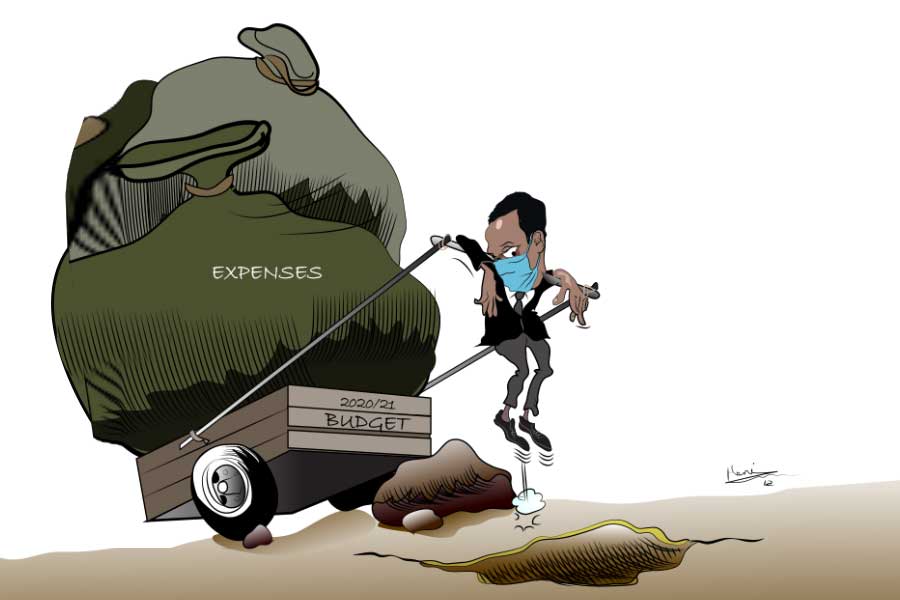
The Ministry of Finance, with its Citizens' Budget, has made efforts to simplify the budget for the fiscal year 2025/26 for wider use, an important gesture toward transparency in a country where fiscal opacity has often eroded public trust.
However, beyond the glossy figures and accessible language, the record 1.93 trillion Br allocation, marking a leap of more than one-third compared to the previous fiscal year, points to an economy struggling to attain a balance between ambition and constraint. Its macroeconomic projections show confidence but also carry a measure of political optimism.
Growth is forecast at 8.9pc, up by 0.5 percentage points from last year. Inflation is assumed to ease by two percentage points to 11.9pc, and the fiscal deficit is capped at a neat one percent of GDP. Imports are projected to rise to 21.3 billion dollars, deepening a chronic current account deficit. While these projections provide a surface impression of stability, they often remain disconnected from the realities many citizens face.
Inflationary pressures are deeply entrenched, steadily eroding disposable incomes and distorting prices across the economy. Currency depreciation continues to fuel imported inflation, and possible revenue shortfalls and mounting expenditure demands will test the carefully drawn deficit target.
On the revenue side, the federal government is betting on long-debated tax reforms to close the fiscal gap. Measures such as a property tax, a motor vehicle circulation levy, the full application of VAT and excise on fuel, and the Minimum Alternative Tax are all set for implementation.
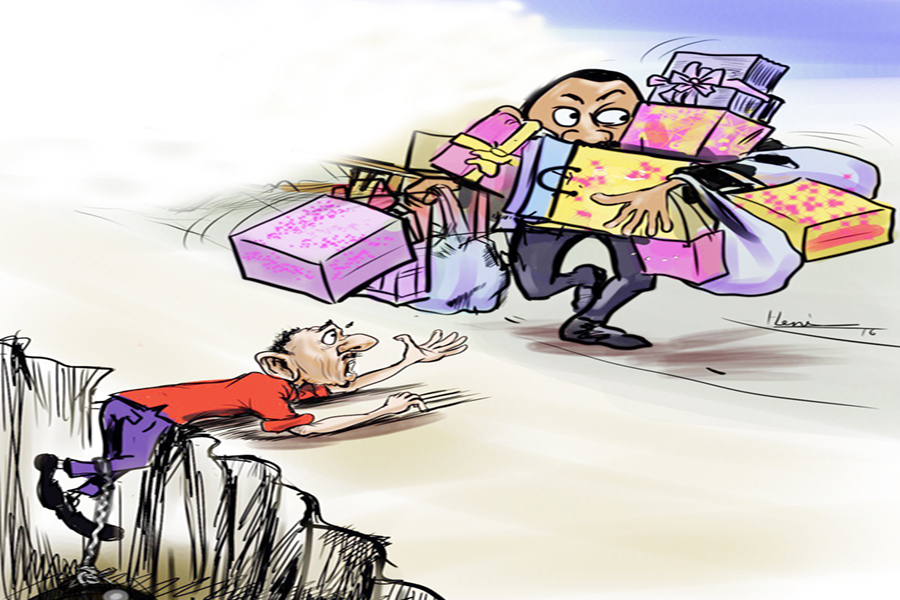
Granted, the country’s tax-to-GDP ratio remains stubbornly below half the African average, making reform unavoidable. Still, policymakers' determination to focus on consumption-based taxes raises concerns, as these tend to hit poorer households hardest, directly affecting transport, logistics, and food prices. Taxation on fuel passes through the supply chain, while VAT exacerbates the squeeze on urban consumers already reeling from inflation. Without visible efficiency gains in public services, these reforms could be seen less as a step toward fiscal sustainability and more as punitive extraction from a stretched tax base.
Expenditure allocations try to balance the need for development with growing social pressures.
Roads claim nearly 85 billion Br of the budget, demonstrating the state’s continued commitment to infrastructure as a catalyst for growth. Education gets more than 40 billion Br for higher learning, along with investments in vocational training. Health receives over 18 billion Br for system expansion, in addition to earmarks for maternal health and immunisation. Irrigation, considered critical for food security and climate resilience, is allocated 17 billion Br.
While these commitments are substantial on paper, the persistent execution deficit, marked by project delays, governance bottlenecks, and regional inequities, threatens to weaken their impact.
Social protection has become a major budget line, quietly acknowledging that vulnerability has become systemic. Nearly 49 billion Br is allocated to the Productive Safety Net Programme, with 24 billion Br dedicated to urban food security. This is a notable shift in a country where social spending has traditionally played second fiddle to capital outlays. Yet, as with other allocations, delivery is the essential variable. Delays, politicisation, or leakages could quickly erode the credibility of the safety nets.
The fiscal challenge is not simply about raising resources. It should also be about ensuring that allocations lead to tangible social outcomes.
Debt dynamics are the silent constraint in the background. Domestic borrowing costs are high, with treasury bills yielding around 16pc. External debt obligations are substantial, and a joint debt sustainability assessment by the World Bank and the IMF continues to rank Ethiopia in the high-risk category of distress. This sharply narrows the government’s fiscal space, leaving little room for discretionary spending or policy mistakes.
The 10 billion Br allocated for post-war reconstruction shows the dilemma. It recognises the scale of devastation but falls far short of the financing needed for credible rehabilitation. The competition between debt servicing, reconstruction, and social spending is growing, constraining policymakers' options.
Undoubtedly, the introduction of a Citizens’ Budget is a practice with good intentions. By breaking down fiscal policy into accessible language, the Ministry is opening the door for greater scrutiny from citizens, civil society, and the media. However, transparency without credibility is a fragile matter. People live not in projections but in markets where food and fuel prices climb relentlessly, in households where wages stagnate, and in communities where public services remain patchy.
Unless visible improvements match transparency in outcomes, it risks becoming another source of frustration.
PUBLISHED ON
Oct 04,2025 [ VOL
26 , NO
1327]

Editorial | Jul 07,2024

Radar | May 06,2023

Fortune News | Aug 22,2020
In-Picture | Apr 26,2026
Fortune News | Aug 17,2025
Fortune News | May 17,2026
Editorial | Sep 14,2024
Editorial | Jul 13,2020

Radar | Oct 31,2020
Radar | Apr 30,2024

Photo Gallery | 193842 Views | May 06,2019

Photo Gallery | 183729 Views | Apr 26,2019

Photo Gallery | 180628 Views | Oct 06,2021

My Opinion | 145985 Views | Aug 14,2021





Dec 22 , 2024 . By TIZITA SHEWAFERAW
Charged with transforming colossal state-owned enterprises into modern and competitiv...

Aug 18 , 2024 . By AKSAH ITALO
Although predictable Yonas Zerihun's job in the ride-hailing service is not immune to...

Jul 28 , 2024 . By TIZITA SHEWAFERAW
Unhabitual, perhaps too many, Samuel Gebreyohannes, 38, used to occasionally enjoy a couple of beers at breakfast. However, he recently swit...

Jul 13 , 2024 . By AKSAH ITALO
Investors who rely on tractors, trucks, and field vehicles for commuting, transporting commodities, and f...

Aug 28 , 2026
Every year, the Ministry of Education (MoE) sets a national examination. Every year,...
Aug 22 , 2026
A record is a strange thing to worry about. Federal trade officials have booked the b...
Aug 14 , 2026
Aschalew Fetene, known as “Ardi” and admired for his poetic depth, has built a ti...

Aug 8 , 2026
The World Bank asks readers to picture a mother in rural Ethiopia who has never held...
Aug 29 , 2026 . By BEZAWIT HULUAGER
The federal government is increasingly relying on Treasury bills (T-bills) to repay T...
Aug 29 , 2026 . By NAHOM AYELE
Judges on a Federal High Court bench have ordered D'Afrique, one of Addis Abeba's old...
The Ministry of Revenues wants to know not just who a taxpayer is but almost everythi...
Aug 29 , 2026 . By BEZAWIT HULUAGER
Electricity supplied from Ethiopia has helped halve Djibouti's power production costs...






 Loading your updates...