

Radar | Oct 05,2019



Apr 13 , 2025
By Bjorn Lomborg
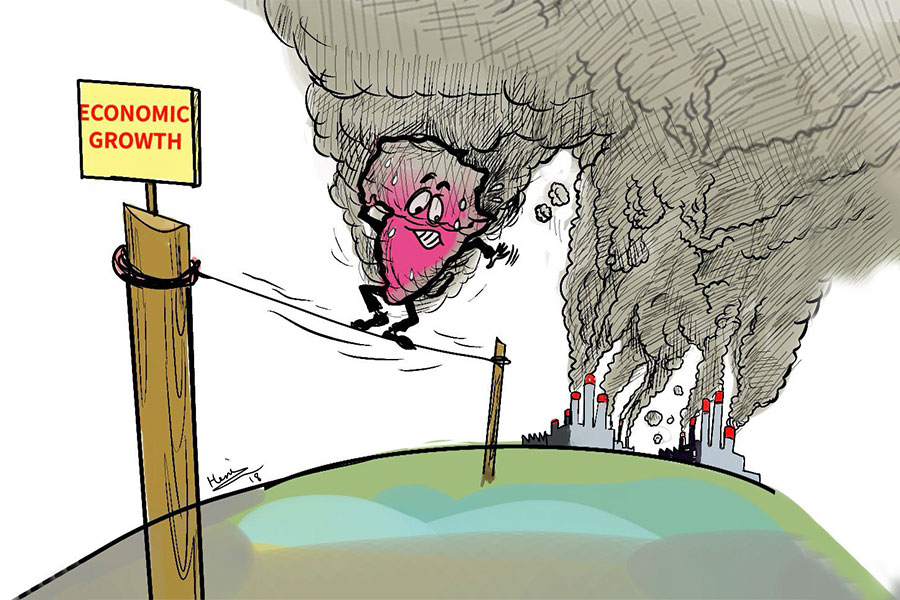
Over the past decade, corporate and international organisation leaders have become used to being lauded for making grand but ultimately empty green promises on stages in Davos and climate summits. How quickly things have changed. Fear of being called out by the Trump Administration is forcing many leaders into changing course, at least in their rhetoric.
World Bank President Ajay Banga's first move when he took over the institution in 2023 was to extend its mission from ending poverty to incorporating climate change and making the planet "livable". Last November, as he headed to the COP summit in Azerbaijan, Banga graced the cover of Time magazine's "climate issue" and warned that climate change was "intertwined" with every challenge. Yet today, he somewhat implausibly tells reporters, "I'm not a climate evangelist".
The shift in self-identification is frankly meaningless without deeper change.
For the development banks, much work remains to end poverty. Astonishingly, the World Bank and the African Development Bank (AfDB) ringfence a whopping 45pc and 55pc of annual financing, respectively, for climate projects. Both institutions divert half or more of these climate funds to projects that reduce the emissions of poor people, an absurdity when energy poverty remains a huge barrier to development.
It is hypocritical and ultimately immoral to insist that poorer countries rely on intermittent solar and wind energy when every single rich country has access to a vast amount of affordable, dependable energy, mostly from fossil fuels. Indeed, Africa has been forced to finally get its own energy bank to fund fossil fuel projects because the major development banks refuse to invest in them.
It remains to be seen whether the U.S. will use its significant shareholdings in the World Bank and the AfDB to encourage a return to less glamorous development basics, or whether the Trump Administration will be content with a mere change in language. The development banks could take a leaf out of corporate America's book. Parts of the private sector have moved ruthlessly to abandon green virtue-signalling and return to their core work.
Climate change is undeniably a real problem which has tangible economic impacts. However, climate solutions also come with their own set of costs, often demanding that businesses and individuals rely on pricier, less dependable energy sources. The decision to balance the expenses of climate policies with the advantages of climate action falls rightly under the responsibility of governments, not profit-driven businesses.
Yet, over the past decade, even major contributors to climate change, such as the fossil fuel industry itself, invested in extraordinary green policies. Five years ago, BP made an astonishing promise to slash its oil and gas production by 40pc by 2030, while increasing green energy generation 20-fold and becoming net-zero. Now, along with other big, western oil companies, it has abandoned those farcical green promises and recommitted to its primary activity: fossil fuels.
No doubt, this U-turn will be lamented by green activists. But the truth is that these promises were always an inefficient way of helping the planet, and very short-sighted for fossil fuel companies. Even after the world has spent 14 trillion dollars on climate policy, more than four-fifths of global energy remains supplied by fossil fuels. Over the past half-century, fossil fuel energy has more than doubled, with 2023 again setting a new record. Consumers and businesses are crying out for more energy, while competitor state-owned oil companies from the Middle East have continued to provide more fossil fuels.
It is a foolish energy company that declares it will supply less energy.
Banks also had a fling with green policies and have now dumped them. The six largest U.S. banks are leaving the Net-Zero Banking Alliance, and Wells Fargo is officially abandoning its goal of achieving net-zero emissions across its financial portfolio by 2050.
While some industries are moving faster than others, there are signs that many companies will change their language, and not their inefficient climate policies. A recent global survey of 1,400 corporate executives found that 58pc of companies "are deliberately planning to decrease their level of external communications" about climate policies, even though most intend to spend even more on these than before. Shareholders need to ask hard questions about what these policies do for the planet, and what they add to the bottom line.
As leaders of international organisations and corporations scramble to adapt to an entirely new world, it is important that they go further than simple rhetorical shifts. The era of being cheered on for every green promise and vow, regardless of how silly or self-defeating, has come to an end. Now, it is time for those leaders to get back to business.
PUBLISHED ON
Apr 13, 2025 [ VOL
26 , NO
1302]

Radar | Oct 05,2019
Editorial | Sep 13,2025

Fortune News | Oct 18,2025
Fortune News | Apr 02,2022
Commentaries | Nov 16,2024

Radar | Oct 16,2021

View From Arada | Jul 19,2025
Viewpoints | Dec 30,2023
Fortune News | Apr 22,2022
Viewpoints | Jun 07,2025

Photo Gallery | 193778 Views | May 06,2019

Photo Gallery | 183666 Views | Apr 26,2019

Photo Gallery | 180531 Views | Oct 06,2021

My Opinion | 145918 Views | Aug 14,2021








Dec 22 , 2024 . By TIZITA SHEWAFERAW
Charged with transforming colossal state-owned enterprises into modern and competitiv...

Aug 18 , 2024 . By AKSAH ITALO
Although predictable Yonas Zerihun's job in the ride-hailing service is not immune to...

Jul 28 , 2024 . By TIZITA SHEWAFERAW
Unhabitual, perhaps too many, Samuel Gebreyohannes, 38, used to occasionally enjoy a couple of beers at breakfast. However, he recently swit...

Jul 13 , 2024 . By AKSAH ITALO
Investors who rely on tractors, trucks, and field vehicles for commuting, transporting commodities, and f...
Aug 22 , 2026
A record is a strange thing to worry about. Federal trade officials have booked the b...

Aug 14 , 2026
Aschalew Fetene, known as “Ardi” and admired for his poetic depth, has built a ti...

Aug 8 , 2026
The World Bank asks readers to picture a mother in rural Ethiopia who has never held...

Jul 31 , 2026
Weldu Yiheysh has not read the Pacific temperature charts. He does not need to. In Shibta District of Enderta Wereda, in...
Aug 22 , 2026 . By BEZAWIT HULUAGER
The forthcoming strategy for interest-free finance will place Sharia-compliant financ...
Aug 22 , 2026 . By NAHOM AYELE
Wegagen Capital Investment Bank (WCIB) has completed its first full year in profit an...
Aug 25 , 2026 . By NAHOM AYELE
Judges at the Federal High Court, sitting on a limited basis to hear only urgent matt...
Aug 22 , 2026 . By BEZAWIT HULUAGER
Federal authorities are about to find out whether they can make a single payment wind...







 Loading your updates...