

My Opinion | Nov 29,2025



Jun 19 , 2021
By Christian Tesfaye
Lately, coffee has been good for Ethiopia. Over the past three months, exports have been showing impressive growth, fetching 107 million dollars in March. The month after that, this reached 114 million dollars. In May, it outperformed records with 131 million dollars worth of coffee exported to the international market.
What is going on?
Characteristically, the authorities would say that it is more effective agricultural and supply chain policies. Indeed, the volume of the commodity being exported has increased. But it has more to do with the fact that every single bag of coffee beans is selling for higher than it used to last year—a consequence of providence.
Or, in Brazil’s case, bad luck. The South American giant is going through a drought, and as the biggest exporter of the bean in the world, there is currently a global coffee shortage. Arabica coffee is now selling for its highest price since 2016, according to Business Insider.
“Coffee prices [on average of all time] have risen nearly 70pc in the past year and currently trade around 1.66 dollars per pound,” reported the financial and business news outlet.
If the drought lasts through August, it bodes terribly for Brazil over the next year, but Ethiopian coffee producers have cause to celebrate. And, hey, it is not like Brazil, while a world leader in the export of the commodity, will have its economy hampered solely by this. It is an economy that has diversified, unlike Ethiopia.
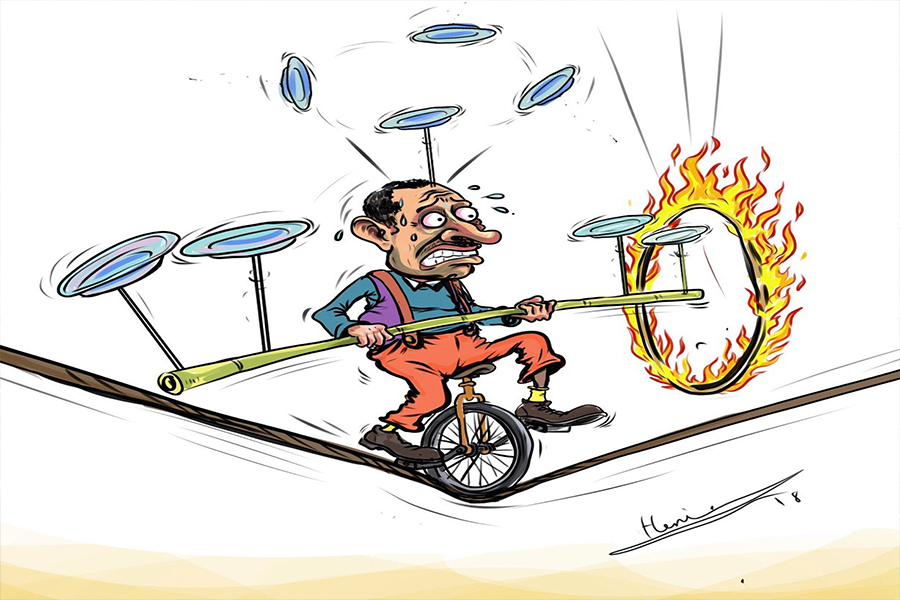
But this is just one side of the story of global inflation and its impact on this country. It is not just a drought in Brazil that is pushing the global prices of goods and services. The primary driver is the United States. The Biden administration’s multi-trillion-dollar economic stimulus package is helping the country and the world recover rapidly from the pandemic-induced global recession. Unfortunately, it is also proving the Miltonian argument that increasing money supply is inherently inflationary, even for the US—the price of goods and services is increasing in the country, although it is yet to be seen if it is lasting.
Making matters worse is that as the global economy recovers and demand increases, supply is not catching up. Commodities such as lumber and copper are all rising. A shortage of semiconductor chips is impacting the production of devices that use electronic equipment, from cars to computers and smartphones.
More importantly for Ethiopia, there is a crippling shortage of shipping containers, also as a result of COVID-19. How this became a problem is too convoluted to explain here but let us just say that the uneven easing of restrictions across the world has meant that many containers are held up in all the wrong places.
When it comes to Ethiopia, this translates to the state monopoly Ethiopian Shipping & Logistics Service Enterprise tripling, in some cases, its shipping prices. The Enterprise is trying to lease or buy more containers, but fat chance it has as every shipping company worldwide is trying to do the same—a costly bidding war.
Just as a global chip shortage has meant that laptops and computers are more expensive—of course, only one factor among many, like the depreciation of the Birr—higher shipping tariffs mean that products would get more expensive here. Importers, manufacturers, distributors and retailers would transfer the inflated prices to consumers; a price for being a member, albeit tiny and mostly insignificant, of the global economy.
PUBLISHED ON
Jun 19,2021 [ VOL
22 , NO
1103]

My Opinion | Nov 29,2025

Viewpoints | Aug 31,2019
Viewpoints | Jul 23,2022
Viewpoints | Oct 09,2021
Commentaries | Jun 14,2025

Commentaries | Jan 10,2026
Viewpoints | May 06,2023

Fortune News | Mar 13,2021
Viewpoints | Nov 29,2020
Advertorials | Apr 10,2023

Photo Gallery | 190990 Views | May 06,2019

Photo Gallery | 180773 Views | Apr 26,2019

Photo Gallery | 177446 Views | Oct 06,2021
My Opinion | 143084 Views | Aug 14,2021







Dec 22 , 2024 . By TIZITA SHEWAFERAW
Charged with transforming colossal state-owned enterprises into modern and competitiv...

Aug 18 , 2024 . By AKSAH ITALO
Although predictable Yonas Zerihun's job in the ride-hailing service is not immune to...

Jul 28 , 2024 . By TIZITA SHEWAFERAW
Unhabitual, perhaps too many, Samuel Gebreyohannes, 38, used to occasionally enjoy a couple of beers at breakfast. However, he recently swit...
Jul 13 , 2024 . By AKSAH ITALO
Investors who rely on tractors, trucks, and field vehicles for commuting, transporting commodities, and f...
Jul 4 , 2026
In the goldfields of the Benishangul-Gumuz Regional State, Ethiopia's balance-of-paym...
Jun 27 , 2026
The federal legislative house rushed through one of the country's most contentious ho...
When Parliament takes up the appropriation bill, federal legislators will receive a d...
Jun 13 , 2026
The recent policy decision to fully open freight forwarding to foreign capital may be...
Jul 7 , 2026
The health sector remains underprovided despite rising public spending, Prime Ministe...
Jul 7 , 2026
Prime Minister Abiy Ahmed (PhD) delivered one of his bluntest rebukes yet to the coun...

Jul 7 , 2026
Prime Minister Abiy answered his critics with a mix of gratitude and edge, thanking l...

Jul 7 , 2026
A ruling-party lawmaker, Mohammed Ahmed, called the Chamber to its feet for Prime Min...







 Loading your updates...