
Editorial | Nov 29,2020



Nov 27 , 2018
By
Clichés may be, well, clichés, but not without reason.
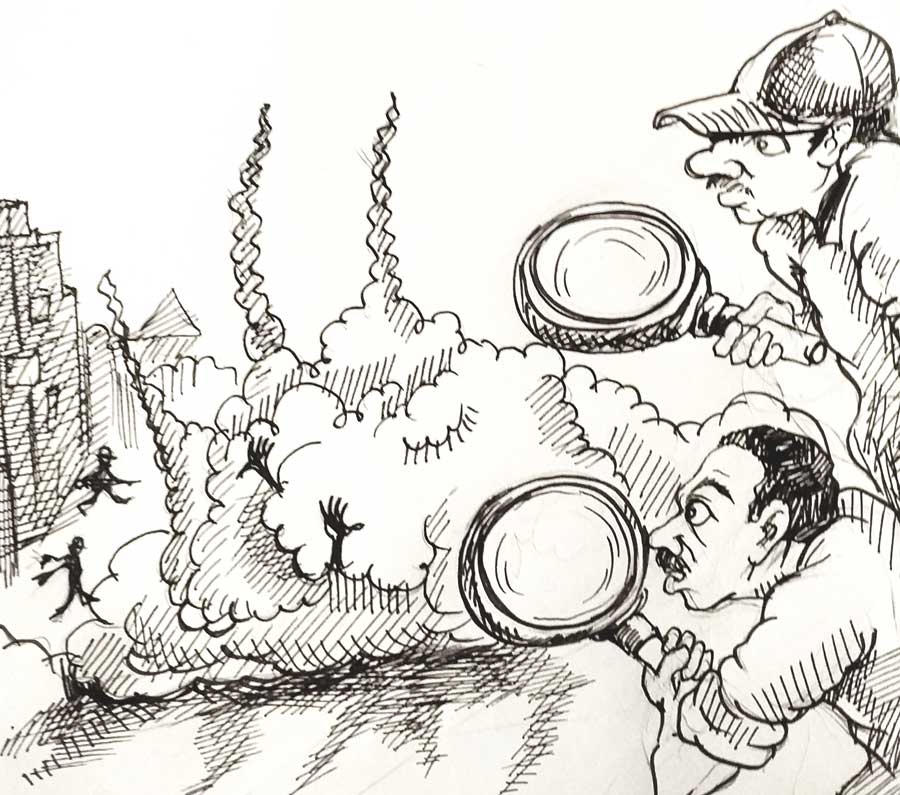
The saying that “those who cannot remember the past are condemned to repeat it,” has become more famous than the philosopher, George Santayana, who coined it, because in recording history more accurately, we have come to notice that he has hit the nail on the head.
Historical recurrences are not wholly identical, but the similarities are astonishing. Even more surprising is that for all humanity’s advancement in making information widely accessible, history keeps repeating itself.
This is all the more true in Ethiopia. It should not be that hard to make a connection between the tectonic political changes taking place today and in the early 1990s and mid-1970s. But while few are able to take stock of the similarities and call for sobriety and a reorientation of focus and priorities, the overwhelming majority continues to indulge in the nationalistic fervours that trickle from the top.
It is of course hard to scold the public for such behaviour. It is not that they are bad students of history; it is only that history has been dictated by politicians. Everyone has a group, an agenda and a motive. The past is marked either as a time of complete darkness or as an utter utopia. Hindsight only goes as far as singling out the worst or the best in the past for condemnation or praise without a need for appraisals.
Of course, politicians will do this. It may be unethical, but there is no law against misstating, misinterpreting or falsifying the past. It is all part of the grand game of constituent politics and one of the unintended consequences of freedom of speech.
Instead, the responsibility of understanding history lays in the hands of the media, the first recorders of history,and the scholars of history. The latter is a group that is rare in Ethiopia. It is undeniable that there are many with that label, but there are few, especially of Ethiopian nationality or origins, who are objective, analytic and reflective.
The large amounts of literature on Ethiopian history can scant be swallowed with a grain of salt. It may offer a measure of the psychology of the time, but it is often regrettably narrowly defined. Most are written not to inform but with the specific objective of persuading. But facts are facts, historians’ primary job is to shed light on the past and persuasion should not reach beyond having to prove that a historical event did take place.
The last element is of special importance, for the behaviour patterns of societies and citizens are much more complicated than events. Today, in the developed world, there are surveys taken to measure matters as diverse as people’s happiness or political party and policy preferences. Even then, with all of the bulk data available, it is not uncommon to find errors.
In Ethiopia, comprehensive surveys are rare. Population numbers are debated, let alone measures of the policy or the ideological preferences of the public at large. Many try to measure the majority’s perspective of events based on social media posts and likes, and this may offer a glimpse into the wishes and behaviour of citizens. But even this is bound to come with a large margin of error given that not everyone is human on social media or that some people run multiple accounts. Additionally, urbanites are over represented compared to the much larger rural population of Ethiopia.
The social history of Ethiopia is faintly understood, much as its political history is. While theories and commentaries are always welcome, there representation as fact has done a great disservice to the current generation’s understanding of the past.
Reconstructing the past will be a mighty job, and while this is indispensable, recording the present should be done with care too. Economic history is relatively straightforward as transactions in money or the value of goods can be measured. On the contrary, political decisions and behaviour patterns of societies, which play a great part in shaping history, need an immense amount of information to responsibly account for.
PUBLISHED ON
Nov 27,2018 [ VOL
19 , NO
970]
Editorial | Nov 29,2020

Life Matters | Feb 01,2020
Commentaries | Aug 10,2019

Radar | Apr 03,2021

Verbatim | Sep 10,2023

Fortune News | Apr 30,2021

Fortune News | Jul 27,2019

Fortune News | Mar 02,2019

Verbatim | Apr 22,2022

Viewpoints | Sep 10,2022

Photo Gallery | 193507 Views | May 06,2019

Photo Gallery | 183402 Views | Apr 26,2019

Photo Gallery | 180214 Views | Oct 06,2021

My Opinion | 145641 Views | Aug 14,2021










Dec 22 , 2024 . By TIZITA SHEWAFERAW
Charged with transforming colossal state-owned enterprises into modern and competitiv...

Aug 18 , 2024 . By AKSAH ITALO
Although predictable Yonas Zerihun's job in the ride-hailing service is not immune to...

Jul 28 , 2024 . By TIZITA SHEWAFERAW
Unhabitual, perhaps too many, Samuel Gebreyohannes, 38, used to occasionally enjoy a couple of beers at breakfast. However, he recently swit...

Jul 13 , 2024 . By AKSAH ITALO
Investors who rely on tractors, trucks, and field vehicles for commuting, transporting commodities, and f...

Aug 14 , 2026
Aschalew Fetene, known as “Ardi” and admired for his poetic depth, has built a ti...

Aug 8 , 2026
The World Bank asks readers to picture a mother in rural Ethiopia who has never held...

Jul 31 , 2026
Weldu Yiheysh has not read the Pacific temperature charts. He does not need to. In Shibta District of Enderta Wereda, in...

Jul 25 , 2026
Ideally, citizens who have paid income tax all year should not have to reach for thei...
Aug 15 , 2026 . By NAHOM AYELE
Federal prosecutors have charged seven defendants over a set of foreign-trade deals t...
Aug 15 , 2026 . By BEZAWIT HULUAGER
Ethio-post is preparing to turn its thousands of branches into banking agents, allowi...
Aug 18 , 2026 . By BEZAWIT HULUAGER
Kassahun Gofe (PhD), minister of Trade & Regional Integration (MoTRI), is prepari...

Aug 16 , 2026 . By NAHOM AYELE
Justices at the Federal Supreme Court widened the shield they are holding over lawyer...







 Loading your updates...