

Radar | Oct 27,2024



A year after a violent storm tore through one of Ethiopia's major flower-growing clusters, Vegpro Flower Farm Plc has clawed its way back from the wreckage, only to face a fresh pressure point. Soaring freight costs are now squeezing exporters who were already working on narrow margins.
The Farm employs nearly 1,000 workers and ships two million kilogrammes of flowers a year to Europe. It was among the businesses worst hit when a powerful storm swept through Bishoftu (Debre Zeit), 45Km east of Addis Abeba, last year. The storm passed, but destroyed greenhouses, damaged crops, and halted operations.
The four-hour storm last August brought heavy rain, strong winds and hail. It struck 10 farms, eight of them flower producers such as Vegpro Flower Farm Plc. Of the 252.6hct of farmland in the cluster, nearly 100hct, was left unusable for production.
For Vegpro, the timing could hardly have been worse. Months of costly repair followed. It has moved past the immediate damage, only to meet a second blow, rising freight costs from the disruption of global shipping routes.
The ongoing instability in the Middle East, around the Strait of Hormuz and Red Sea, has piled pressure on exporters that lean heavily on imported inputs such as fertilisers, chemicals and packaging.
According to Mahendra Patel, an Indian manager at Vegpro, the company had been affected by the rise in freight costs after the Middle East conflict.
"We’re being tested badly by the increase in freight prices," Patel told Fortune.
Patel saw how, since February this year, after the conflict escalated, the cost of importing goods in a 20-foot container has increased by 3,000 dollars, while a 40-foot container has jumped by 2,000 dollars. For the 20ft container from China to Ethiopia, the previous rate was around 3,500 dollars. It has increased by about 3,000 dollars and is now around 6,500 dollars.
For the 40ft container from India to Ethiopia, the previous rate was around 1,200 dollars. It has now increased to about 3,200 dollars, an increase of almost 2,000 dollars. Disruption to shipping and higher fuel prices have pushed up inland transport costs as well.
"From Djibouti to our farm, the transportation fee has also increased,” he said. “Because of that, we’re affected a lot.”
The difficulty is not only the rising cost of imports, but the narrow room to pass it on. Flower exporters sell into a fiercely competitive market, mostly in Europe, where buyers can move to other countries the moment prices from Ethiopia climb. According to Patel, Vegpro had tried to negotiate higher export prices and met resistance.
"We try to increase our price when we export, but our buyers are not ready for a price increase,” he said. “We compete with international sellers, and they aren’t affected like us because of import costs. If we increase our prices, no one will be interested in accepting that increase. Even if we wish to increase prices, we can’t.”
Exporters had been given no clear breakdown of the added costs, yet felt their weight all the same. Because flowers are transported by air, Ethiopian Airlines had also raised its export charges.
“There is a high increase that can affect us,” said Patel. “Ethiopian Airlines has increased the export flower price by 20pc compared with before the war. That is also a challenge for us.”
Now the conflict in the Middle East appears to have subsided, he hopes freight costs will ease.
"We hope the freight price will reduce," Patel said.
However, the logistics squeeze reaches past the flower farms. Across the export sector, firms that depend on international shipping are wrestling with higher logistics bills and fading competitiveness.
For Edao Abdi, founder of Edao International Trading Plc, which exports pulses, oilseeds and coffee, rising freight costs have made exporting steadily harder, even as the end of the conflict brought hopes of relief. Before the conflict, sending a container to India cost his company around 750 dollars. It now costs 2,500 dollars.
"The increase has made exports non-competitive and unprofitable," Edao said.
His company buys white pea beans at around 800 dollars a tonne. With the added load, selling below 1,000 dollars a tonne no longer makes financial sense.
The higher costs bear down hardest on commodity exporters, whose margins are capped by world prices. They cannot simply raise prices to recover the difference, competing against suppliers with fewer logistical burdens.
"We either won't sell or won't ship," Edao told Fortune.
Yet holding back exports is rarely a real choice for firms that need foreign currency and steady buyers.
"Sometimes, we're forced to export even at a loss simply because we desperately need the cash flow,” he said. “We’re exporting at a loss.”
Domestic transport has climbed too, due to increased fuel prices and regional instability. Freight rates that were previously 70 Br a quintal for domestic transport have gone up to 300 Br. Moving goods from Adama (Nazareth) to Djibouti, once 250 Br a quintal, has increased to 750 Br. Falling volumes and higher costs have left many exporters like Edao in a hard place.
"This cost spike is destroying our export competitiveness and wiping out margins," he said. “Exporters are struggling because the cost of moving goods has increased while international buyers remain sensitive to price changes.”
Ethiopia's exposure deepened after the United States (US) and Israel opened war against Iran, which began at the end of February. As a landlocked economy, Ethiopia depends on the Red Sea corridor and ports in Djibouti, which handle more than 95pc of its international trade, and imports essentials such as petroleum, fertiliser, machinery, pharmaceuticals and food.
When conflict disrupts shipping or drives oil prices higher, costs on freight, insurance and fuel climb. They lift import prices, feeding inflation, while export costs rise and delivery times stretch, draining foreign-exchange earnings.
The IMF reported that low-income countries were especially exposed to food insecurity from higher food and fertiliser prices and tighter finance, some needing more outside support even as such help shrank.
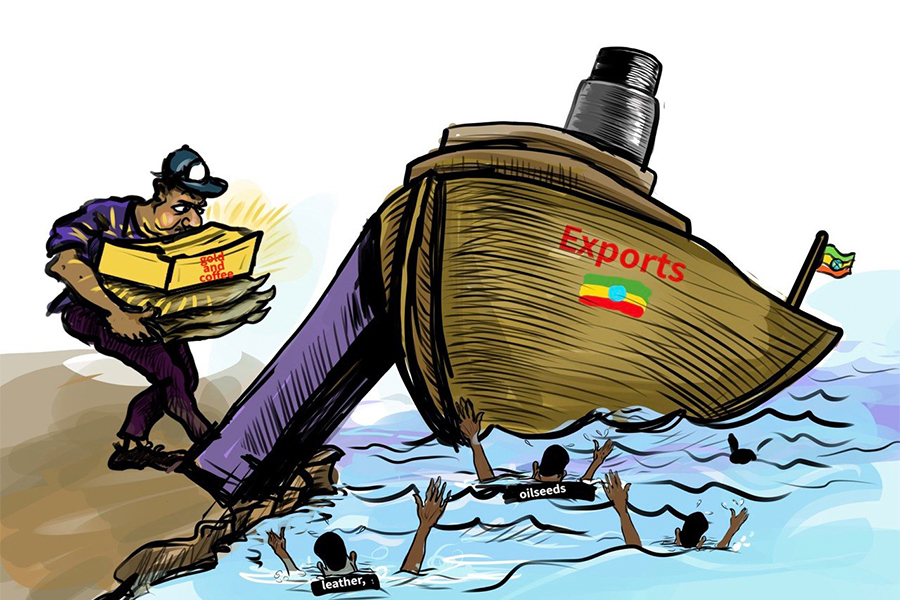
During the previous budget year, Ethiopia imported goods worth around 18 billion dollars, while foreign exchange earnings reached 11 billion dollars, a 33pc growth from last year. Of these earnings, exports of gold and coffee comprised 79pc.
Freight costs swing with destination, commodity, season and shipping line, carriers working through negotiated contracts rather than published tariffs.
Industry estimates put a 20-foot container from Djibouti at between 1,200 and 2,300 dollars, and a 40-foot at between 1,800 and 3,600 dollars, before inland transport, customs, handling, documentation and surcharges. The main export commodities travel mostly in 20-foot containers because of weight limits, moving through Djibouti with operators that include Ethiopian Shipping & Logistics (ESL), Maersk, MSC and CMA CGM.
The pressure has reached importers, whose higher costs eventually surface in retail prices.
According to Hayder Kemal, who has worked in import and export and imports pharmaceutical equipment, the rise had heaped fresh pressure on firms tied to international supply chains.
"The cost has increased significantly,” he told Fortune. “It’s making things difficult these days.”
Importers are obliged to use vessels operated by the ESL loading cargoes from ports it calls. A directive issued in the late 1990s by Kassu Illala (PhD), then transport minister, remains in force almost 30 years later, instructing banks not to open letters of credit for importers without having bills of lading from ESL. Should they bring cargoes from ports where ESL service is unavailable, they should produce waivers from the national shipping company.
The Enterprise operates a relatively small owned fleet alongside extensive use of chartered vessels and international slot carriers. Its vessels transported about 1.1 million tonnes during the year.
"When importers want to bring goods into the country through areas where Ethiopian vessels are available, they are forced to ship through ESL, but the price is not easy," said Hayder.
The escalating and cumulative costs on the logistics corridor unfold while the domestic economy still contends with inflation. According to the Central Statistical Service, annual inflation fell to single digits for the first time in years in March, at 9.4pc. It then reverted to 13.9pc in June 2026, with food inflation at 15.1pc and non-food inflation around 12pc.
According to the IMF, people in low-income developing countries are most exposed when prices rise, because food takes up about 43pc of consumption on average, against 25pc in emerging markets and 12pc in advanced economies.
The face of IMF abstractions is citizens like Eseatesillasie Ashenafi, a public service employee and mother of one. She works at Tikur Anbessa Specialised Hospital, on the communications team, and has been working for almost a decade.
“Having a daily meal has become a luxury,” she told Fortune.
Eseatesellasie earns a net income of nearly 8,000 Br a month. Her husband, a broker, has struggled to find steady work, leaving her salary as the household's mainstay. Though she works in central Addis Abeba, she rents a small house in Bole Arabsa on the city's edge for 6,000 Br a month. After rent, only about 2,000 Br is left, which she finds too little to cover food for her family, including her 11-year-old child.
"I gave my child to my family to live with them because I can’t feed her properly," she said. "I don't know if there will be a day called tomorrow. I live today.”
She would have to brace for challenging times ahead as industry sources warn rates could climb further as the full effect of the war in the Middle East and the domestic instability became clear. Executives of the Ethiopian Shipping & Logistics, though, say they had limited the increases tied to regional instability, including war-risk insurance, to avoid heaping more pressure on businesses and consumers.
According to Tefera Kassa, ESL’s shipping-sector executive, the state-owned company had met higher costs from fuel and insurance.
"Bunker fuel costs quadrupled, and Djibouti's designation as a war-risk area, due to the presence of a US military base, triggered mandatory war-risk insurance,” Tefera said. “These factors demanded minor rate adjustments.”
Tefera believes that, seen against competing shipping operators, ESL’s increases had stayed modest, though he declined to disclose figures. According to Tefera, ESL’s remit reached beyond profit, being mandated to support trade and shield the economy through disruption. The Enterprise has put “market stability ahead of profit, absorbing part of the cost, trimming margins and at times charging only administrative fees.” However, he warned conditions could worsen.
For a country whose imports and exports must pass through foreign ports, overwhelmingly Djibouti, ESL occupies an unusually powerful position. Its business begins at sea but extends deep inland, encompassing vessels, leased shipping capacity, dry ports, trucks, rail connections, container handling and multimodal freight services.
The company transported about 7.04 million tonnes of cargo in the year ended July 7, generating 157.2 billion Br in revenue as fertiliser deliveries, container movements, inland haulage and maritime services pushed activity to record levels. Its gross profit reached 28.2 billion Br, with revenue coming in about 8.5pc above its target, while cargo volumes were 108pc of plan.
The biggest driver during the latest financial year was bulk cargo, particularly fertiliser. It transported two million tonnes of fertiliser, moving a commodity whose timely delivery has become politically and economically critical in an economy still heavily dependent on agriculture. However, the company also handled about five million tonnes of non-containerised cargo and roughly two million tonnes of containerised freight.
ESL supplied close to 34,000 containers to exporters during the year, while its management has credited better use of technology, ship and vehicle monitoring, improved loading capacity and cost controls for lifting performance. Those gains came despite what the company described as vessel downtime, fuel shortages and regional security disruptions.
Logistics specialists urge careful watch against a passing shock becoming a lasting load. According to Matiwos Ensermu (PhD), a logistics expert and head of the President's Office at Addis Abeba University, cost increases were to be expected after regional instability, but should be watched closely.
“Regulators should hold firm oversight,” he said, “since some firms might exploit the uncertainty to load on excessive charges. State enterprises such as ESL should do more to support exporters and keep logistics affordable.”
For economists such as Atlaw Alemu (PhD), a lecturer at the Addis Abeba University, “economic hardship faced by businesses and citizens in many countries would be enough to trigger government action.”
He does not see the authorities respond with the urgency the situation demands.
“The government is behaving as though it governed a wealthy nation rather than one where many struggle to afford basics,” he told Fortune.
Atlaw faulted them for bringing no emergency measures, when adjustments to taxes and subsidies could have offered relief for citizens like Eseatesillasie.
The struggling Farm in Bishoftu, Vegpro, has rebuilt its greenhouses, and its two million kilogrammes of flowers are again bound for Europe. What the Farm cannot rebuild is the cost of getting them there.
PUBLISHED ON
Aug 09,2026 [ VOL
27 , NO
1371]
Radar | Oct 27,2024

News Analysis | Nov 15,2025

Radar | Aug 22,2026

Radar | Jan 17,2026

Fortune News | Aug 23,2025

Commentaries | Jul 17,2022

Radar | Feb 21,2026


Exclusive Interviews | Sep 06,2025

View From Arada | Feb 21,2026

Dec 22 , 2024 . By TIZITA SHEWAFERAW
Charged with transforming colossal state-owned enterprises into modern and competitiv...

Aug 18 , 2024 . By AKSAH ITALO
Although predictable Yonas Zerihun's job in the ride-hailing service is not immune to...

Jul 28 , 2024 . By TIZITA SHEWAFERAW
Unhabitual, perhaps too many, Samuel Gebreyohannes, 38, used to occasionally enjoy a couple of beers at breakfast. However, he recently swit...

Jul 13 , 2024 . By AKSAH ITALO
Investors who rely on tractors, trucks, and field vehicles for commuting, transporting commodities, and f...
Aug 22 , 2026
A record is a strange thing to worry about. Federal trade officials have booked the b...

Aug 14 , 2026
Aschalew Fetene, known as “Ardi” and admired for his poetic depth, has built a ti...

Aug 8 , 2026
The World Bank asks readers to picture a mother in rural Ethiopia who has never held...

Jul 31 , 2026
Weldu Yiheysh has not read the Pacific temperature charts. He does not need to. In Shibta District of Enderta Wereda, in...










 Loading your updates...