
Fortune News | Dec 26,2020



Mar 9 , 2024
By Hintsa Andebrhan
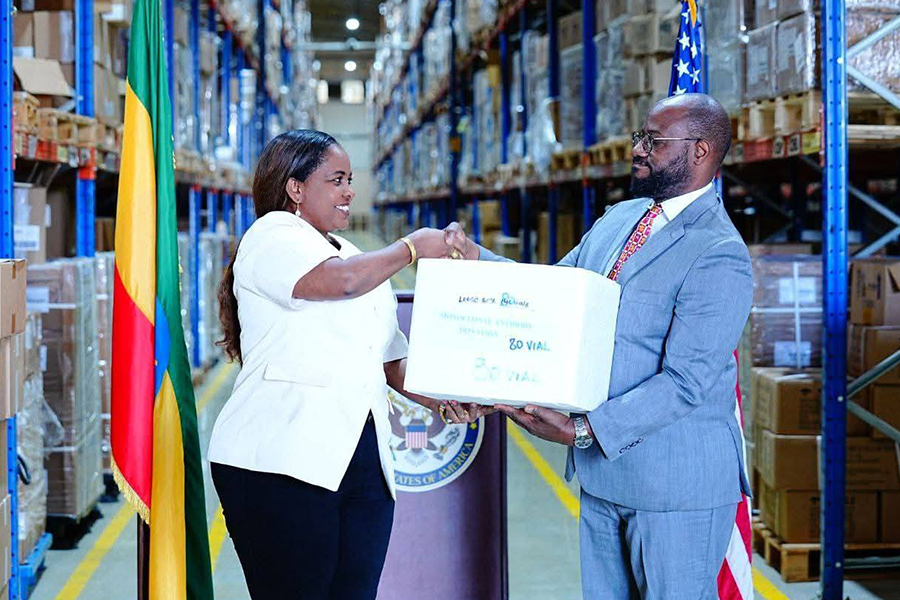
The U.S. Embassy recently disclosed an "investment" nearing 125 million dollars through the President's Emergency Plan for AIDS Relief (PEPFAR), which has been made to strengthen Ethiopia's healthcare infrastructure markedly.
Comprising the construction of six national and regional reference laboratories, renovation of numerous hospital laboratories, and establishment of outpatient care centres, health centres, and pharmaceutical warehouses, the initiative represents a substantial commitment to enhancing the country's health system. The Embassy wishes to see the project's success in expanding service coverage and maintaining a commendable 95pc treatment retention rate among patients. It also hopes the investment will reduce laboratory turnaround times from two months to one week.
Washington has funnelled 13 billion dollars into Ethiopia over the past two decades through the United States Agency for International Development (USAID). The talking point among American officials could be that the "investments" were made mainly on "broadening access to quality healthcare, elevating educational standards, and promoting an economic environment driven by the private sector's dynamism and innovation."
However, the term "investment" employed in this context does not fit with the conventional understanding tied to foreign direct investment (FDI) but rather encapsulates a strategic deployment of American resources to exert soft power and secure political leverage in Ethiopia. It is a subtle relationship between aid and investment, where the former, despite its benevolent facade, often serves broader geopolitical objectives.
The diplomatic ties between Ethiopia and the United States, spanning over a century, present a long history of cooperation and tension. Yet, a closer look at foreign direct investments from the United States to Ethiopia reveals a cautious, if not reticent, reality towards engaging in more substantial business ventures akin to those observed in Egypt and Kenya. The disparity should raise eyebrows about the standards and considerations guiding American investment strategies across Africa.
As the largest beneficiary of U.S. direct investment in Africa, Egypt hosts significant American business interests, including Apache Corp Texas and notable corporations such as General Motors, Johnson & Johnson, Marriott, and Coca-Cola. These investments point to Egypt's strategic importance to American interests and position it as a vital regional economic hub. Similarly, Kenya's FDI landscape is notably enriched by U.S. companies, with a total FDI stock of 10.4 billion dollars, of which American firms contribute 10.3pc.
Contrastingly, U.S. direct investment in Ethiopia, despite the presence of American giants like Boeing, Corteva, General Electric, and Coca-Cola, remains relatively modest at 29 million dollars. Compared to the substantial aid provided, this figure paints a picture of a partnership heavily skewed towards compassion rather than equitable economic engagement. The involvement of companies such as Corteva, funded by USAID, further blurs the line between commercial ventures and aid-driven projects, casting doubt on the nature of the business that brings the companies to Ethiopia.
The dichotomy between aid and investment should invite a deeper reflection on Ethiopia's limitations as a potential destination for foreign investments. Despite the significant aid flows from the U.S., the conspicuous absence of more FDI raises questions about trust, risk assessment, and the broader standards American entities employ in selecting their investment battlegrounds. The success of Chinese companies in Ethiopia's investment landscape, often through a model that blends loans with infrastructure projects executed by Chinese firms, suggests an alternative paradigm of engagement that, while not without its critics, has delivered tangible benefits and infrastructural development in the least developed economies such as Ethiopia.
The comparison with China's engagement strategy, often criticized for creating dependencies on debt-driven investments, nonetheless demonstrated a willingness to embed within the Ethiopian economic fabric in a manner the Americans have yet to grasp.
Ethiopians' perception of the United States' role in their country is convoluted, shaped by historical legacies, contemporary political realities, and the impacts of external powers' involvement in their daily lives. Their awareness of political dynamics and the implications for sovereignty, economic development, and national identity transcends traditional aid paradigms. The concerns lie in addressing immediate health and humanitarian needs and promoting a genuinely reciprocal partnership, grounded in economic cooperation, and respectful of Ethiopia's aspirations for development and autonomous policy space.
PUBLISHED ON
Mar 09,2024 [ VOL
24 , NO
1245]

Fortune News | Dec 26,2020
Viewpoints | Aug 23,2025
Radar | Dec 24,2022
Sunday with Eden | Oct 31,2020
Featured | Jan 03,2021
Letter To Editor | Feb 29,2020
My Opinion | Apr 29,2023
Viewpoints | May 02,2024
Viewpoints | Dec 25,2018
Radar | Dec 13,2025

Photo Gallery | 193581 Views | May 06,2019

Photo Gallery | 183475 Views | Apr 26,2019

Photo Gallery | 180301 Views | Oct 06,2021

My Opinion | 145725 Views | Aug 14,2021


Dec 22 , 2024 . By TIZITA SHEWAFERAW
Charged with transforming colossal state-owned enterprises into modern and competitiv...

Aug 18 , 2024 . By AKSAH ITALO
Although predictable Yonas Zerihun's job in the ride-hailing service is not immune to...

Jul 28 , 2024 . By TIZITA SHEWAFERAW
Unhabitual, perhaps too many, Samuel Gebreyohannes, 38, used to occasionally enjoy a couple of beers at breakfast. However, he recently swit...

Jul 13 , 2024 . By AKSAH ITALO
Investors who rely on tractors, trucks, and field vehicles for commuting, transporting commodities, and f...
Aug 22 , 2026
A record is a strange thing to worry about. Federal trade officials have booked the b...
Aug 14 , 2026
Aschalew Fetene, known as “Ardi” and admired for his poetic depth, has built a ti...

Aug 8 , 2026
The World Bank asks readers to picture a mother in rural Ethiopia who has never held...
Jul 31 , 2026
Weldu Yiheysh has not read the Pacific temperature charts. He does not need to. In Shibta District of Enderta Wereda, in...
Aug 22 , 2026 . By BEZAWIT HULUAGER
The forthcoming strategy for interest-free finance will place Sharia-compliant financ...
Aug 22 , 2026 . By NAHOM AYELE
Wegagen Capital Investment Bank (WCIB) has completed its first full year in profit an...
Aug 22 , 2026 . By NAHOM AYELE
Judges at the Federal High Court, sitting on a limited basis to hear only urgent matt...
Aug 22 , 2026 . By BEZAWIT HULUAGER
Federal authorities are about to find out whether they can make a single payment wind...





 Loading your updates...